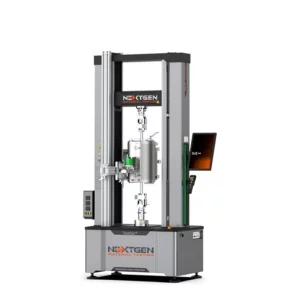
GB/T 16825.1 is a Chinese national standard used to calibrate and verify the force-measuring system of static uniaxial tension and/or compression testing machines. It is commonly referenced to demonstrate that a universal testing machine’s indicated force meets a defined accuracy class over a specified force range.
This standard is most often used by QA/QC and lab teams during initial machine acceptance, periodic re-verification, post-service checks, and when preparing documentation for audited testing programs. If you need help matching your machine capacity, force range, and target accuracy class to the way your product standard cites GB/T 16825.1, contact our team.
GB/T 16825.1 — Metallic materials—Calibration and verification of static uniaxial testing machines—Part 1: Tension/compression testing machines—Calibration and verification of the force-measuring system
GB/T 16825.1 focuses on the metrological performance of the machine’s force indication (the load measurement chain), using calibrated force-proving instrumentation to evaluate indication error, repeatability, and related performance checks that support classification of the machine over a defined measuring range.
Because the standard is aimed at static verification, results and acceptance decisions depend on the exact edition cited and the specific force range being confirmed on the machine.
| Item | Details |
|---|---|
| Standard number | GB/T 16825.1 |
| Latest published edition (standard record) | GB/T 16825.1-2022 (in force; implemented 2023-05-01) |
| Document type | Calibration and verification / classification framework for the force-measuring system (static) |
| Applies to | Tension and/or compression testing machines (static force verification) |
Quick Definition
In one line: GB/T 16825.1 defines how to check whether a static uniaxial test machine’s indicated force agrees with a traceable force-proving device closely enough to meet a specified accuracy class over a stated force range.
What it is not: It is not a material tensile test method; it is a machine verification standard that supports confidence in force results used by tensile, compression, and other force-controlled mechanical tests.
What This Standard Covers
GB/T 16825.1 addresses a combination of machine checks and force-system calibration/verification activities, typically including a general inspection of the machine and accessories used to apply force, calibration of the force-measuring system with a suitable force-proving instrument, and evaluation steps used to determine compliance with a defined class over a stated force range.
A key practical limitation is that the standard is oriented to static verification; calibration outcomes are not necessarily transferable to high-speed or dynamic testing without additional consideration.
Why This Standard Matters in Testing
Many product and material test methods require the force indication of the test machine to meet a stated accuracy level. When GB/T 16825.1 is cited, it typically becomes the controlling reference for whether reported forces (and derived values such as tensile strength, yield strength, or compressive strength) are defensible from a measurement-quality standpoint.
For audits and inter-lab comparability, the value of GB/T 16825.1 is that it standardizes how force accuracy is evaluated (and documented) so that a “qualified machine” claim can be tied to a defined class and qualified force range.
Common Materials, Product Types, or Applications Covered
Because this is a machine verification standard (not a specimen test method), it is used broadly anywhere a tensile/compression testing machine is used for static mechanical testing.
Common users: Metals and alloys labs, fastener and wire/rod manufacturers, weld and heat-treatment QA, automotive and aerospace supply chains, universities and R&D labs, and third-party test labs performing force-based mechanical tests.
Common driver: A product/material test standard requires the testing machine’s force-measuring system to meet a particular accuracy level, and GB/T 16825.1 is the referenced route to demonstrate that capability.
Common Test or Verification Workflow
GB/T 16825.1 is typically applied as a verification job on the testing machine rather than as part of a single specimen test.
Common workflow:
- Define the machine configuration being confirmed (load cell or force transducer, indicator/controller, and the accessories that can affect force application).
- Select an appropriately calibrated force-proving instrument and set up alignment/loading so the proving device is loaded correctly.
- Apply discrete force points across the target force range and record indicated vs. applied force values.
- Evaluate performance measures used for classification (commonly including indication error and repeatability) and document results in a verification report.
- Set verification intervals consistent with your quality system and any contractual or regulatory expectations.
Practical caution: The checked “class” is only meaningful for the specific force range checked and the specific machine configuration used (including controller settings and any adapters that can influence force introduction).
Equipment Commonly Used for This Standard
GB/T 16825.1 generally points to an equipment path centered on force traceability and controlled static loading.
Common equipment: Static universal testing machine (electromechanical or servo-hydraulic), suitable compression platens and/or tensile gripping, a calibrated force-proving instrument (e.g., a force transducer/load cell-based proving device) with appropriate adapters, and data capture/reporting tools.
Common setup needs: Proper alignment and stable fixturing to avoid parasitic loads, environmental awareness (temperature effects), and a force range plan that matches how the machine is actually used in production testing.
Quoting note: If you are selecting a new test frame or upgrading a force-measuring chain to meet a stated class across your working range, the correct capacity, load cell selection, controller resolution, and calibration access all matter. For purchase-oriented guidance, you can request a detailed quote for a configuration aligned with your force range and documentation expectations.
How to Read This Designation or Revision
GB/T: Indicates a recommended (non-mandatory) Chinese national standard.
16825.1: Identifies Part 1 within the GB/T 16825 series covering calibration and verification of static uniaxial testing machines.
Year suffix (when shown): Editions are often cited with a publication year (for example, GB/T 16825.1-2022). When a customer or product standard references GB/T 16825.1, always match the edition cited, because acceptance limits, reporting expectations, and classification details can change between revisions.
Related Standards, Methods, or Frameworks
GB/T 16825.1 is commonly used alongside standards for calibrating the force-proving devices used during verification and alongside material test methods that require qualified force accuracy.
Often paired references: ISO 376 (and its Chinese adoption GB/T 13634) for calibration of force-proving instruments used to verify uniaxial testing machines; ISO 7500-1 as a closely related international framework for force verification of uniaxial testing machines; and other parts of the GB/T 16825 series (for example, GB/T 16825.2 for specific machine verification needs beyond Part 1).
Get Help Applying GB/T 16825.1
If you need to meet a specified accuracy class over a defined force range (or need verification documentation that will stand up to customer or audit review), we can help you choose a practical machine and calibration approach. Share your target force range, capacity, and the standards you test to, and talk with our team about a setup that fits your lab workflow.