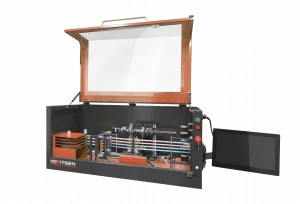
ASTM E466 is an ASTM practice for conducting force-controlled, constant-amplitude axial fatigue tests on metallic materials. It is commonly used to generate stress-life (S–N) fatigue strength data in the primarily elastic strain regime using laboratory test specimens.
If you need help aligning a customer or internal requirement to the right fatigue approach (force-controlled vs. strain-controlled, notched vs. unnotched, runout criteria, and reporting expectations), talk with our team about your test plan before you finalize equipment and fixturing.
ASTM E466 – Standard Practice for Conducting Force Controlled Constant Amplitude Axial Fatigue Tests of Metallic Materials
ASTM E466 is used when a metallic specimen is cycled in direct axial loading under a controlled force (load) waveform at a constant amplitude. The output is typically fatigue life (cycles to failure) or fatigue strength at a stated life, under a defined set of test conditions.
This document is a practice, meaning it focuses on how to run the test in a consistent, comparable way (including test conditions and reporting), rather than serving as a product acceptance specification.
Quick Definition
What it is: A force-controlled axial fatigue testing practice for metallic materials using constant-amplitude cyclic loading.
What it’s for: Building comparable fatigue strength / fatigue life data for metals when strains are predominantly elastic during the test.
Typical outputs: Cycles to failure at specified stress (or force) levels, and S–N style datasets suitable for statistical and engineering analysis.
What This Standard Covers
ASTM E466 describes procedures for axial force-controlled fatigue testing on metallic specimens under constant-amplitude, periodic loading in air at room temperature. It applies to both unnotched and notched axial specimens, within the test regime where the strains remain primarily elastic.
The scope is limited to specimen testing and does not extend to full-scale components, structures, or consumer products.
Why This Standard Matters in Testing
Force-controlled axial fatigue data is widely used to compare material conditions and processing variables that influence fatigue resistance (for example: heat treatment, surface condition, geometry features, and stress level). ASTM E466 helps labs run these tests with consistent controls and documentation so results can be compared across lots, programs, and test facilities.
For many QA/QC, supplier-qualification, and R&D workflows, the biggest practical value of E466 is repeatability: consistent alignment, load control, cycle counting, and clear reporting of the conditions that drive fatigue life scatter.
Common Materials, Product Types, or Applications Covered
ASTM E466 is used for metallic materials where axial fatigue performance is being evaluated in a laboratory specimen form. It is commonly referenced in programs involving structural metals and alloys when cyclic axial loading is a relevant service condition.
Common application contexts: Material comparisons for durability, process-change validation, surface-condition studies, and design-allowable development where a stress-life approach is appropriate.
Common Test or Verification Workflow
A typical ASTM E466 workflow uses an axial fatigue test system to cycle a specimen at a defined constant-amplitude force (often expressed and controlled as an equivalent stress level based on specimen geometry). Multiple specimens are usually tested at different stress (or force) levels to generate a relationship between stress and fatigue life.
Common workflows: Define specimen type (notched/unnotched) and geometry, select target stress levels, set load ratio and waveform, run to failure or a defined runout, and report test conditions and results in a way suitable for comparing datasets.
Equipment Commonly Used for This Standard
ASTM E466 typically points to an axial fatigue test setup capable of applying controlled cyclic force with stable amplitude over potentially large cycle counts. Configuration choices are driven by required force capacity, frequency, alignment needs, and how specimens are gripped.
Common equipment: Servo-hydraulic or electrodynamic axial fatigue load frames, dynamic-capable load cells, axial fatigue grips (threaded ends, collet/wedge styles as appropriate), alignment tooling/fixtures, controller with waveform and cycle counting, and data acquisition for load, cycle count, and test termination conditions.
If you are selecting a load frame capacity, grip style, and controller features for an ASTM E466 program, you can request a detailed quote for a configuration matched to your specimen type and target force range.
How to Read This Designation or Revision
Standard number: E466 identifies the ASTM document.
Revision year suffix: The year suffix (for example, “-21”) indicates the edition year tied to that revision. Fatigue testing programs should cite the exact edition used, since requirements and recommended details (such as specimen geometry guidance and reporting expectations) can change between revisions.
Units note: This standard states values in inch-pound units as the standard, with SI conversions provided for information.
Related Standards, Methods, or Frameworks
ASTM E466 is often used alongside complementary fatigue guidance for analyzing and communicating results and for selecting alternate fatigue control modes when appropriate.
- ASTM E739: Commonly used for statistical analysis of stress-life (S–N) and strain-life (ε–N) fatigue data.
- ASTM E468/E468M: Commonly used for presenting constant-amplitude fatigue test results for metallic materials.
- ASTM E606/E606M: Often referenced when strain-controlled fatigue testing is required instead of force-controlled testing.
Talk with a Fatigue Testing Specialist
For ASTM E466 projects, equipment fit depends heavily on specimen geometry, force range, alignment expectations, and how you plan to define runout and data reporting. If you want help scoping the right axial fatigue system and grip package, contact our team with your material, specimen drawings, and target load ratios.