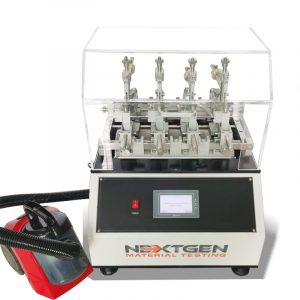
ASTM D4157 is a standard test method used to evaluate the abrasion resistance of woven textile fabrics using an oscillatory cylinder abrasion tester (often called a Wyzenbeek abrasion test).
It is commonly specified for upholstery and other woven fabrics where buyers need a repeatable, comparative wear indicator for material selection and quality control. If you need help matching your fabric type, abradant, and endpoint criteria to the exact edition being cited, talk with our team.
ASTM D4157-13(2022) — Standard Test Method for Abrasion Resistance of Textile Fabrics (Oscillatory Cylinder Method)
ASTM D4157 defines a laboratory abrasion procedure for woven textile fabrics using an oscillatory cylinder tester. Results are generally used to compare fabrics and to support procurement, product development, and incoming/ongoing QC decisions.
Abrasion performance depends strongly on the fabric construction and the test conditions (including abradant selection and evaluation criteria), so purchasing specs should always cite the exact standard designation and any project-specific acceptance requirements.
Quick definition
Document type: Test method.
What it measures: Comparative abrasion resistance of woven textile fabrics under controlled rubbing action on an oscillatory cylinder tester.
Typical result format: Cycles (double rubs) to a defined endpoint (for example, yarn breaks and/or noticeable wear criteria specified by the program or purchaser).
What this standard covers
ASTM D4157 covers determining abrasion resistance of woven textile fabrics using an oscillatory cylinder tester. The method is not necessarily suitable for every fabric construction, and the standard emphasizes that abrasion resistance is influenced by many material and test-condition variables.
ASTM D4157 is often used as part of a broader durability evaluation rather than as a standalone predictor of in-service life.
Why this standard matters in testing
For upholstery, contract textiles, and other wear-prone woven fabric applications, abrasion screening helps reduce risk when comparing candidates, qualifying suppliers, or tracking consistency across production lots.
This method is especially useful when a purchasing specification requires a repeatable abrasion indicator under a defined abradant and endpoint rule. Because different abrasion methods are not directly interchangeable, it is important to call out ASTM D4157 specifically when Wyzenbeek-style results are required.
Common materials, product types, or applications covered
ASTM D4157 is most often associated with woven fabrics used in seating and upholstery, but it can also be applied to other woven textile constructions where oscillatory-cylinder abrasion is an appropriate comparative test.
- Upholstery and furniture fabrics (including contract/commercial interiors)
- Woven apparel and accessory fabrics (where a Wyzenbeek-style abrasion metric is specified)
- Industrial woven textiles where comparative surface wear is a concern
Common test or verification workflow
A typical ASTM D4157 workflow is built around controlled mounting, controlled rubbing against a specified abradant, and an agreed endpoint definition.
Common workflow steps: Select specimens (often in both warp and weft directions when required by the spec), mount the fabric taut in the specimen frame, run the oscillatory rubbing cycles against the specified abradant, and record the cycles (double rubs) at the defined endpoint (for example, yarn breaks and/or noticeable wear criteria specified by the program).
What buyers often specify in addition to the standard: The abradant type (commonly cotton duck, with alternate abradants sometimes used for particular fiber types), the endpoint rule, any maximum cycle cap, and how results are summarized (minimum, average, or directional requirements).
Equipment commonly used for this standard
ASTM D4157 is equipment-driven. The core requirement is an oscillatory cylinder abrasion tester configured to run a controlled rubbing motion against a defined abradant while maintaining consistent specimen tension and loading.
Common equipment: Oscillatory cylinder (Wyzenbeek) abrasion tester, specimen mounting frames, specified abradant media, cycle counter/control system, and basic tools for specimen cutting and marking.
Quoting and setup cautions: The exact edition cited, the abradant choice, the loading/tension settings, and the endpoint criteria can materially affect the configuration and how results are reported. If you are matching an internal method to a customer spec, you can request a detailed quote for a Wyzenbeek abrasion setup aligned to your target workflow.
How to read this designation or revision
ASTM standards are commonly cited with a letter-and-number designation plus a year. For ASTM D4157, the number after the dash typically indicates the year of issue for that edition, and a year shown in parentheses indicates the year of last reapproval when applicable.
In ASTM listings, you may also see “R” used within an internal product code (for example, a reapproved version). For purchasing, QA, and contract documents, it is best practice to cite the complete designation exactly as required by the customer or governing specification so the correct edition and requirements are unambiguous.
Related standards, methods, or frameworks
ASTM D4157 is one of several abrasion-related textile methods. It is often referenced alongside other textile abrasion guides and methods depending on fabric type and end-use expectations.
- ASTM D3884 (guide) and ASTM D4158 (guide) for abrasion resistance of textile fabrics (other abrasion approaches and guidance)
- ASTM D3885 and ASTM D3886 (test methods) for other abrasion tester configurations used for textiles
- AATCC 93 (test method) referenced as an additional abrasion procedure in textile testing programs
- ASTM D4966 (test method) for Martindale abrasion testing when that method is specified instead of Wyzenbeek
Get help selecting a Wyzenbeek abrasion test setup
If you are building or updating an ASTM D4157 testing capability and need help matching tester configuration, abradant handling, and reporting expectations to your customer specification, you can request pricing and configuration options for a system sized to your lab throughput.