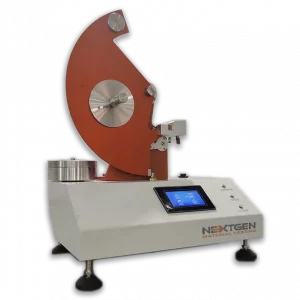
NF T54-141 is a French standard focused on determining the tear resistance of plastic film and sheeting using the Elmendorf pendulum method.
This type of tear test is commonly used in packaging and converted-film quality control to compare materials, check production consistency, and support incoming inspection or supplier qualification. If you need help aligning your internal method with the right cited edition or successor document, talk with our team.
NF T54-141 — Plastics: film and sheeting — determination of tear resistance — Elmendorf method
NF T54-141 addresses tear resistance measurement for plastic films and sheets using an Elmendorf-style pendulum tear tester. The result is typically used as a comparative property for materials, lots, orientations (machine direction vs transverse direction), and process conditions.
This page is a practical overview for lab and production users; the official standard remains the controlling reference for specimen geometry, conditioning, calculation, and reporting requirements.
Quick Definition
NF T54-141 is an Elmendorf pendulum tear method for plastic film and sheeting, used to quantify resistance to tear propagation under a defined initiating cut and test setup.
What This Standard Covers
NF T54-141 covers tear resistance testing for plastic film and sheeting using a pendulum tear instrument (Elmendorf method).
Typical output: A tear resistance value used for comparison and compliance reporting (units and calculation details depend on the standard’s requirements and the cited edition).
What it does not do: It is not a full product performance specification by itself; it provides a standardized way to run and report a tear test so results can be compared consistently.
Why This Standard Matters in Testing
Elmendorf tear results are widely used as a fast, repeatable indicator of how a film or sheet resists tear propagation once a tear has started. In practice, teams use this to support material comparisons, process troubleshooting, and supplier-to-supplier benchmarking.
Because tearing behavior is sensitive to directionality, thickness, formulation, and processing history, the best value comes from consistent specimen preparation and consistent instrument configuration.
Common Materials, Product Types, or Applications Covered
NF T54-141 is typically associated with plastic films and sheets used in packaging, converting, and industrial sheet applications where tear resistance is a relevant QC metric.
Common examples: Flexible packaging films, protective films, liner materials, and general polymer film/sheet products where comparative tear performance is specified or monitored.
Common Test or Verification Workflow
In many labs, tear testing to an Elmendorf method follows a straightforward routine aligned to the standard’s details.
- Condition specimens as required (temperature/humidity and time, when specified).
- Prepare specimens using the required shape and a defined pre-cut (initiating notch).
- Select the appropriate pendulum capacity/range so the reading falls in the instrument’s recommended measurement window.
- Run replicates in the required orientation(s) and report results in the standard’s format.
Equipment Commonly Used for This Standard
The equipment selection is primarily driven by the Elmendorf pendulum method itself and by the film/sheet strength range you need to cover.
Common equipment: Elmendorf pendulum tear tester (with selectable pendulums or range options), specimen cutting die or template matched to the method, and basic dimensional measurement tools (as required for reporting).
Practical selection notes: Buyers typically focus on pendulum capacity coverage, repeatability, ease of safe operation, and whether the instrument supports the reporting workflow used in their QA/QC system (manual reading vs digital output, data capture, etc.). If you are comparing capacity ranges or configurations for your material set, you can request pricing for an Elmendorf tear tester setup matched to your films and sheets.
How to Read This Designation or Revision
Designation: “NF T54-141” is a French NF standard designation historically associated with plastics testing.
Status and replacement: NF T54-141 (October 1984) is listed as cancelled and replaced by NF EN ISO 6383-2 (published December 2004), which covers plastics film and sheeting tear resistance using the Elmendorf method.
Revision sensitivity: Equipment may be similar across editions, but specimen dimensions, conditioning, calculation, and reporting rules can vary by edition and by the replacement standard cited on a purchase order or internal spec.
Related Standards, Methods, or Frameworks
For organizations modernizing legacy references, NF EN ISO 6383-2 is the commonly cited successor document for the Elmendorf tear method on plastics films and sheets.
Depending on your product and customer requirements, tear may also be specified using alternative tear methods (for example, methods based on different specimen types). Use the exact standard referenced in your customer specification to avoid mismatched results.
Get help selecting an Elmendorf tear testing setup
If you are updating a legacy NF T54-141 requirement to a current equivalent, or you need help matching an Elmendorf tear tester range to your film thickness and expected tear levels, contact our team to talk through your application and documentation needs.