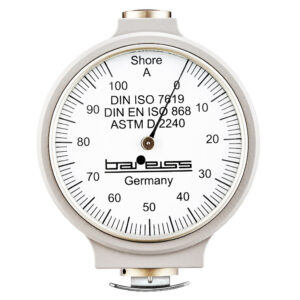
NF T 51-174 is a French designation commonly used to reference the Shore durometer indentation hardness method for plastics and ebonite (hard rubber). In practice, it is associated with the French adoption of ISO 868 (published as NF EN ISO 868) for Shore A (softer materials) and Shore D (harder materials).
This standard is widely used for incoming inspection, process control, and comparative material checks where a fast, repeatable hardness number is needed. If you need help matching Shore scale, specimen form, and durometer configuration to your product, talk with our team.
NF T 51-174 (NF EN ISO 868) — Plastics and ebonite: indentation hardness by durometer (Shore hardness)
NF T 51-174 is typically encountered in specifications as the French reference for Shore hardness testing on plastics and ebonite using a durometer. The current internationally maintained method is ISO 868:2003, which has remained current after periodic review.
Because Shore hardness is an empirical indentation test, results are most valuable when the same scale (A or D), dwell time, and measurement setup are used consistently across lots, suppliers, and plants.
Quick definition
What it is: A standardized method for measuring indentation hardness (Shore hardness) on plastics and ebonite using Shore durometers.
Typical outputs: Shore A or Shore D hardness readings taken at a defined time after contact (initial and/or after a specified dwell time, depending on the requirement).
Best use case: Fast, repeatable control measurements and material-to-material comparisons under consistent conditions.
What This Standard Covers
This standard describes how to determine indentation hardness of plastics and ebonite using durometers, with:
- Type A durometers typically used for softer materials.
- Type D durometers typically used for harder materials.
It also allows for readings taken either at initial contact and/or after a defined period of time, depending on what the calling specification requires.
Why This Standard Matters in Testing
Shore hardness is often used as a quick acceptance check because it is fast to run and easy to repeat with the same toolchain. For many products, it provides a practical way to monitor formulation shifts, cure effects, plasticizer changes, or lot-to-lot variation.
Because results depend on scale selection, contact time, and how the instrument is applied to the specimen, consistent setup is essential when you are comparing results across labs or suppliers.
Common Materials, Product Types, or Applications Covered
NF T 51-174 / ISO 868 is commonly cited for Shore hardness checks on:
- Rigid and semi-rigid plastics (often Shore D).
- Softer plastics and polymeric compounds where Shore A is more appropriate.
- Ebonite (hard rubber) components and sheets.
Shore hardness values are frequently used in product datasheets, purchase specifications, and routine QA checks for molded parts, extrusions, sheets, and finished goods where a quick hardness indicator is needed.
Common Test or Verification Workflow
Most labs run this standard as a short, controlled bench check rather than a full mechanical characterization test.
Common workflow: Select the required Shore scale (A or D), ensure the specimen is suitable and supported, apply the durometer consistently (handheld or with a stand), take the required reading(s) at the specified time, and report results with enough detail to make the measurement repeatable.
Reporting sensitivity: For meaningful comparisons, results should be tied to the exact Shore scale and the reading time requirement used by the customer or internal specification.
Equipment Commonly Used for This Standard
Equipment selection is generally straightforward, but repeatability depends heavily on controlled application and consistent technique.
Common equipment: Shore A durometer and/or Shore D durometer (analog or digital), a stable specimen support/anvil, and (when tighter repeatability is needed) a durometer test stand to control force application and contact geometry.
Common accessories: Reference blocks for functional checks, a thickness gauge (where thickness verification is part of your internal procedure), and simple cutting/prep tools for flat specimens so the indenter sits squarely on the surface.
If you are building a setup for supplier qualification or multi-operator QA, you can request a detailed quote for a durometer and stand configuration matched to your material range and reporting needs.
How to Read This Designation or Revision
NF T 51-174: A French designation commonly used in industry to reference Shore indentation hardness testing for plastics/ebonite within the NF system.
Common current reference: Many specifications will instead cite NF EN ISO 868 (French adoption of ISO 868:2003) for the detailed method and reporting expectations.
Revision sensitivity: When a customer drawing or purchase spec cites “NF T 51-174” without an edition, it is good practice to confirm whether they intend ISO 868:2003 / NF EN ISO 868 and whether they require initial and/or timed readings.
Related Standards, Methods, or Frameworks
Shore indentation hardness is one of several hardness approaches used across polymers and elastomeric materials. Depending on the material class and the intent of the specification, related references may also appear alongside this designation.
Common related reference: ISO 48 is often used for rubber hardness measurement across an IRHD range and may be preferred for certain softer materials where an alternative hardness approach is specified.
Get help selecting a Shore hardness setup for NF T 51-174
If you share your material type (soft vs rigid), part geometry, and whether you need Shore A, Shore D, or both, we can recommend a practical durometer and stand configuration that supports your reporting and repeatability targets—contact our team.