ISO 7438 is an International Standard for bend testing of metallic materials. It is commonly referenced to check whether a metal product can undergo a specified amount of plastic deformation in bending without cracking, as defined by the applicable product standard.
If you are unsure whether ISO 7438 applies to your product form (or which bend fixture style and dimensions your product standard expects), contact our team and we can help you align the setup to the requirement.
ISO 7438: Metallic materials — Bend test
ISO 7438 describes a bend test used to evaluate the ability of metallic materials to undergo plastic deformation in bending. It applies to test pieces taken from metallic products, with test-piece requirements typically driven by the relevant product specification.
This standard is typically used as a practical acceptance or quality check (for example, verifying bendability to a required angle or around a required former) rather than as a full “flexural properties” characterization method.
Quick Definition
In simple terms: ISO 7438 is a standardized bend test for metal product test pieces, used to bend a specimen to a specified condition and then evaluate performance (often by checking for visible cracking) per the applicable product requirement.
Document type: Test method (bend test procedure for metallic materials).
What This Standard Covers
ISO 7438 specifies a method for determining the ability of metallic materials to undergo plastic deformation in bending.
It applies to test pieces taken from metallic products as specified in the relevant product standard. The ISO abstract also notes that it is not applicable to certain materials or products (for example, tubes in full section or welded joints) where other bend-test standards are used.
Why This Standard Matters in Testing
Bend testing is widely used to demonstrate ductility and forming tolerance for metals, and to support product-standard acceptance criteria. When ISO 7438 is cited, it typically means the buyer or specification owner expects a controlled bend setup and a consistent pass/fail evaluation method.
For lab and production teams, ISO 7438 helps standardize how the specimen is supported and bent, how the bend condition is achieved (for example, to a target angle), and what constitutes an acceptable result when the product standard references this method.
Common Materials, Product Types, or Applications Covered
ISO 7438 is used for metallic materials and is commonly applied to test pieces taken from finished or semi-finished metal products when bend performance is a purchase requirement.
Common specimen forms (varies by product standard): Flat and non-flat test pieces, including common cross-sections such as rectangular and round, depending on the product form and the referenced product specification.
Common Test or Verification Workflow
ISO 7438 bend tests are typically run as a controlled bending operation on a prepared test piece taken from the product. The specimen is bent using an approved bending device until a specified bend condition is reached (often a target bend angle or an equivalent condition defined in the product standard).
Typical evaluation approach: The result is interpreted against the applicable product standard. Where the product standard does not specify otherwise, the outcome is often based on whether visible macro-cracks appear on the tension side after bending.
Workflow sensitivity: Support spacing, former (mandrel) geometry, and the required bend angle/radius are commonly product-standard dependent, so quoting equipment or fixtures should be done against the exact requirement being cited.
Equipment Commonly Used for This Standard
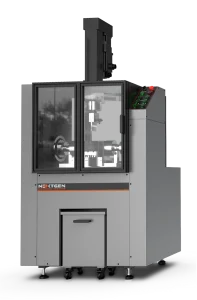
ISO 7438 bend testing is commonly performed using a universal testing machine or press equipped with a bend-test fixture. The standard allows for different bending devices, and one common arrangement is a two-supports-plus-former configuration (a 3-point style bending device) that applies load at mid-span to achieve the required bend condition.
Common equipment elements: Load frame (electromechanical or hydraulic), bend fixture with supports/rollers, a former (loading nose/mandrel), and a means to control and/or measure displacement so the required bend condition can be reached consistently.
Practical buying note: Because ISO 7438 is frequently tied to product-standard criteria (thickness range, specimen width, support span, and former radius), fixture configurability and available tooling sizes are often more important than a single “one-size-fits-all” bend setup. If you are comparing fixture spans, former diameters, and machine capacity for your specimens, you can request a detailed quote for a configuration matched to your product standard and throughput.
How to Read This Designation or Revision
Standard number: ISO 7438 identifies the bend test method for metallic materials.
Year/date suffix: The year in the citation (for example, ISO 7438:2020) indicates the published edition of the standard being referenced. When a customer specification calls out ISO 7438, the edition can matter for details such as allowed bending devices, acceptance interpretation, and reporting expectations.
Revision note: ISO 7438:2020 is published as Edition 4, and earlier editions (such as ISO 7438:2016) have been withdrawn.
Related Standards, Methods, or Frameworks
ISO 7438 is often used alongside product standards that define sampling, test-piece dimensions, bend angle/radius requirements, and acceptance criteria for a given metal product. Where the product form is outside the scope noted by ISO (such as certain tube full-section or welded-joint bend evaluations), other specialized bend-test standards are typically referenced instead.
Get help selecting an ISO 7438 bend-test setup
If you can share your specimen dimensions, material type, and the exact acceptance requirement from the product specification, we can recommend a practical bend fixture and machine configuration for ISO 7438 and help you plan a repeatable workflow. To compare options and pricing, request pricing for a system matched to your force range, tooling sizes, and reporting needs.