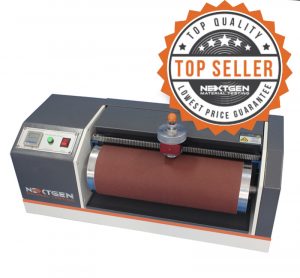
ISO 4649 is an ISO test method for measuring the abrasion resistance of vulcanized or thermoplastic rubber using a rotating cylindrical drum device (commonly associated with “DIN abrasion” style testing).
It is widely used for comparative material screening, quality control, and specification compliance where controlled abrasive wear performance needs to be reported as volume loss or as an abrasion resistance index. If you need help matching Method A vs. Method B to your product or existing customer requirements, contact our team.
ISO 4649:2024 — Rubber, vulcanized or thermoplastic — Determination of abrasion resistance using a rotating cylindrical drum device
ISO 4649 specifies laboratory procedures that abrade a rubber test piece against a defined abrasive sheet on a rotating drum under controlled conditions, then quantify the resulting material loss.
The standard includes two test methods (A and B) and allows results to be expressed as relative volume loss or as an abrasion resistance index, depending on how the test is set up and reported.
Quick definition
Standard type: Test method (laboratory abrasion test).
In simple terms: A prepared rubber specimen is rubbed over an abrasive sheet on a rotating drum; the wear is quantified and reported in a standardized way for comparison and control.
| Method | Test piece motion | Common reporting options |
|---|---|---|
| A | Non-rotating test piece | Relative volume loss or abrasion resistance index |
| B | Rotating test piece | Relative volume loss or abrasion resistance index |
What this standard covers
ISO 4649 covers determination of abrasion resistance by measuring the volume loss caused by rubbing a rubber test piece over a specified abrasive sheet on a rotating cylindrical drum device.
It is intended for comparative testing and control; abrasion results from this laboratory method should not be treated as a direct predictor of in-service performance across all real wear modes.
Why this standard matters in testing
Abrasion performance is often a go/no-go characteristic in rubber product development and purchasing, especially when compounds are being compared across batches, suppliers, or formulation changes.
Because abrasive media, sheet condition, and prior wear can influence absolute values, ISO 4649’s comparative approach (including reference compounds and defined reporting formats) supports more repeatable internal QA/QC and clearer customer/vendor communication.
Common materials, product types, or applications covered
ISO 4649 is commonly applied to vulcanized rubber and thermoplastic rubber compounds used in products where abrasive wear is a design concern.
Common examples: Soles and heel materials, industrial rubber sheeting, wear-prone elastomer components, seals and protective elements where compound-to-compound abrasion ranking is required.
Common test or verification workflow
Most ISO 4649 workflows follow a controlled, comparative lab routine that ties together specimen preparation, abrasive sheet management, and a defined reporting format.
Common workflow:
- Select Method A (non-rotating) or Method B (rotating) based on the cited requirement or internal practice.
- Prepare and condition test pieces as required for the material type and the cited edition.
- Run the abrasion sequence on the rotating drum device using the specified abrasive sheet approach.
- Determine loss and calculate the required result format (for example relative volume loss or abrasion resistance index).
- Report the method, key setup details, and the chosen result expression for traceability.
Revision sensitivity: Even when the equipment is the same, details such as calibration, reference compounds, and required reporting items can change with the cited edition—match your setup and report format to the exact year referenced on drawings, purchase specifications, or customer documents.
Equipment commonly used for this standard
ISO 4649 points to a rotating cylindrical drum abrasion system plus supporting measurement and specimen-prep tools needed to produce consistent, reportable results.
Common equipment:
- Rotating cylindrical drum abrasion tester with fixtures/support for Method A (non-rotating specimen) and/or Method B (rotating specimen), depending on what you must run.
- Specified abrasive sheet system (sheet grade control, mounting approach, and any cleaning/handling practices required by the cited edition).
- Specimen preparation tools (cutters, dies, and trimming tools suitable for producing consistent test pieces).
- Mass and dimensional measurement tools (laboratory balance and suitable gauges) to support the required loss and volume-based reporting.
- Conditioning capability appropriate for the required test environment (for example, controlled lab temperature where applicable).
When you are selecting a system, the most practical purchasing decision is usually whether you need to support both methods, what level of calibration/support documentation your quality system requires, and how you will standardize abrasive sheet handling across operators and shifts.
If you are specifying a new DIN abrasion-style system or replacing an older unit, you can request a detailed quote based on the method(s), throughput, and reporting expectations in your lab.
How to read this designation or revision
ISO 4649:2024 identifies the ISO standard number (4649) and the publication year (2024). ISO also tracks the edition number; ISO 4649:2024 is Edition 5.
Older citations such as ISO 4649:2017 may still appear in customer documentation. When a contract, drawing, or internal control plan cites a year, keep your procedure and reporting aligned to that exact edition.
Related standards, methods, or frameworks
Rubber wear and abrasion can be evaluated using multiple laboratory approaches depending on the product and wear mode. ISO 4649 is the rotating drum approach, and some organizations reference other documents when comparing wear testers and use-cases.
Commonly referenced context document: ISO 23794 (overview of wear resistance test equipment for rubber compounds) may be used as background when selecting a wear test approach for a given application.
Talk with us about ISO 4649 testing capacity
If you need to run ISO 4649 for customer qualification, incoming inspection, or compound development, we can help you align method selection, abrasive sheet handling, and reporting expectations to the edition you are required to cite. To discuss your application, talk with our team.