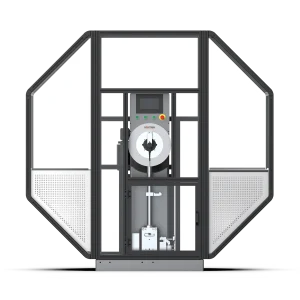
ISO 14556 defines an instrumented Charpy V-notch pendulum impact test method for metallic materials, including requirements for the measurement and recording system used to capture the impact event.
It is commonly used when teams need more detail than a traditional Charpy absorbed-energy value—such as a force signal during fracture—while still working within a standardized pendulum impact workflow. If you need help matching instrumentation, striker style, or reporting expectations to the edition you must follow, talk with our team.
ISO 14556: Metallic materials — Charpy V-notch pendulum impact test — Instrumented test method
ISO 14556 is a testing standard focused on instrumented Charpy V-notch pendulum impact testing of metallic materials.
In addition to the usual Charpy impact context, the instrumented approach is used to record the impact response with dedicated sensors and electronics, supporting deeper fracture-behavior analysis than energy alone.
Quick Definition
ISO 14556 is a test method for running a Charpy V-notch pendulum impact test on metals using an instrumented setup that measures and records the impact response (not just the dial/encoder absorbed energy).
What This Standard Covers
ISO 14556 covers instrumented Charpy V-notch pendulum impact testing on metallic materials, with requirements tied to measurement and recording equipment performance.
It is intended to supplement the conventional Charpy pendulum impact test framework by adding instrumentation and data capture so users can evaluate fracture behaviour during the impact event.
Key emphasis: requirements for the instrumented measurement chain (sensing, recording, and related performance expectations) used during the pendulum impact test.
Why This Standard Matters in Testing
When labs, mills, and QA teams need insight beyond a single absorbed-energy number, an instrumented Charpy test can provide additional information about how the specimen fractures under impact loading.
ISO 14556 is also important because it includes a clear limitation: instrumented Charpy analysis results are not meant to be directly transferred to structural/component performance, and they should not be used directly for design calculations or safety assessments.
Common Materials, Product Types, or Applications Covered
Material class: Metallic materials (e.g., steels and other structural alloys where Charpy V-notch impact testing is part of qualification, process control, or comparative material evaluation).
Typical use cases: material benchmarking, heat-treatment comparisons, production verification programs, and investigations where force-signal detail during impact is valuable alongside absorbed energy.
Common Test or Verification Workflow
ISO 14556 generally follows the Charpy V-notch pendulum impact workflow while adding instrumented data collection.
Common workflow elements:
- Prepare Charpy V-notch specimens and notch geometry appropriate to the Charpy method being used.
- Condition specimens to the required test temperature when temperature-dependent behaviour is being evaluated.
- Perform the pendulum impact test while collecting an instrumented signal during impact.
- Review instrumented outputs alongside conventional absorbed energy for analysis and reporting.
Equipment Commonly Used for This Standard
ISO 14556 points to an instrumented pendulum impact setup rather than a basic impact tester alone. Equipment selection typically centers on capturing a reliable impact signal and producing consistent Charpy results.
Common equipment families:
- Instrumented Charpy pendulum impact tester (pendulum machine configured for Charpy V-notch testing).
- Instrumented striker / force sensing hardware and a compatible data acquisition / recording system for the impact event.
- Charpy supports/anvils and striker geometry appropriate to V-notch testing.
- Specimen preparation tools (cutting/machining and notch preparation per the Charpy method used).
- Temperature conditioning equipment (as applicable), such as cooling/heating devices and handling tools to maintain temperature control through the test sequence.
If you are comparing instrumented Charpy system configurations (pendulum capacity, striker/instrumentation options, and software outputs), you can request a detailed quote for a setup aligned with your lab’s workflow.
How to Read This Designation or Revision
Designation: ISO 14556
Year suffix: When cited as “ISO 14556:2023” (for example), the year indicates the published edition being required by a contract, customer specification, or internal procedure.
Revision sensitivity: Instrumentation requirements, recording expectations, and analysis/reporting practices can vary by edition, so equipment setup and software deliverables should be matched to the exact year referenced in your requirement.
Related Standards, Methods, or Frameworks
ISO 14556 is used in the context of the Charpy pendulum impact test method described in ISO 148-1.
In practice, many labs treat ISO 148-1 and ISO 14556 as companion references: ISO 148-1 for the base Charpy method and ISO 14556 for instrumented measurement and recording expectations.
Get help selecting an ISO 14556 test setup
If you need to align an instrumented Charpy system to a specific ISO 14556 edition and your reporting requirements, contact our team to discuss instrumentation, data capture, and the practical equipment package that fits your specimens and temperature range.