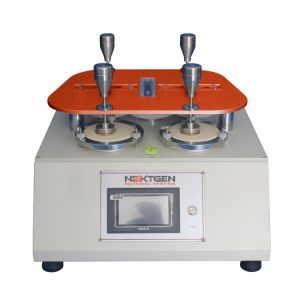
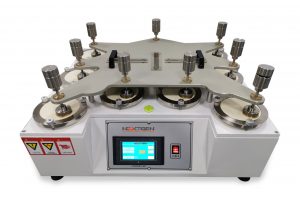
ISO 12947-4:1998 describes how to evaluate the appearance change of textile specimens after Martindale abrasion. It is used when the end point is not only “failure” or “mass loss,” but how the surface looks after a defined abrasion exposure.
This part is commonly applied to a wide range of fabrics (including nonwovens) where a specifier is concerned with early visual wear such as shading, fuzzing, surface disruption, or other appearance-related change. If you need help matching your product requirement to the correct Martindale part and evaluation approach, talk with our team.
Textiles — Determination of the abrasion resistance of fabrics by the Martindale method — Part 4: Assessment of appearance change (ISO 12947-4:1998)
ISO 12947-4 is a test-method document focused on how to assess the visible change in a specimen’s surface after abrasion using a Martindale abrasion tester setup as defined within the ISO 12947 series.
It is typically selected when appearance retention is a key performance expectation and the acceptance criteria are based on a defined level of visual change after a specified abrasion exposure.
| Item | Details |
|---|---|
| Standard | ISO 12947-4:1998 |
| Topic | Assessment of appearance change after Martindale abrasion |
| Status | Published (Edition 1, 1998-12; confirmed in 2023) |
Quick Definition
ISO 12947-4 defines an approach for visually evaluating how a textile specimen’s surface appearance changes after abrasion using the Martindale method.
What This Standard Covers
This standard focuses on the assessment step after abrasion exposure rather than defining abrasion resistance as a single mechanical end point. It applies to the evaluation of appearance change on textile specimens after a specified Martindale abrasion procedure.
ISO 12947-4 is intended to be used alongside the relevant parts of the ISO 12947 series that address the Martindale apparatus and other abrasion outcomes.
Why This Standard Matters in Testing
Many product specifications are driven by what the fabric looks like after wear, not only whether it breaks down or how much mass is lost. ISO 12947-4 supports appearance-based requirements by providing a consistent framework for assessing visible change after abrasion.
For procurement and QA/QC teams, this helps align internal quality checks and supplier submissions to the same assessment approach when appearance retention is part of the acceptance criteria.
Common Materials, Product Types, or Applications Covered
ISO 12947-4 is broadly applicable across textile fabrics, including nonwovens, where appearance change after abrasion is a key concern.
Common application areas: Upholstery and contract fabrics, apparel and uniform textiles, workwear fabrics, and technical textiles where surface appearance after wear is specified.
Common Test or Verification Workflow
In practice, ISO 12947-4 is used as the evaluation and reporting component of a Martindale abrasion program.
Common workflows: Condition and prepare specimens per the governing test plan, run abrasion exposure using a Martindale tester under the specified setup, then assess and record the resulting appearance change using the defined evaluation approach and agreed acceptance criteria.
Equipment Commonly Used for This Standard
Because ISO 12947-4 is an assessment-focused part of the Martindale series, equipment selection usually starts with the Martindale abrasion platform and then adds the evaluation tools needed for consistent appearance grading.
Common equipment: Martindale abrasion tester configured for ISO 12947 use, specimen holders and loading components appropriate to the test plan, and standardized abradant/media consumables used within the Martindale method.
Assessment support tools: Controlled lighting for visual evaluation (commonly a light cabinet or equivalent controlled viewing condition) and documentation tools for consistent recording of appearance change.
If you are configuring a Martindale system for appearance-based specifications (not only breakdown or mass loss), you can request a detailed quote for a configuration matched to your specimen format, throughput needs, and evaluation workflow.
How to Read This Designation or Revision
ISO 12947-4:1998 identifies Part 4 of the ISO 12947 Martindale abrasion series and the year of publication (1998). This standard has also been issued with at least one corrigendum, so purchase orders, customer specifications, and lab reports should cite the full designation used for the requirement.
Revision sensitivity: Appearance assessment can be especially sensitive to the exact referenced edition and any referenced evaluation aids or acceptance criteria included in the controlling specification.
Related Standards, Methods, or Frameworks
ISO 12947-4 is part of a multi-part Martindale abrasion standard set. It is commonly used with other parts of ISO 12947 depending on whether the required outcome is appearance change, specimen breakdown, or mass loss.
-
ISO 12947-1: Martindale abrasion testing apparatus (general introductory and apparatus context for the series)
-
ISO 12947-2: Determination of specimen breakdown
-
ISO 12947-3: Determination of mass loss
Get help selecting a Martindale setup for ISO 12947-4
If you need to align a Martindale abrasion tester configuration with an ISO 12947-4 appearance-change requirement (including specimen formats, holders, and evaluation workflow), contact our team and share the exact specification citation and pass/fail criteria you are working to.