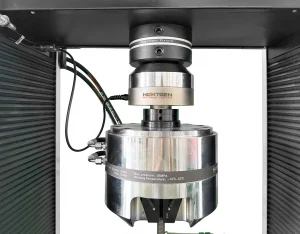
DIN 50100 is a German standard for running and evaluating constant-amplitude, load-controlled fatigue (endurance) tests on metallic test specimens and metallic components. It is commonly used to generate S–N (Wöhler) data and fatigue strength metrics under defined cyclic loading conditions.
If you need help matching your fatigue test setup, specimen type, and control mode to the DIN 50100 workflow your customer or internal procedure calls out, talk with our team.
DIN 50100: Load controlled fatigue testing – execution and evaluation of cyclic tests at constant load amplitudes on metallic specimens and components
DIN 50100 describes how to conduct constant-amplitude fatigue tests where the machine controls force (load) rather than strain, and how to evaluate and document the resulting fatigue-life data. It is typically applied to axial fatigue testing, but it can also be used as a framework when fixtures are designed for component-level cyclic loading.
The standard is frequently referenced in industrial qualification and validation programs where repeatable load-controlled cycling, defined mean load (or stress ratio), and consistent failure/end-of-test criteria are needed for reporting.
Quick Definition
DIN 50100: A load-controlled, constant-amplitude fatigue testing and evaluation standard for metallic specimens and components (often used for S–N / Wöhler testing).
What This Standard Covers
DIN 50100 focuses on test execution and evaluation for cyclic loading at a constant load amplitude. In practical terms, it helps define how to run a single-stage constant-amplitude fatigue test and how to capture and report the key parameters required to interpret fatigue life.
Typical parameters controlled or reported: Load amplitude, mean load (or mean stress), stress ratio concepts used in fatigue testing, number of cycles to failure (or runout), and relevant test/environment documentation.
Why This Standard Matters in Testing
Constant-amplitude fatigue data is often used to compare materials, processes, and design details (for example: heat treatment, surface condition, welds, and geometry effects) under cyclic loading. DIN 50100 provides a consistent basis for producing comparable fatigue-life results and defensible test reports.
For labs and QA/QC teams, the biggest practical impact is repeatability: stable load control, reliable cycle counting, and clear documentation of how the cyclic loading was applied and how failure/runout was determined.
Common Materials, Product Types, or Applications Covered
DIN 50100 is written for metallic materials and metallic components.
Common use cases: Generating S–N curves for metals, comparing fatigue performance across manufacturing routes, screening design details for fatigue sensitivity, and documenting fatigue performance for customer or internal validation.
Common Test or Verification Workflow
While the exact details depend on your specimen geometry, fixture design, and program requirements, a typical DIN 50100-style workflow looks like this:
- Define the loading condition (constant load amplitude) and the mean load / loading ratio used for the test series.
- Set up the fatigue test system for closed-loop load control and verify stable cycling at the intended frequency range.
- Run single-stage constant-amplitude cyclic loading until failure or a defined runout cycle limit.
- Record cycles-to-failure (or runout), document test conditions, and evaluate results for reporting (often as S–N / Wöhler data).
Practical caution: Fatigue results can be highly sensitive to alignment, gripping, fixture stiffness, and how load is introduced into the specimen or component. These setup details often drive whether results are comparable across labs.
Equipment Commonly Used for This Standard
DIN 50100 points to equipment that can apply repeatable cyclic loading under closed-loop force control and accurately count cycles while capturing test parameters needed for reporting.
Common equipment families: Servo-hydraulic fatigue testing systems (typical for a wide force range and many fixture styles), electrodynamic fatigue systems (common for higher-frequency, lower-force regimes), fatigue-rated load cells, hydraulic or wedge grips suitable for cyclic loading, and fatigue-capable controller/software for waveform generation and cycle counting.
Common accessories (application-dependent): Alignment fixtures, anti-buckling guides (when compressive loading is involved), specialized threaded/shoulder grips for axial specimens, and custom component fixtures designed to introduce the required load path without parasitic bending.
If you are comparing dynamic force capacity, actuator stroke, controller features, and grip/fixture options for DIN 50100 testing, you can request a detailed quote for a configuration matched to your load range and specimen/component geometry.
How to Read This Designation or Revision
DIN standards are commonly cited with a date code. For example, DIN 50100:2022-12 refers to the December 2022 edition.
Because fatigue testing is procedure-sensitive (control mode, runout definition, reporting fields, and evaluation approach), procurement and test planning should always confirm the exact edition referenced in the customer specification or internal test plan.
Related Standards, Methods, or Frameworks
In many fatigue programs, DIN 50100 is used alongside other constant-amplitude fatigue standards or customer-specific fatigue test procedures. Laboratories may also see cross-references to ISO and ASTM fatigue methods depending on the industry and reporting format required.
Common practical consideration: Even when standards appear similar at a high level, differences in specimen definition, runout criteria, reporting requirements, or permitted control approaches can affect comparability. Edition matching and method alignment are usually the critical steps.
Talk to NextGen About DIN 50100 Testing Setups
If you need a fatigue system sized for your target force range, frequency range, and specimen/component fixturing—or you want to confirm what you need for load-controlled constant-amplitude testing—contact our team to discuss your application.