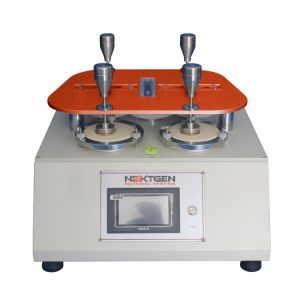
BS 3424 / BS 5690 is a commonly cited British Standards reference used when specifying Martindale-style abrasion testing for textiles and coated fabrics. In practice, it points labs toward a Martindale abrasion tester setup and a defined rub/cycle-based evaluation of wear performance.
If you need help matching a customer specification to the right Martindale configuration (stations, loads, holders, and consumables), talk with our team about your material and the acceptance criteria you must report.
BS 3424 / BS 5690 (Martindale abrasion testing reference)
This combined citation is often used as shorthand for Martindale abrasion testing requirements drawn from two related British Standards: BS 5690 for abrasion resistance of fabrics using the Martindale machine concept, and BS 3424 parts focused on coated-fabric testing (including abrasion-focused methods).
Because contracts and legacy specifications may cite these documents differently (including specific parts/method numbers), the exact test endpoint, load, and reporting format should be taken from the edition and clause referenced in the purchase specification.
Quick definition
BS 3424 / BS 5690 is used to specify Martindale-type abrasion evaluation for textile fabrics and coated fabrics, typically reported as cycles to a defined endpoint (such as breakdown or appearance change) under controlled contact pressure using standard abradants.
What this standard covers
When BS 3424 / BS 5690 is invoked, the intent is usually to assess how a fabric surface withstands repeated rubbing under a controlled load using Martindale motion (often described as a Lissajous figure) and defined consumables.
| Referenced document | Typical intent when cited |
|---|---|
| BS 5690 | Martindale-based abrasion resistance determination for fabrics (flat woven, knitted, and some nonwovens), usually expressed in cycles to an endpoint. |
| BS 3424 (coated fabrics), including abrasion-focused parts such as BS 3424-24 | Abrasion resistance determination for coated fabrics, commonly aligned with Martindale-style abrasion fixtures and reporting. |
What it is not: This combined citation is not a single standalone document. The detailed requirements (conditioning, specimen dimensions, loads, abradant selection, endpoint definition, and reporting) depend on the exact part/method and edition referenced in the customer or regulatory specification.
Why this standard matters in testing
Martindale abrasion results are widely used as a durability screen for apparel, upholstery, technical textiles, and coated materials where surface wear drives service life, aesthetics, or functional performance.
For QA/QC teams, the standardization of load and motion helps make abrasion results more comparable across lots, suppliers, and product changes, provided the same endpoint definition and consumables are used.
Common materials, product types, or applications covered
BS 3424 / BS 5690 is most often applied to:
- Woven and knitted fabrics used in apparel and uniforms
- Upholstery and contract fabrics where abrasion cycles are tied to durability requirements
- Coated fabrics (polymer-coated textiles) used in protective covers, curtains, seating, and technical applications
- Selected nonwoven fabrics where a Martindale-style abrasion method is specified
Common test or verification workflow
A typical Martindale abrasion workflow under this citation includes controlled conditioning, specimen cutting/mounting, selection of an abradant and backing materials, application of a specified mass/load, and cycling to a defined endpoint.
Common endpoints: Cycles to specimen breakdown (e.g., hole formation or yarn break), or cycles to a specified level of appearance change (depending on the referenced method and product spec).
Common reporting: Number of cycles (rubs) achieved at the endpoint, plus any required observations (surface change, coating damage, seam effects, or other defined failure descriptions).
Equipment commonly used for this standard
The equipment path is centered on a Martindale abrasion tester configured for the cited method and material type.
Common equipment: Martindale abrasion/pilling tester with appropriate stations; specimen holders and clamping rings; loading weights to achieve specified contact pressure; abradant fabric and standard felts/foams as required; a cutting die/punch set for consistent specimen diameters; a counter/timer and (where needed) a controlled environment for conditioning.
If you are selecting a multi-station unit or need to align accessories with a specific customer clause (for example, a breakdown endpoint versus an appearance-change endpoint), you can request a detailed quote for a configuration matched to your throughput and reporting needs.
How to read this designation or revision
“BS 3424 / BS 5690” is typically used as a combined reference, and the actual requirements come from the specific BS 3424 part/method and the cited BS 5690 edition referenced in the controlling specification.
Revision sensitivity: Many organizations have moved to later ISO/EN adoptions for Martindale abrasion (for example, the BS EN ISO 12947 series). When a customer calls out BS 5690 or a specific BS 3424 part, edition matching can affect consumables, loads, endpoints, and the way results are stated.
Related standards, methods, or frameworks when useful
Depending on what the purchase specification is trying to prove, Martindale abrasion may be paired with pilling evaluation methods and/or alternative abrasion methods.
Common related references in specifications: BS EN ISO 12947 (Martindale abrasion series) and, for coated fabrics, ISO 5470-2 (Martindale abrader approach for rubber/plastics-coated fabrics) where explicitly required by the program or customer document.
Talk to us about a BS 3424 / BS 5690 test setup
If your specification cites BS 3424 / BS 5690 but does not clearly state the part/method, endpoint, or load, contact our team and share the clause callout so we can help you align the test configuration and consumables to the requirement.