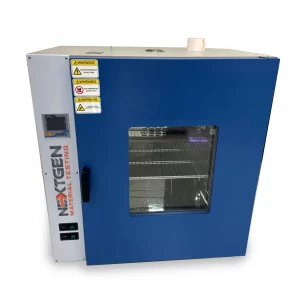
ASTM E145 is a specification used to define and verify performance for general-purpose laboratory air ovens used in testing operations, including gravity-convection and forced-ventilation designs.
If you are trying to align an oven purchase or an internal oven verification program to a specific ASTM E145 revision and oven type, contact our team to talk through temperature range, chamber size, airflow style, and uniformity expectations.
ASTM E145 — Standard Specification for Gravity-Convection and Forced-Ventilation Ovens
ASTM E145 is written for general-purpose air ovens commonly used as part of materials testing workflows (for example, specimen conditioning, drying, or heat exposure steps required by other test methods).
Because it is a specification, it focuses on oven performance characteristics and how those characteristics are evaluated, rather than defining a single “material test” performed on a specimen.
Quick definition
What it is: A performance specification for laboratory air ovens used in testing operations.
Oven styles covered: Gravity-convection ovens and forced-ventilation ovens.
What it helps control: Temperature control and chamber temperature behavior (such as uniformity) as assessed using the methods within the specification.
What This Standard Covers
ASTM E145 addresses general-purpose air ovens with a defined chamber-size limit and establishes performance requirements for multiple oven “types” (including both gravity and forced-ventilation categories).
It applies to gravity-convection ovens operating over all or part of a range that extends from above ambient up to a moderate elevated temperature, and to forced-ventilation ovens that can extend to higher maximum temperatures. The exact suitability depends on the oven’s rated operating range and the specific E145 type being targeted.
Why This Standard Matters in Testing
Ovens are often “support equipment” inside a larger test method. If the oven’s temperature behavior is not appropriate for the conditioning or exposure step, it can create variability that shows up later as inconsistent mass change, mechanical properties, cure state, or aging results.
ASTM E145 is commonly used as a procurement and quality reference because it provides a standard way to describe and evaluate oven performance for testing operations—helpful when a lab needs repeatability across sites, programs, or suppliers.
Common Materials, Product Types, or Applications Covered
ASTM E145 is not material-specific. It is typically referenced when an oven is used for temperature conditioning or thermal exposure within another standard, internal procedure, or customer requirement.
Common application examples: Specimen conditioning prior to testing, drying steps, thermal exposure/aging steps, and general lab heat treatments that must be controlled and documented as part of a QA/QC workflow.
Common Test or Verification Workflow
ASTM E145 is usually applied as an oven acceptance, verification, or comparison reference—either when bringing a new oven into service or when periodically checking whether an in-service oven still meets the intended performance class.
Common workflow pattern: Select the intended oven category/type, verify the usable operating range for the planned process, evaluate chamber temperature behavior using appropriate instrumentation and measurement placement, then document results for internal quality records or accreditation needs.
Equipment Commonly Used for This Standard
Because ASTM E145 is a performance specification for ovens, the equipment focus is typically split between (1) the oven itself and (2) the measurement tools used to evaluate oven temperature behavior.
Common equipment: Gravity-convection lab ovens, forced-ventilation lab ovens, temperature sensors (often thermocouples or RTDs suited to the temperature range), multi-channel data loggers/recorders, and fixtures or stands to place sensors at defined chamber locations without contact errors.
For buyers, the practical selection issues usually include chamber volume, maximum temperature rating, airflow style (gravity vs forced), controller capability, and the ability to support a documented temperature survey using your lab’s preferred sensors and recording approach. If you are comparing oven configurations for an E145-driven requirement, you can request a detailed quote for an oven and measurement package matched to your temperature range and chamber size.
How to Read This Designation or Revision
ASTM E145: The ASTM “E” series designation and the number identify the specific oven specification.
Edition year: When shown as ASTM E145-19, the “-19” indicates a 2019 edition.
Reapproval suffix: ASTM may show a reapproval year suffix (for example, an “R” year) to indicate the standard was reaffirmed without technical changes. When a contract, audit, or customer requirement cites ASTM E145, match the exact edition/reapproval referenced in the requirement before finalizing an oven acceptance plan.
Related Standards, Methods, or Frameworks
ASTM E145 is commonly used alongside other test methods that require controlled oven conditioning or thermal exposure steps. The controlling document is usually the material/product test method; ASTM E145 is the supporting reference used to define whether the oven is suitable for that step.
When multiple documents apply, the most practical approach is to align the oven’s temperature range and performance class to the most demanding procedure in your lab’s scope and then standardize verification records so they can be reused across programs.
Talk with us about an ASTM E145 oven setup
If you need help selecting a gravity or forced-ventilation oven and the instrumentation needed to support an ASTM E145-style performance check, ask for a quote with your target temperature range, chamber size, and whether your workflow is conditioning, drying, or thermal exposure.