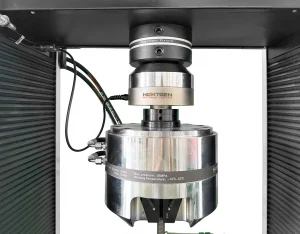
ASTM E1012 is a standard practice used to verify testing frame and specimen alignment when applying axial tensile or compressive forces. Its focus is identifying bending introduced by the load train (frame, fixtures, grips, platens, and specimen setup) during routine testing in the elastic range.
Alignment is especially important when test results can be sensitive to unintended bending—such as tension, compression, creep, and uniaxial fatigue work—because misalignment can shift stress distribution and influence measured properties. If you need help determining whether alignment verification is appropriate for your method, fixture stack-up, or accreditation requirements, talk with our team.
ASTM E1012 — Standard Practice for Verification of Testing Frame and Specimen Alignment Under Tensile and Compressive Axial Force Application
This standard provides procedures to quantify bending that occurs when a nominally axial force is applied through a materials testing system. It is used as a reference practice when a separate test method or customer requirement places limits on allowable misalignment or bending during loading.
Document type: Practice (alignment verification and terminology; not a material property test method).
Quick Definition
ASTM E1012 helps labs evaluate how well a test frame and load train apply force along the intended specimen axis by measuring the bending introduced during tensile and compressive loading in the elastic range.
What This Standard Covers
ASTM E1012 covers methods to determine the amount of bending that occurs while applying tensile and compressive forces to notched and unnotched specimens during routine testing in the elastic range.
It is broadly applicable to both metallic and nonmetallic testing, and it is commonly referenced where axiality is important for data quality or comparability.
Why This Standard Matters in Testing
Even small eccentricities in grips, fixtures, or specimen seating can introduce bending stresses alongside the intended axial stress. Those bending stresses can influence measured behavior, increase scatter, or trigger premature failure modes—particularly in tests that are sensitive to alignment.
In practice, ASTM E1012 is often used to support:
- Machine qualification or acceptance after installation, service, or relocation
- Verification after changing grips, platens, load cells, or other load-train components
- Ongoing alignment checks when required by a governing test method, internal SOP, or customer specification
Common Materials, Product Types, or Applications Covered
Because ASTM E1012 is an equipment-and-setup verification practice (not a product specification), it is used across many programs where axial loading quality matters.
Common applications: Tension and compression testing, creep testing, and uniaxial fatigue testing where misalignment limits or bending sensitivity are a concern.
Common specimen contexts: Notched or unnotched specimens evaluated in the elastic range for the purpose of alignment verification (as defined by the practice and any referencing method).
Common Test or Verification Workflow
ASTM E1012 is typically performed as an alignment verification activity alongside your normal mechanical test capability. The exact acceptance criteria and verification interval are usually defined by the test method that invokes alignment requirements or by agreement between parties.
Typical workflow:
- Assemble the test frame with the same grips/fixtures/platens and geometry used for production testing.
- Apply tensile and/or compressive loading in the elastic range while capturing signals needed to quantify bending.
- Calculate bending contribution and document the alignment condition of the system as configured.
- Adjust components (as needed) and re-verify until requirements are met.
Equipment Commonly Used for This Standard
ASTM E1012 typically drives equipment and accessory choices related to axial loading quality and measurement of bending/strain response.
Common equipment families:
- Servo-hydraulic or electromechanical universal testing machines (tension and compression capable)
- Grips, wedge grips, collet grips, compression platens, and alignment hardware appropriate to the specimen and load level
- Alignment verification specimens and instrumentation capable of resolving bending during axial loading (commonly strain-based measurement with suitable signal conditioning / DAQ)
- Appropriate fixturing to reduce off-axis loading (for example, well-maintained grip faces, centering features, and load-train components matched to the specimen geometry)
Equipment selection is highly dependent on maximum force, tension vs. compression needs, specimen geometry, and whether your program needs periodic verification or continuous indicators of alignment condition.
If you are specifying a new frame or updating grips/fixtures for an axiality-sensitive program, you can request a detailed quote for a configuration that matches your force range and alignment verification approach.
How to Read This Designation or Revision
ASTM standards are commonly cited by their designation and a suffix that identifies the edition year (for example, “E1012-19”). Because procedures, terminology, and reporting expectations may change between editions, the safest approach is to match the exact year/edition specified by your customer, governing test method, or internal quality system.
Revision sensitivity: Alignment verification setup, calculation details, and documentation requirements may depend on the cited edition and any methods that reference ASTM E1012.
Related Standards, Methods, or Frameworks (When Useful)
ASTM E1012 is commonly used as a supporting verification reference when another mechanical test method limits misalignment or requires evidence of axial loading quality. When quoting equipment or planning a verification program, it’s important to identify the primary method(s) you run (tension, compression, creep, fatigue, etc.) and any customer-specific axiality limits.
Talk to Us About ASTM E1012 Equipment and Setup
For help selecting a test frame, grips/platens, and alignment verification approach appropriate to your force range and specimen types, request pricing and we’ll scope a system configuration that fits your workflow.