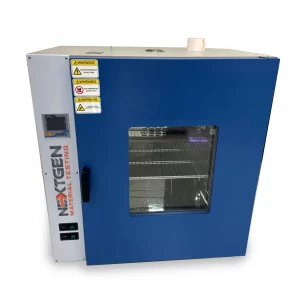
ASTM D5374 provides test methods for evaluating forced-convection, ventilated, electrically heated laboratory ovens used in thermal endurance evaluation of electrical insulating materials. It focuses on confirming that an oven can hold stable, repeatable conditions so aging or endurance results are driven by the material—not by oven variability.
If you need help determining whether your existing oven and instrumentation can support the uniformity and circulation expectations tied to electrical insulation endurance work, talk with our team about your temperature range, workspace size, and qualification approach.
ASTM D5374: Standard Test Methods for Forced-Convection Laboratory Ovens for Evaluation of Electrical Insulation
ASTM D5374 is a set of laboratory test methods used to evaluate oven performance characteristics for forced-convection, ventilated, electrically heated ovens used in electrical insulation thermal endurance programs.
These methods are commonly used as part of an “oven qualification” or “oven performance verification” activity before running long-duration thermal aging exposures, and they are often referenced alongside an associated oven specification.
Quick definition
In practical terms: ASTM D5374 helps labs measure and document whether a forced-convection lab oven provides sufficiently uniform and controlled temperature and air circulation for thermal endurance evaluation of electrical insulating materials.
What this standard covers
ASTM D5374 covers procedures for evaluating the characteristics of forced-convection, ventilated, electrically heated ovens used for thermal endurance evaluation of electrical insulating materials.
Oven type: Forced-convection, ventilated, electrically heated laboratory ovens.
Typical operating range: It addresses ovens operating over all or part of a range that extends from above ambient up to high temperatures (the standard’s scope describes operation from 20 °C above ambient up to 500 °C).
International alignment: The methods are based on IEC 60216-4-1 and are described by ASTM as technically identical.
Why this standard matters in testing
Thermal endurance evaluation can require long exposure times. If an oven has poor uniformity, unstable control, or inconsistent air circulation, samples can see different effective temperatures—even when the controller setpoint is the same. That can distort aging rates, shift life curves, and create disagreements between labs.
ASTM D5374 is typically used to document that the oven environment is controlled and repeatable, supporting confidence in thermal endurance results and reducing rework when data is reviewed by customers, auditors, or internal quality teams.
Common materials, product types, or applications covered
This standard is used in test programs involving electrical insulating materials that are evaluated for thermal endurance (thermal aging). Examples can include insulation systems, films, varnishes/coatings used as insulation, laminates, tapes, or other insulating components where long-term heat exposure performance is being characterized.
Typical users: Electrical insulation material suppliers, motor/generator and transformer supply chains, independent test laboratories, and QA/R&D groups running thermal aging and endurance evaluations.
Common test or verification workflow
ASTM D5374 is usually applied as an oven verification step that supports (rather than replaces) the thermal endurance test program performed on the insulation material.
Common workflow:
- Select the intended operating temperature(s) and the usable working volume (the space where specimens will be placed).
- Instrument the workspace with appropriate temperature sensors and run checks intended to characterize oven performance (such as temperature uniformity and circulation-related behavior) under representative operating conditions.
- Compare measured performance against the lab’s acceptance criteria or an associated oven specification used by the program.
- Document results for qualification, ongoing monitoring, or troubleshooting (for example, after maintenance, relocation, or controller changes).
Because acceptance limits are often defined by a companion specification, it is common to pair ASTM D5374 procedures with ASTM D5423 requirements when establishing pass/fail criteria for an oven used in electrical insulation endurance work.
Equipment commonly used for this standard
ASTM D5374 is equipment-focused: it evaluates the performance of a forced-convection laboratory oven and the measurement tools used to characterize that oven.
Common equipment families:
- Forced-convection laboratory oven: Ventilated, electrically heated oven suitable for the target temperature range and exposure durations used in electrical insulation thermal endurance programs.
- Temperature measurement system: Calibrated sensors (commonly thermocouples or equivalent temperature probes appropriate for the temperature range), plus a data acquisition system or multi-channel recorder to capture spatial temperature behavior.
- Sensor placement hardware: Racks, fixtures, or non-conductive supports that allow repeatable probe positioning within the working volume without obstructing airflow.
- Verification tools and documentation: Calibration records, test templates, and reporting formats that support repeatable surveys over time.
Practical selection note: For quoting or specifying an oven for D5374-driven qualification work, the key decisions are usually working volume, maximum temperature, ventilation/airflow design, controller capability and stability, and the multi-point measurement setup needed to demonstrate performance in the usable workspace.
How to read this designation or revision
Base designation: “ASTM D5374” identifies the standard within ASTM’s D-series.
Year suffix: A hyphenated two-digit year (for example, “D5374-22”) indicates the year of acceptance or last revision.
Letter after the year: If the standard is revised more than once in the same year, an additional letter may be appended (for example, “D5374-22a”) to indicate the second revision in that year.
Revision sensitivity: Oven qualification criteria, instrumentation expectations, and reporting details can be edition-dependent. For any contractual or accreditation-driven program, match your procedure and report to the exact revision cited by your customer, internal spec, or quality system.
Related standards, methods, or frameworks
ASTM D5374 commonly appears with companion references that define acceptance criteria or align the approach internationally.
Common related references:
- ASTM D5423: An associated specification referenced by ASTM D5374 for permissible variations from absolute uniformity for these ovens.
- IEC 60216-4-1: International reference that ASTM D5374 is based on and described as technically identical to.
- Legacy reference: ASTM D5374 and the associated specification are described as replacing ASTM D2436.
Get help selecting an oven and qualification setup
If you are specifying a forced-convection oven for electrical insulation thermal endurance work—or updating your qualification instrumentation and reporting—you can request a detailed quote based on your target temperature range, workspace needs, and documentation requirements.