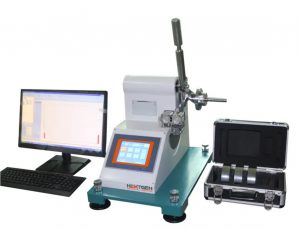
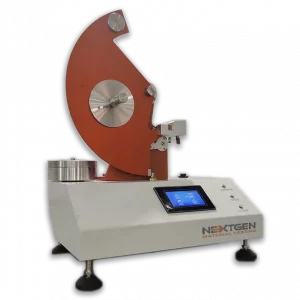
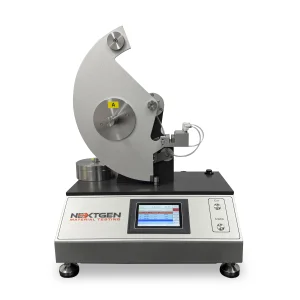
ASTM D1424 is a standard test method for measuring the force required to propagate a single-rip tear in textile fabrics using a falling-pendulum (Elmendorf-type) tear tester.
It is commonly referenced when tear propagation resistance is a key performance requirement for woven and nonwoven fabrics, coated textiles, industrial fabrics, and other fabric constructions where controlled tear behavior matters in service. If you need help aligning your fabric type, direction of test, and wet/dry conditioning to the cited edition, contact our team.
ASTM D1424 — Standard Test Method for Tearing Strength of Fabrics by Falling-Pendulum (Elmendorf-Type) Apparatus
ASTM D1424 is used to generate an Elmendorf tear value by propagating a tear from a pre-cut slit under a rapid, pendulum-driven tearing action. The result is widely used for product qualification, supplier/customer agreements, and comparative evaluation between fabric constructions or directions.
Because tear behavior can be direction-dependent and construction-dependent, ASTM D1424 is typically specified with clear direction (for example, warp vs. fill) and with any required conditioning (including wetting, where applicable).
Quick Definition
ASTM D1424 in one line: An Elmendorf (falling-pendulum) tear propagation test that determines the force required to continue a single-rip tear in a fabric specimen.
| Item | What ASTM D1424 Covers |
|---|---|
| Document type | Test method |
| Primary property | Force required to propagate a single-rip tear starting from a cut |
| Test principle | Falling-pendulum (Elmendorf-type) apparatus |
| Material focus | Most textile fabrics (including treated and coated fabrics), with direction limitations for many knitted constructions |
What This Standard Covers
ASTM D1424 describes how to determine tearing strength by propagating a tear from a pre-cut slit in a fabric specimen using an Elmendorf-type pendulum tear tester.
It applies to most fabrics (including untreated, sized, coated, or resin-treated fabrics) when the fabric does not tear crosswise to the direction of force application during the test. The method also includes provisions for testing with or without wetting, when wet-state performance is required.
ASTM D1424 is suitable only for the warp direction tests of warp-knit fabrics, and it is not suited for the course direction of warp knit fabrics or for either direction of most other knitted fabrics.
Why This Standard Matters in Testing
Elmendorf tear results are often used as an acceptance criterion for commercial shipments of fabrics and as a comparative durability indicator across lots, suppliers, and constructions. In purchasing and QA/QC, this is a common way to control the risk that small cuts or defects propagate into functional failures during converting or end use.
For inter-laboratory comparisons and acceptance testing, tear results can be sensitive to specimen variability and technique. When buyer/supplier disputes occur, comparative testing between labs may be needed to evaluate potential bias and improve agreement.
Common Materials, Product Types, or Applications Covered
ASTM D1424 is typically applied to textile fabrics where tear propagation resistance is a key performance requirement.
- Woven fabrics used in industrial and protective applications
- Nonwoven and layered textile structures (when suitable for the Elmendorf tear approach)
- Coated, sized, or resin-treated fabrics where finishing can change tear behavior
- Air bag fabrics and blanket-type constructions (when specified by the material program)
Direction matters: Many product requirements specify tear in defined fabric directions (for example, warp and fill) because tearing strength can vary significantly by direction and construction.
Common Test or Verification Workflow
ASTM D1424 is typically run as a tear propagation check using a defined specimen preparation and an Elmendorf pendulum tear tester.
Common workflow: Condition specimens as required; prepare specimens with a defined pre-cut slit; mount the specimen in the tester clamps; release the pendulum to propagate the tear; record the indicated tearing force and report results by direction and any required conditioning state (such as wet vs. not wetted).
Practical caution: Because this method is often used for acceptance testing, labs commonly standardize specimen cutting tools, clamp condition, and routine verification checks to improve repeatability across operators and sites.
Equipment Commonly Used for This Standard
ASTM D1424 points to an Elmendorf (falling-pendulum) tear testing setup rather than a universal testing machine. The core requirement is a pendulum tear tester configured for the expected tear-force range of the fabric being evaluated.
Common equipment: Elmendorf (falling-pendulum) tear tester; specimen cutting die/cutter for consistent geometry and the required slit initiation; routine verification accessories as required by the lab’s quality system (for example, checks of indicated values and mechanical condition); conditioning equipment when a defined atmosphere or wetting step is required.
If you are selecting a pendulum capacity, automation level, or specimen cutter options for your fabric program, you can request a detailed quote based on your tear-force range and throughput needs.
How to Read This Designation or Revision
ASTM standards are commonly cited with a suffix that indicates the year of issue or last revision (for example, “D1424-25”). Some citations also include a year in parentheses that indicates a reapproval year (for example, “D1424-09(2019)”).
Revision sensitivity: Equipment configuration and reporting expectations can depend on the exact edition cited in a purchase specification, internal control plan, or customer drawing, so it is good practice to match the cited year designation when setting up an acceptance test program.
Related Standards, Methods, or Frameworks
Several fabric tear methods are used alongside ASTM D1424 depending on material behavior, required loading mode, and the equipment available.
- ASTM D2261: Tongue (single rip) tear procedure using a constant-rate-of-extension (CRE) tensile testing machine.
- ASTM D5587: Trapezoid tear procedure using a constant-rate-of-extension (CRE) tensile testing machine.
These alternatives are often considered when a program specifies a CRE-based tear approach or when an Elmendorf pendulum method is not the preferred tear mode for the fabric construction under evaluation.
Talk With a Test Equipment Specialist
If you are building or updating a tear-testing workflow around ASTM D1424, talk with our team about matching pendulum capacity, specimen cutting tools, and conditioning needs to the fabric types and directions you run most often.