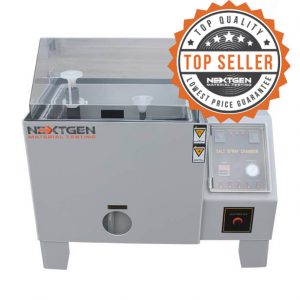
ASTM B117 covers the apparatus, operating procedure, and environmental conditions used to create and maintain a salt spray (fog) environment for corrosion exposure testing. It is widely cited when metals and coated metals need to be compared in a controlled chamber rather than by open-air field exposure alone.
Because ASTM B117 is a practice for running the chamber, not a universal pass/fail product specification, equipment selection often depends on specimen size, chamber capacity, control features, and the companion acceptance criteria tied to the material or coating being tested. Contact Us if you need help matching an ASTM B117 workflow to the right corrosion test setup.
ASTM B117: Standard Practice for Operating Salt Spray (Fog) Apparatus
ASTM B117 is a standard practice used to establish and maintain a controlled salt spray chamber environment. It is one of the most widely referenced corrosion exposure standards for metals and coated metals, especially when a specification calls for neutral salt fog exposure under consistent laboratory conditions.
The standard is focused on the chamber environment itself. It does not, by itself, define the correct specimen type for every product, the exposure duration for every application, or the acceptance criteria that determine whether a part passes or fails.
Quick Definition
At a glance, ASTM B117 is the operating framework behind many salt spray corrosion test programs.
| Topic | ASTM B117 |
|---|---|
| Document type | Standard practice |
| Primary focus | Operating a salt spray (fog) apparatus and maintaining the exposure environment |
| Typical use | Controlled corrosion exposure for metals and coated metals |
| Not defined by B117 alone | Product-specific specimen selection, exposure duration, and pass/fail interpretation |
What This Standard Covers
ASTM B117 covers the apparatus, procedure, and operating conditions required to create and maintain the salt spray test environment. In practical terms, it is the chamber-operation standard behind many corrosion exposure requirements used for coated panels, plated parts, and other finished metal components.
Common controls addressed by the practice: preparation of the salt solution, air supply and atomization, chamber temperature control, specimen positioning during exposure, fog collection checks, and post-exposure handling before evaluation.
Important limit: ASTM B117 does not tell every user how long to run the exposure or how to judge the final result for every product. Those points are usually set by a coating specification, product standard, customer requirement, or companion evaluation method.
Why This Standard Matters in Testing
ASTM B117 matters because it gives labs and manufacturers a consistent way to generate a corrosive chamber environment for comparative testing. When the chamber conditions are controlled correctly, teams can use the exposure to compare finishes, pretreatments, substrates, or coating systems under a repeatable laboratory workflow.
It is also important to use ASTM B117 for what it is designed to do. Salt spray results are often useful for relative comparison, screening, process control, and specification-based qualification, but they are not a direct stand-alone prediction of real-world service life in every outdoor or mixed-environment application.
The quality of the result depends heavily on specimen type, evaluation criteria, and how tightly the chamber variables are controlled. That is why edition matching, specimen loading, monitoring, and reporting details matter when equipment is being selected.
Common Materials, Product Types, or Applications Covered
ASTM B117 is broadly associated with metals and coated metals. It is commonly used where corrosion resistance needs to be compared for bare metal surfaces, plated parts, painted or coated panels, and finished metal components exposed to damp or corrosive service conditions.
Common applications: automotive components, construction and architectural hardware, aerospace-related metal finishes, electronics enclosures and parts, consumer products, and general industrial coated or plated assemblies.
Common purchasing context: a buyer is often not asking for ASTM B117 by itself, but for a product or coating requirement that cites ASTM B117 as the exposure environment behind the corrosion test.
Common Test or Verification Workflow
A typical ASTM B117 workflow starts with a governing specification that identifies the specimens to be tested, how long they must be exposed, and how performance will be judged after exposure. ASTM B117 then provides the chamber environment and operating framework used during that exposure.
-
Prepare the specimens as required by the applicable product, coating, or customer specification.
-
Load the specimens in a salt spray chamber arranged for controlled exposure.
-
Run the chamber under the required salt solution, air, temperature, and fog conditions.
-
Monitor the operating variables throughout the exposure period.
-
Remove, clean, or condition the specimens as required for evaluation.
-
Assess corrosion, coating breakdown, or other appearance changes using the specified acceptance method.
For many painted or coated systems, the exposure standard and the rating standard are separate documents. That distinction is important when planning a lab workflow or specifying equipment.
Equipment Commonly Used for This Standard
ASTM B117 work is most closely associated with a salt spray or corrosion test chamber sized for the specimen load being run. The right setup depends on whether the lab is testing flat panels, mixed hardware, production samples, or larger finished components.
Common equipment: salt spray chambers or corrosion cabinets, solution reservoirs and atomization hardware, compressed-air regulation and conditioning components, chamber temperature controls, specimen racks or supports, fog collection accessories, and instruments used to check solution condition and operating consistency.
Practical selection point: chamber volume, specimen capacity, access for loading, control stability, and monitoring features can matter as much as the base chamber itself when ASTM B117 is part of a qualification or production-release workflow.
If you are comparing chamber sizes, control packages, or specimen-capacity needs for ASTM B117 work, Request a Quote.
How to Read This Designation or Revision
In ASTM formatting, the designation stays with the standard and the year after the hyphen identifies the approval or last revision year for that edition. That means a citation such as ASTM B117-26 points to a specific published edition, and that edition can matter when a contract, coating specification, or customer requirement calls it out directly.
If a standard is revised more than once in the same year, ASTM may add a letter suffix to the year. Some ASTM standards may also show a parenthetical reapproval year, and editorial-only changes can be marked separately without changing the main year designation.
Revision sensitivity: when quoting equipment or planning a compliance workflow, it is best to match the exact cited edition in the governing specification so chamber setup, reporting language, and companion methods stay aligned.
Related Standards, Methods, or Frameworks
ASTM B117 is often used alongside other corrosion or coating standards rather than on its own. The most useful related references depend on whether you are changing the chamber environment or changing the way exposed specimens are evaluated.
-
ASTM D1654: commonly used for evaluating painted or coated specimens after corrosive exposure.
-
ASTM G85: used when a modified salt spray or cyclic environment is needed instead of the basic B117 chamber practice.
-
ASTM B368: used for copper-accelerated acetic acid salt spray testing where a different exposure method is specified.
Talk Through Your ASTM B117 Setup
ASTM B117 projects often come down to chamber volume, rack layout, operating controls, specimen load, and how the governing specification defines exposure time and evaluation. Contact Us to discuss the right ASTM B117 corrosion testing setup for your lab or program.