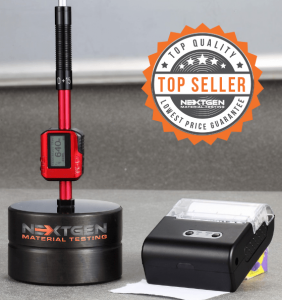
ASTM A956/A956M is the ASTM test method for Leeb hardness testing of steel products. It covers rebound-type hardness checks on steel, cast steel, and cast iron, and it also includes instrument verification and calibration of standardized test blocks.
This standard is commonly used when teams need fast surface hardness information on steel parts and larger components where portable hardness testing is a good fit. Because Leeb hardness is a surface reading, surface condition, part support, and the exact cited edition all matter. If you need help deciding whether this method fits your application, Contact Us.
ASTM A956/A956M Standard Test Method for Leeb Hardness Testing of Steel Products
ASTM A956 is a test method focused on Leeb hardness testing for ferrous products. In recent editions, the designation is commonly cited as ASTM A956/A956M.
The standard stays focused on steel products rather than general hardness testing across all materials. It addresses the Leeb method itself, verification of Leeb hardness testing instruments, and calibration of standardized test blocks used with the method.
Quick Definition
ASTM A956/A956M is a rebound-type hardness test method for steel, cast steel, and cast iron.
Document type: Test method.
Main result: A Leeb hardness reading taken from the tested surface.
Important limitation: The method gives a surface-specific hardness indication and does not describe subsurface condition.
What This Standard Covers
This standard covers three closely related parts of the Leeb hardness workflow for steel products.
Material scope: Steel, cast steel, and cast iron.
Method scope: Determination of Leeb hardness on the test surface.
Verification scope: Verification of Leeb hardness testing instruments.
Calibration scope: Calibration of standardized test blocks used with the method.
Units: Recent A956/A956M editions present SI and inch-pound units separately, and the two systems are intended to be used independently rather than mixed.
Why This Standard Matters in Testing
ASTM A956 matters because it supports fast hardness checks without moving every steel product to a bench hardness tester. It is often used when a portable method is needed for production checks, incoming verification, maintenance work, or surface hardness review on larger steel parts.
The Leeb method is dynamic and rebound-based, so the reading is influenced by the condition of the tested surface and the support of the part being measured. That makes setup, surface preparation, and instrument verification especially important when buyers are selecting equipment or comparing results across locations.
It is also important to treat Leeb hardness as a surface measurement only. A result taken at one location should not be assumed to represent every area of the part.
Common Materials, Product Types, or Applications Covered
The material scope is narrow and clear: this method is written for steel products, cast steel, and cast iron.
- Steel components and fabricated steel products
- Cast steel parts and heavy castings
- Cast iron parts
- Forged or machined steel sections where portable surface hardness checks are useful
- Larger parts or installed components that are not convenient for fixed-location hardness testing
When a project involves nonferrous metals or a different portable hardness principle, another standard or method may be more appropriate.
Common Test or Verification Workflow
A typical ASTM A956 workflow starts with confirming that the product and hardness requirement are suitable for the Leeb method and the cited edition of the standard.
- Prepare the test surface so the reading reflects the metal surface rather than scale, coatings, or contamination.
- Select a compatible Leeb hardness instrument and impact device for the part geometry and access conditions.
- Check or verify instrument performance with the appropriate standardized test block.
- Take readings at the required locations on the steel product.
- Review and report results in the correct designation and unit context for the cited standard edition.
For quoting equipment, the most important practical questions are usually the material type, part size and support condition, surface finish, access to the test area, and whether the customer also needs reference blocks and verification capability.
Equipment Commonly Used for This Standard
ASTM A956 usually points to portable Leeb hardness testing equipment rather than a fixed bench hardness machine.
Common equipment: Portable Leeb hardness testers, compatible impact devices, electronic display or data unit, and standardized Leeb test blocks.
Common accessories: Surface preparation tools, cleaning tools, support or coupling aids when needed, and carrying cases for field or plant use.
Buying caution: Equipment should be matched to the steel product, part geometry, and verification needs, not just to a generic hardness range.
If you are selecting a portable Leeb system, reference blocks, or a complete configuration for steel products, Request a Quote.
How to Read This Designation or Revision
ASTM citations for this method can appear in more than one format, so it helps to read the designation carefully.
ASTM A956: Older editions may appear in this format.
ASTM A956/A956M: Recent editions use a dual designation that covers inch-pound and SI versions in one standard.
Year suffix: A suffix such as -22 identifies the revision year of the cited edition.
Legacy title note: Older references may also use the earlier Equotip-based title for this method.
When a purchase order, customer drawing, or internal procedure cites a specific edition, the equipment setup and reporting approach should match that exact reference.
Related Standards, Methods, or Frameworks
ASTM A956 is often used alongside other hardness references, depending on how results are reported or what portable method is preferred.
ASTM E140: Commonly referenced when hardness values are converted among Leeb and other hardness scales, with the usual caution that conversions are approximate and material-dependent.
ASTM A1038: Another portable hardness standard, but for the ultrasonic contact impedance method rather than the Leeb rebound method.
These related documents do not replace ASTM A956. They are typically used when a project needs conversion guidance or an alternate portable hardness approach.
Get Help With ASTM A956 Equipment Options
If you need a portable Leeb hardness tester, standardized test blocks, or help matching an ASTM A956 setup to your steel product, application, or reporting requirement, Request a Quote.