Metallographic sample preparation plays a key role in material analysis, as it provides assurance that specimens are properly encapsulated for microstructural analysis to be accurate. The quality of this process directly impacts metallographic testing reliability, affecting research outcomes, industrial quality control, and failure analysis. Without precise mounting, inconsistencies in specimen handling can lead to inaccurate results, which may impact further polishing, grinding, and microscopic examination.
Knowing the importance of high-quality sample mounting, we at NextGen Material Testing, are committed to providing state-of-the-art mounting systems for precision, efficiency, and reliability. This article presents 3 of our most popular fully automatic metallographic mounting presses, each engineered to meet modern laboratories’ needs. Whether you are looking for a dual hydraulic mounting system for high-throughput applications, a motorized press for silent operation, or a cost-effective single hydraulic model, our GenPress MFA Series offers a highly efficient solution for all metallographic sample preparation requirements.
Here, you will find a detailed examination of what a metallographic mounting press is, how it assists in sample preparation processes, and a comparison of our advanced hot compression mounting systems to assist you in selecting the most appropriate system for your lab.
What is a Metallographic Mounting Press?
A metallographic mounting press is a specialized laboratory device used to encapsulate material samples in a hardened resin for easier handling, improved edge retention, and reliable microstructural analysis. This process, known as sample mounting, is a necessary step in metallographic preparation, guaranteeing that specimens remain intact during grinding, polishing, and microscopic evaluation.
Purpose and Function
Metallographic mounting presses protect fragile or irregularly shaped specimens from damage while maintaining structural integrity. Encapsulation prevents material loss, increases durability, and allows for consistent sample preparation for high-precision metallographic analysis. The process also improves edge retention, which is particularly important when examining fine details under a microscope.
Hot vs. Cold Mounting
There are 2 main mounting methods:
-
Hot mounting involves placing the specimen in a thermosetting resin mold. The press applies heat and pressure, curing the resin into a hardened structure. This method is fast, durable, and widely used for routine metallographic analyses.
-
Cold mounting is performed at room temperature using liquid resins, which cure over time without heat. It is preferred for heat-sensitive materials, delicate samples, and porous specimens that require vacuum impregnation for complete resin penetration.
Key Measurements and Operating Parameters
Metallographic mounting presses can handle different sample sizes, with mold diameters typically ranging from 1 to 2 inches (25 to 50 mm). Hot mounting systems heat at temperatures up to 200°C, while applied pressure can reach up to 250 bar, depending on the material and resin type.
NextGen’s Fully Automatic Metallographic Mounting Presses
Modern laboratories require highly efficient, automated solutions for metallographic sample preparation, which provide accuracy, repeatability, and ease of use. NextGen Material Testing, Inc. offers a range of fully automatic metallographic mounting presses whose purpose is to simplify the hot compression mounting process. These advanced systems feature programmable controls, hydraulic or motorized pressure applications, and integrated cooling systems, allowing laboratories to optimize workflow while maintaining high-quality sample preparation standards.
Each model in the GenPress MFA Series is designed for specific laboratory needs, providing different levels of automation, pressure control, and sample capacity. Below, we introduce our 3 top-performing models, starting with the GenPress MFA Dual HYD—a high-capacity, fully automatic dual hydraulic mounting press.
GenPress MFA Dual HYD – Fully Automatic Dual Hydraulic Mounting Press
The GenPress MFA Dual HYD is a fully automatic dual hydraulic mounting press, engineered for laboratories with high-volume, high-precision sample preparation. With its dual hydraulic system, this model can process up to 4 samples per cycle, making it one of the most efficient and powerful options in the GenPress series.
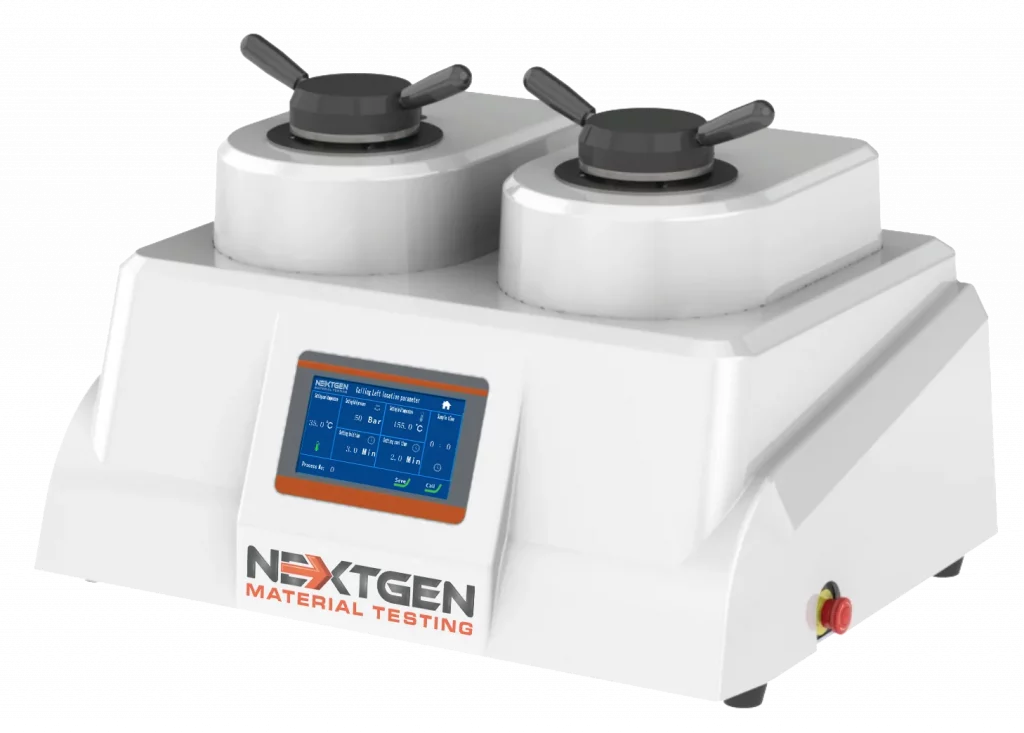 This state-of-the-art mounting press features a 7-inch touchscreen controller, allowing operators to set and store up to 100 mounting programs for quick, repeatable processes. The system automatically regulates heating, pressure, and cooling, resulting in uniform sample preparation with minimal operator involvement.
Key Features of the GenPress MFA Dual HYD
-
Dual Hydraulic Compression System – Provides consistent and uniform pressure distribution for optimal sample integrity.
-
Multi-Sample Capacity – Allows processing of up to 4 mounted specimens per cycle, increasing laboratory efficiency.
-
Integrated Cooling System – Accelerates cooling times, reducing overall cycle duration.
-
Fully Programmable Settings – Operators can adjust pressure (0-60 Bar), temperature (up to 200°C), and cycle time (up to 99 minutes) through a user-friendly touchscreen interface.
-
Durable Construction – Built with a high-quality ABS shell for easy maintenance and long-term reliability.
-
Versatile Mold Sizes – Supports a variety of specimen sizes, including 1”, 1.25″, 1.5″, 1.75”, 2″, and metric equivalents (25mm, 30mm, 40mm, 50mm).
GenPress MFA MOT – Fully Automatic Motorized Mounting Press
The GenPress MFA MOT is a fully automatic motorized mounting press, designed for laboratories that prioritize precision, quiet operation, and energy efficiency. Unlike the dual hydraulic model, this system uses a motorized compression mechanism, allowing for consistent pressure application with minimal noise. It is an excellent choice for smaller laboratories or environments where hydraulic systems may not be ideal.
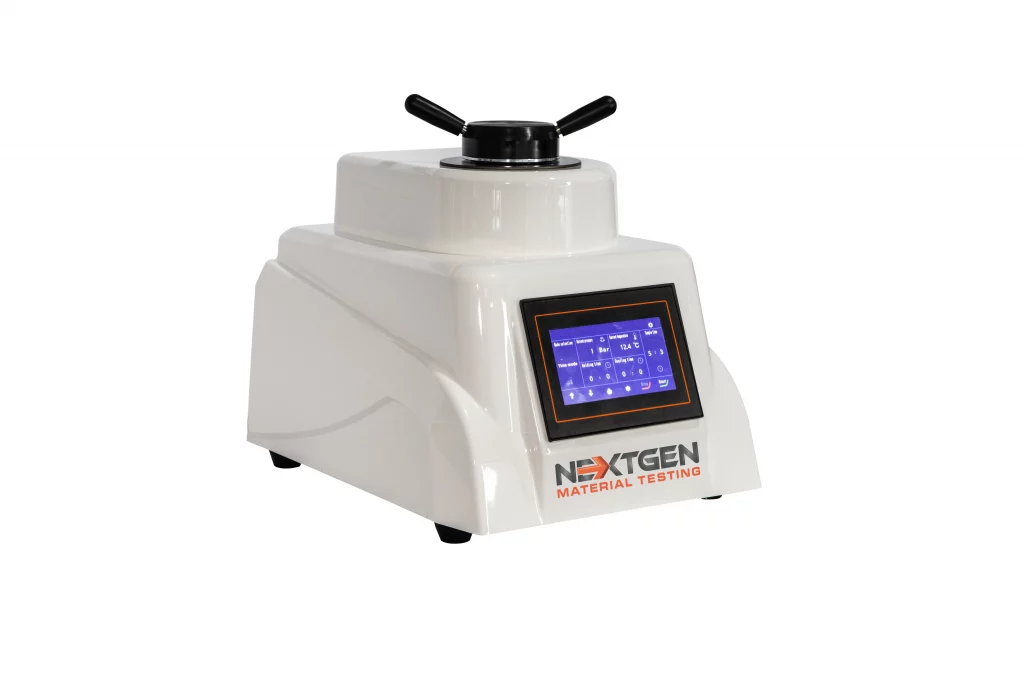
Equipped with a 7-inch touchscreen controller, the GenPress MFA MOT allows users to program and store up to 100 mounting cycles, adjusting temperature, pressure, and cycle time based on specific specimen requirements. This model supports up to 2 samples per cycle, thus offering a convenient and cost-effective method for preparing routine samples.
Key Features of the GenPress MFA MOT
-
Motorized Compression System – Assures consistent and precise pressure application, reducing mechanical wear and noise.
-
User-Friendly Automation – The fully automatic system allows operators to focus on other tasks while the mounting process runs independently.
-
Integrated Cooling System – Reduces cycle time by accelerating sample cooling, thus increasing overall productivity.
-
Customizable Mounting Parameters – Operators can set and store temperature (up to 200°C), pressure (0-60 Bar), and time (up to 99 minutes) through an intuitive touchscreen interface.
-
Compact & Energy-Efficient – With a total power consumption of just 2.2KW, this model is ideal for labs looking for a low-energy alternative to hydraulic presses.
-
Supports Various Mold Sizes – Accommodates 1”, 1.25″, 1.5″, 1.75”, 2”, and metric sizes (25mm, 30mm, 40mm, 50mm).
GenPress MFA HYD – Fully Automatic Hydraulic Mounting Press
The GenPress MFA HYD is a fully automatic hydraulic mounting press that combines precision, durability, and ease of use for metallographic sample preparation. Assembled with a hydraulic compression system, this model provides reliable pressure applications while maintaining a compact, space-saving footprint.
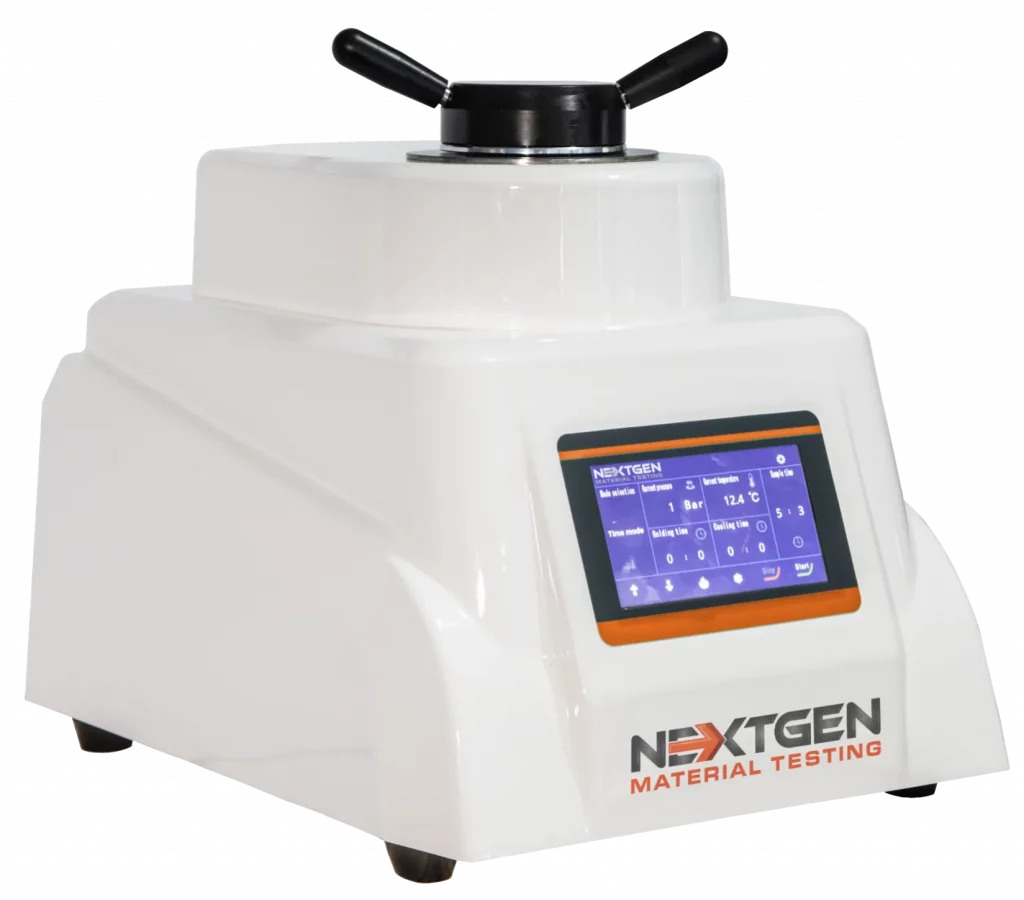
This system supports up to 2 specimens per cycle. With a 7-inch touchscreen controller, users can store up to 100 mounting programs, facilitating quick adjustments and optimizing workflow.
Key Features of the GenPress MFA HYD
-
Hydraulic Compression System – Delivers stable, consistent pressure, providing uniform mounting results.
-
Fully Programmable Control Panel – Adjust pressure (0-60 Bar), temperature (up to 200°C), and cycle duration (up to 99 minutes) for customizable sample preparation.
-
Water Cooling Integration – Reduces total cycle time, optimizing efficiency for high-throughput laboratories.
-
Versatile Sample Compatibility – Standard Ø40mm mold size, with additional options for Ø22mm, Ø25mm, Ø30mm, Ø45mm, and Ø50mm.
-
Compact and Durable Design – Smaller than the dual hydraulic model, making it ideal for space-constrained environments.
-
Energy-Efficient Performance – Lower total power consumption (2.2KW) than larger models, helping labs optimize energy use.
Below, we compare the GenPress MFA Dual HYD, GenPress MFA MOT, and GenPress MFA HYD, highlighting who benefits the most from each and which applications they serve best.
GenPress MFA Dual HYD – Best for High-Volume Laboratories & Industrial Quality Control
The GenPress MFA Dual HYD is the most powerful and high-capacity model, featuring a dual hydraulic compression system that allows for up to 4 samples per cycle. With high heating power (4KW) and an advanced cooling system, this press is ideal for labs requiring fast, efficient, and high-throughput sample preparation.
Who Will Benefit Most?
-
Industrial quality control facilities that need consistent, large-scale sample processing.
-
High-throughput metallurgical research laboratories work with multiple specimens per batch.
-
Aerospace, automotive, and metal manufacturing industries, where speed and repeatability are critical.
Best Applications:
-
Mass production and sample preparation for steel, aluminum, and composite materials.
-
Failure analysis and metallurgical research that requires handling multiple specimens at once.
-
Process optimization for large-scale industrial material testing.
GenPress MFA MOT – Best for Precision Labs & Silent Operation Needs
The GenPress MFA MOT is motorized, making it quieter and more energy-efficient than hydraulic models. With a capacity of up to 2 samples per cycle, it is well-suited to labs that require precision but not high-volume processing. Its compact design and low power consumption (2.2KW) make it the perfect choice for smaller facilities or those prioritizing energy efficiency.
Who Will Benefit Most?
-
Educational and research institutions focus on individual specimen preparation.
-
Laboratories with noise-sensitive environments, such as medical material testing or precision optics research.
-
Small to mid-sized metallographic labs that need cost-effective, automated sample mounting without hydraulic systems.
Best Applications:
-
Fine-detail sample preparation for ceramics, polymers, and specialized alloys.
-
Forensic and failure analysis labs where silent operation and controlled processing are crucial.
-
Research studies require minimal mechanical wear and vibration impact on delicate specimens.
GenPress MFA HYD – Best for Cost-Conscious Labs & General Metallographic Testing
The GenPress MFA HYD is a cost-effective, fully automatic hydraulic mounting press, that balances precision, durability, and affordability. While it does not have the dual hydraulic power of the Dual HYD model, it still provides reliable pressure control, making it a great all-purpose metallographic mounting system.
Who Will Benefit Most?
-
Laboratories need a reliable, budget-friendly automatic mounting press.
-
General metallographic testing labs that require reproducible sample preparation but no mass production capabilities.
-
Quality control facilities test a variety of materials but with lower sample volume needs.
Best Applications:
-
Routine metallographic sample preparation for metals, ceramics, and composite materials.
-
Standardized industrial material testing where two-sample cycles are sufficient.
-
Laboratories that require an easy-to-use, low-maintenance mounting press without excessive power consumption.
Final Thoughts: Selecting the Ideal Metallographic Mounting Press
Choosing the right metallographic mounting press is key to high-quality sample preparation in research, quality control, and industrial applications. The GenPress MFA Series offers 3 advanced solutions, each customized to meet specific laboratory needs.
-
The GenPress MFA Dual HYD is the best choice for high-volume labs needing rapid multi-sample processing with a dual hydraulic system.
-
The GenPress MFA MOT is ideal for small, precision-focused laboratories that require quiet, motorized compression with energy-efficient operation.
-
The GenPress MFA HYD is a cost-effective, fully automatic hydraulic press, which makes it an all-purpose solution for standard metallographic sample preparation.
If you require additional information about any of our metallographic mounting presses or need assistance selecting the right equipment, we are here to help with all your material testing needs. Contact us directly or request an online quote today, and we will guide you in making the right choice for your laboratory.
Keep Reading in Mounting Press System for Metallography
See the Mounting Press System for Metallography range Flexural (Bend) Testing Explained: 3-Point vs 4-Point, Standards, and SetupFlexural (bend) testing explained: what it measures, three-point vs four-point setups, the standards for plastics, metals, composites and concrete, and how to choose the right fixtures and...Read the articleGenTest Software Setup Guide for NextGen NG-EML Universal Testing MachinesGenTest setup affects the full UTM testing workflow: method storage, PC-to-controller communication, user permissions, simulation files, live data acquisition, and report output. This guide follows the GenTest setup video step by step for NextGen NG-EML electromechanical universal testing machines. It covers installation, license activation, workspace configuration, UTM controller connection, safety and peripheral setup, user management, DEMO Mode, simulation files, Control Panel setup, Quick Test, and test method creation. GenTest is the software layer where the test method, machine connection, operator input, live data, calculated results, and report output come together. For operators, service teams, QA/QC labs, and R&D users, the goal is to...Read the articleMetallography Sample Preparation Equipment: How to Improve Accuracy from Cutting to Final AnalysisAccurate metallographic analysis starts before the specimen reaches the microscope. Cutting, mounting, grinding, and polishing all influence whether the final surface reflects the material’s true structure or carries preparation-related damage. Excess heat, weak edge support, inconsistent pressure, poor abrasive progression, and unstable polishing conditions can all introduce artifacts that affect interpretation. Well-matched metallography sample preparation equipment helps control these risks across the full workflow. By improving sectioning control, mounting stability, and grinding and polishing repeatability, labs can produce more consistent specimens and reduce the chance that preparation defects are mistaken for real material features. Why...Read the articleBrinell, Rockwell, Vickers, or Microhardness: Which Test Makes Sense for Your Application?Choosing a hardness test starts with the part itself. Material type, section thickness, geometry, surface condition, inspection purpose, and required testing speed all affect which method will produce a reliable result. Brinell, Rockwell, Vickers, and microhardness methods work differently, so they are not equally suitable for the same component or the same quality task. Brinell, Vickers, and Knoop are based on the size of an indentation, while Rockwell is based on indentation depth. That difference directly affects how the result is obtained and where the method fits best. In production and lab work, problems usually appear when the test method does not fit the application. A part may be too thin for the selected load, the surface may be too rough...Read the article
Machines Behind This Article
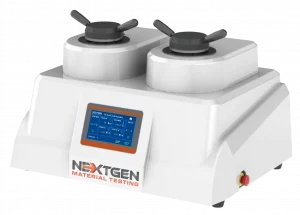 Mounting Press System for MetallographyGenPress MFA Dual HYD – Fully Automatic Dual Hydraulic Mounting PressGenPress MFA Dual HYD is a fully automatic dual hydraulic mounting press for higher-throughput metallographic sample mounting. It can produce up to four samples per...View product
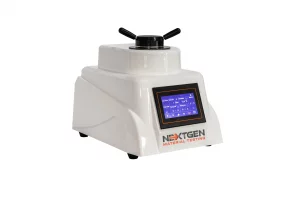 Mounting Press System for MetallographyGenPress MFA MOT – Fully Automatic Motorized Mounting PressGenPress MFA MOT is a fully automatic motorized mounting press for compression mounting of metallographic samples before grinding, polishing, and microscopic...View product
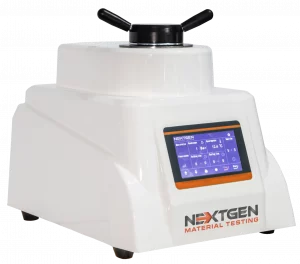 Mounting Press System for MetallographyGenPress MFA HYD – Fully Automatic Hydraulic Mounting PressGenPress MFA HYD is a fully automatic hydraulic mounting press for preparing metallographic samples before grinding, polishing, and microscopic inspection. It...View product
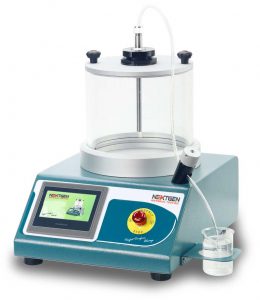 Mounting Press System for MetallographyGenVac MP3 Series – Vacuum Impregnation System for Epoxy MountingGenVac MP3 is an intelligent vacuum impregnation system for epoxy mounting of porous metallographic specimens. It supports up to 99 degassing cycles, eight stored...View product
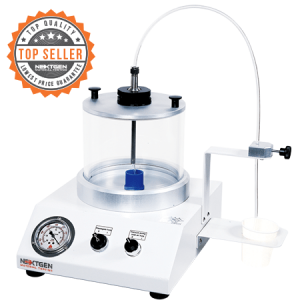 Mounting Press System for MetallographyGenVac MP Series – Vacuum Impregnation System for Epoxy MountingGenVac MP Series is a vacuum impregnation system for epoxy cold mounting of porous metallographic specimens. Designed for rocks, minerals, ceramics, circuit boards,...View product
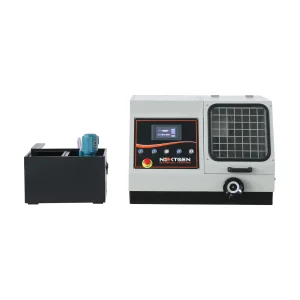 Precision Metallographic CuttingGenCut GL350 – Metallographic Cutting MachineGenCut GL350 is a precision metallographic sample cutting machine for larger laboratory and industrial specimens. With automatic and manual work modes, a maximum...View product
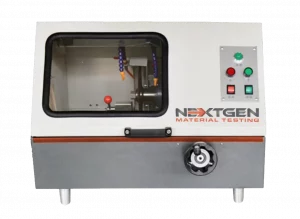 Precision Metallographic CuttingGenCut GL100M – Manual Metallographic Cutting MachineGenCut GL100M is a precision manual metallographic sample cutting machine for clean, controlled preparation of metal specimens. It supports cutting sections up to...View product
 Precision Metallographic CuttingGenCut GL80A – Precision Metallographic Cutting MachineGenCut GL80A is a precision metallographic sample cutting machine for preparing metal specimens with a cutting capacity up to Φ80 mm. Designed for simple,...View product
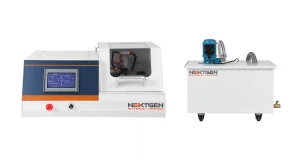 Precision Metallographic CuttingGenCut GL200E – High-Speed Precision Metallographic CutterGenCut GL200E is a high-speed automatic precision metallographic cutter for accurate sectioning of metals, ceramics, biological specimens, and other materials up to...View product
 Precision Metallographic CuttingGenCut GL100E – Low-Speed Precision Metallographic CutterGenCut GL100E is a low-speed automatic precision cutter for metallographic preparation of small and delicate specimens. Designed for metals, composites, ceramics,...View product
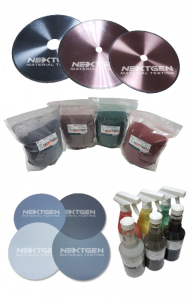 Mounting Press System for MetallographyMetallography ConsumablesMetallography consumables cover the materials needed for sectioning, mounting, grinding, polishing, etching, and cleaning specimens before microscopic examination....View product