
Choosing a hardness test starts with the part itself. Material type, section thickness, geometry, surface condition, inspection purpose, and required testing speed all affect which method will produce a reliable result. Brinell, Rockwell, Vickers, and microhardness methods work differently, so they are not equally suitable for the same component or the same quality task. Brinell, Vickers, and Knoop are based on the size of an indentation, while Rockwell is based on indentation depth. That difference directly affects how the result is obtained and where the method fits best.
In production and lab work, problems usually appear when the test method does not fit the application. A part may be too thin for the selected load, the surface may be too rough for accurate optical reading, or the job may require a hardness profile across a case or weld zone rather than a single value. In those cases, the problem is usually method fit rather than the tester itself.
This is why ASTM and ISO standards matter in routine testing. They define the method, the limits, and the conditions needed for results that can be repeated, compared, and accepted across labs, operators, and suppliers. In North America, the main references are ASTM E10 for Brinell, ASTM E18 for Rockwell, ASTM E92 for Vickers and Knoop, and ASTM E384 for microindentation. International work often also refers to ISO 6506, ISO 6508, ISO 6507, ISO 4545, and ISO 2639.
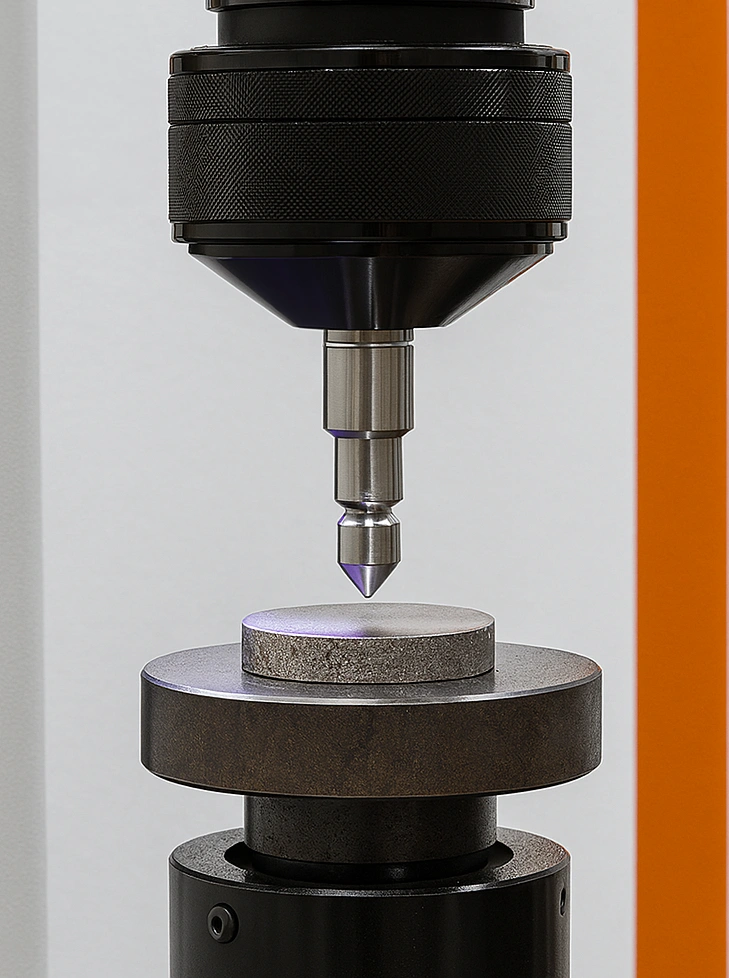
What Determines The Right Test
Hardness method selection usually becomes easier once the part and the testing objective are clearly defined. In most cases, the method is narrowed down by five factors: the material itself, the part’s size and thickness, the condition of the surface, the purpose of the test, and the pace of the workflow. Those factors matter because each method responds differently to structure, section size, indentation footprint, and measurement technique.
Material And Microstructure
Material structure changes what the indentation actually represents. On coarse or non-uniform materials, a larger impression can be an advantage because it averages over more of the structure instead of reflecting only a very small local area. That is one reason Brinell is widely used for castings, forgings, and other sections where the material is not perfectly uniform from point to point.
At the other end of the scale, localized methods are more useful when the question is tied to a very small region. Knoop is especially useful for thin layers, brittle materials, and situations where a shallower indentation helps reduce the influence of the substrate. Its elongated impression is also easier to read in certain thin-section applications and hardness traverses.
Part Geometry And Thickness
Part size and section thickness put hard limits on what can be tested reliably. If the indentation reaches too deeply relative to the section, the reading can be distorted by the support condition or by the opposite side of the part. That is why thickness rules are built into everyday method selection. For Rockwell, practical guidance commonly calls for minimum specimen thickness of about 10 times the indentation depth for diamond penetrators and 15 times the indentation depth for ball penetrators.
Vickers has its own geometry rule. A common practical guideline is to keep specimen thickness at no less than 1.5 times the diagonal length of the indentation. Brinell requires even more physical room because the impression is much larger. A widely used rule is around 8 times the indentation depth, and many shops use an even more conservative margin closer to 10 times depth when the setup or material is less forgiving.
These limits matter in real work. Thin sections, small finished parts, narrow lands, gear teeth, case-hardened zones, and fine weld regions often eliminate one method before speed or convenience is even considered.
Surface Condition And Preparation
Surface condition affects all hardness methods, but not to the same degree. Rockwell is generally less dependent on optical edge reading because it is based on penetration depth. Brinell, Vickers, and Knoop depend on measuring the indentation itself, so surface finish has a more direct effect on accuracy. If the edge of the impression is difficult to see, the result becomes harder to trust.
That becomes more important as the indentation gets smaller. Vickers and microhardness work demand cleaner preparation because the impression is smaller and the reading is more sensitive to polish quality, contrast, and local surface damage. In microhardness work, even slight roughness can distort the measurement enough to affect the conclusion, especially in thin coatings, hardness gradients, and metallographic sections.
Test Purpose
The correct method also depends on what the result is meant to support. For routine incoming inspection or production checks, Rockwell is often the fastest choice because it gives a direct reading and fits high-throughput workflows well. For large sections and bulk hardness evaluation on heavier components, Brinell is often a better fit. Vickers is useful in lab environments that handle a wider range of materials or need a smaller indentation than Brinell. Microindentation methods are used when the question is tied to a specific zone, such as case depth, weld heat-affected areas, coatings, or hardness gradients through a section.
This is where many selection problems start. A method that works well for bulk acceptance testing may not be suitable for a hardness traverse. A method that works well for a polished cross-section may be too slow for routine floor inspection. The testing objective has to be defined before the method is selected.
Throughput And Workflow
Testing speed matters when hardness is part of a production routine rather than a one-off lab check. Rockwell remains popular in that role because it is fast, direct, and relatively simple to run. The operator does not need to measure the residual indentation optically, which helps reduce handling time and makes the method efficient for repeated checks.
Optical methods can still fit efficient workflows, especially when the system includes CCD imaging, software-based reading, and automated reporting. Those features help reduce operator subjectivity and improve repeatability in Brinell, Vickers, and microhardness work, where visual interpretation of the indent has a larger influence on the final value. In lab settings or mixed-application environments, that kind of automation can make a major difference in both speed and consistency.
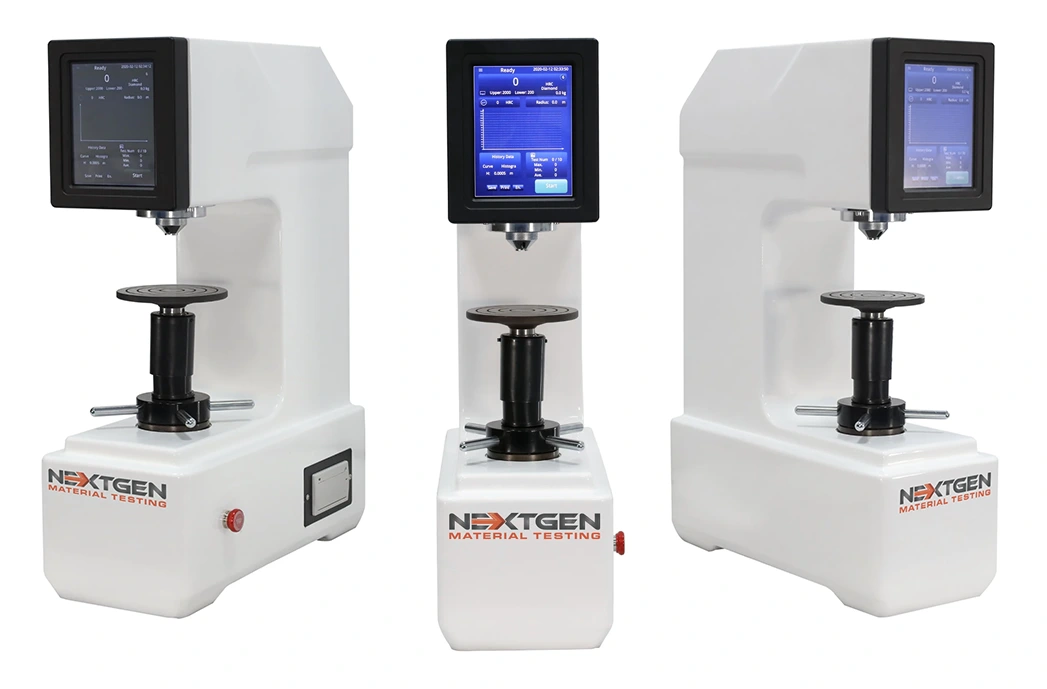
Quick Comparison Of Brinell, Rockwell, Vickers, And Microhardness
The table below is meant to answer the first screening question: which method is generally aligned with the part, the material, and the type of decision you need to make. It does not replace the method-specific requirements in ASTM or ISO standards, but it gives a practical starting point using the correct test logic and terminology.
| Criteria | Brinell | Rockwell | Vickers | Microhardness |
|---|---|---|---|---|
| Basic Principle | Hardness is determined from the mean diameter of the residual indentation after applying a specified force for a specified dwell time. | Hardness is determined from the permanent depth of penetration under a minor load followed by a major load. | Hardness is determined from the mean length of the two diagonals of a square-based pyramid indentation. | Hardness is determined from a small-scale optical indentation, typically using Vickers or Knoop, to evaluate localized hardness in very small regions. |
| Indenter | Tungsten carbide ball; common ball diameters include 1, 2.5, 5, and 10 mm. | Diamond cone for diamond scales and ball indenter for ball scales; regular and superficial scales are standardized. | Diamond pyramid with an angle of 136° between opposite faces. | Diamond pyramid (Micro Vickers) or Knoop indenter with elongated geometry for shallow penetration and thin-layer work. |
| Typical Force / Load Level | Common industrial Brinell forces range from lower-force setups up to 3000 kgf, depending on ball size and application. | Method depends on scale; regular Rockwell commonly uses total test forces such as 60, 100, or 150 kgf, with superficial scales used for lighter-force applications. | Broad usable range from low-force testing into macro ranges, commonly spanning from gram-force levels up to tens of kilograms-force, depending on the standard and application. | Typically low-force microindentation, commonly in the gram-force range, often from 1 gf to 1000 gf depending on method and application. |
| Best Suited For | Large parts, castings, forgings, thicker sections, and materials with coarser or more heterogeneous structure where a larger impression gives a more representative bulk reading. | Routine QC, incoming inspection, production-floor testing, repeated checks on common metal parts, and workflows where speed and direct readout are important. | A wide range of materials, smaller parts, finished components, lab work, and applications needing a smaller indentation than Brinell with broader flexibility than many single-scale methods. | Case depth, coatings, thin sections, welds and HAZ, hardness traverses, metallography, microstructural zones, and localized property evaluation. |
| Less Suited For | Thin sections, small finished parts, narrow features, localized hardness mapping, and parts where a large indentation is unacceptable. | Thin layers, hardness gradients, very small features, metallographic sections, and applications where a single bulk reading does not answer the question. | Very rough production surfaces, cases where fast high-volume direct-read testing is the main priority, and situations where optical reading discipline cannot be maintained. | Routine floor inspection where a single fast bulk value is enough, rough surfaces, and applications where specimen preparation time is not justified. |
| Surface Prep Sensitivity | Moderate to high. Surface condition matters because the indentation diameter must be read clearly, though Brinell is generally more forgiving than microindentation on polished sections. | Low to moderate relative to optical methods, because the result is depth-based rather than based on visual measurement of the indentation. Proper support and surface condition still matter. | High. Edge definition and surface finish directly affect diagonal measurement. | Very high. Even slight roughness or poor polish can affect measurement, especially at low loads and small indentation sizes. |
| Speed / Throughput | Moderate. Slower than direct-read Rockwell because the indentation must be measured, but suitable for routine heavy-section testing. | High. Commonly the fastest method for repeated production testing. | Moderate to low in manual workflows; can improve significantly with image analysis and software-assisted reading. | Low to moderate manually; improves with automated stage movement, autofocus, imaging, and software measurement. |
| Typical Applications | Foundry work, forgings, heavy steel components, bulk hardness checks on structurally non-uniform materials. | Production inspection, acceptance testing, general metal parts, heat-treated components where a rapid bulk reading is needed. | General lab testing, broader cross-material comparison, smaller components, applications needing a controlled optical indentation method. | Case-hardened parts, thin coatings, weld cross-sections, microstructural analysis, failure analysis, metallographic laboratories. |
A few points are worth keeping in mind while reading the table. Brinell, Vickers, and Knoop are all optical indentation methods, so edge clarity and surface condition directly affect the reading. Rockwell is different because it is based on penetration depth, which is one reason it is widely used in fast production inspection. In practice, microhardness usually means low-force Vickers or Knoop testing used for localized evaluation.
From a standards perspective, the main North American references are ASTM E10 for Brinell, ASTM E18 for Rockwell, ASTM E92 for Vickers and Knoop, and ASTM E384 for microindentation hardness. In international work, the corresponding ISO references commonly include ISO 6506 for Brinell, ISO 6508 for Rockwell, ISO 6507 for Vickers, ISO 4545 for Knoop, and ISO 2639 where effective case depth is part of the discussion.
A Closer Look At Where Each Method Fits
A quick comparison table is useful for screening, but method selection becomes much clearer once each option is viewed in application terms. The main differences come down to indentation size, section thickness, surface condition, measurement method, and the type of result the job actually requires. The four methods below cover very different testing situations, so each one needs to be judged by fit rather than familiarity.
Brinell Hardness Testing
Brinell is a practical choice for larger parts, thicker sections, castings, forgings, and materials with a coarse or non-uniform structure. It uses a tungsten carbide ball, and hardness is determined from the measured diameter of the residual indentation. Because the impression is relatively large, the reading reflects a broader area of material than smaller-scale methods. Common Brinell ball diameters include 1, 2.5, 5, and 10 mm, with industrial test forces reaching 3000 kgf depending on the scale and application. In our lineup, the BrinGen 3000M covers forces from 62.5 to 3000 kgf and a stated range of 8 to 650 HBW.
Its limitations are mostly geometric. The indentation is large enough that thin sections, small finished parts, and localized testing points can become poor candidates very quickly. Practical setup rules matter here. Brinell work commonly follows a specimen thickness rule around 8 times indentation depth, with many shops using a more conservative margin closer to 10 times depth. Spacing matters as well. Adjacent indents are commonly kept at least 3 times the indentation diameter apart, with edge distance around 2.5 times the diameter. Those requirements are not minor details. They are one of the main reasons Brinell works well on larger components and poorly on cramped test areas.
Rockwell Hardness Testing
Rockwell is often the most efficient option for routine production checks and incoming inspection. Instead of measuring the size of an indent optically, it determines hardness from indentation depth under a minor load followed by a major load. It is fast, straightforward, and well suited to repeated testing when the goal is a bulk hardness value rather than a detailed profile. Regular and superficial scales are both standardized, and common regular-force testing often falls within the 60, 100, and 150 kgf range, with superficial testing used when lower-force conditions are needed.
The method works best when the part has enough thickness, stable support, and a geometry that allows proper seating. Thin sections, unsupported parts, curved surfaces without proper fixturing, and applications that need hardness variation across a case or weld are weaker fits. Thickness is the most common screening issue. Practical guidance often calls for minimum specimen thickness of about 10 times indentation depth for diamond penetrators and 15 times indentation depth for ball penetrators. Rockwell is more tolerant of surface condition than optical methods, but it still depends on controlled testing practice, especially when tolerances are tight.
Vickers Hardness Testing
Vickers is often selected when a smaller indentation is needed without giving up broad applicability across different metallic materials. It uses a diamond pyramid with a 136° angle between opposite faces, and hardness is determined from the mean of the two indentation diagonals. That geometry gives Vickers a smaller footprint and broad applicability across many metallic materials. Depending on the application and standard, Vickers can be used across a wide force range, from low-force work into macro testing.
That flexibility comes with tighter demands on preparation and measurement discipline. Since the result depends on reading the diagonals accurately, surface finish, indentation clarity, and perpendicular alignment all matter. A rough or poorly prepared surface can reduce confidence in the reading long before the test itself becomes the issue. Geometry still matters as well. A common practical rule is to keep specimen thickness at no less than 1.5 times the diagonal length. Vickers is a strong option when the test area is smaller than Brinell would allow and when more control is needed than a fast Rockwell check can provide.
Microhardness Testing
Microhardness is used when a single bulk reading is not enough. Typical applications include case depth work, coatings, weld heat-affected zones, microstructural features, thin sections, and small localized regions where hardness has to be measured over a short distance. In practice, this usually means low-force Vickers or Knoop testing. ASTM terminology often refers to this as microindentation hardness. The useful distinction is that the method is chosen for very small, shallow impressions and for the ability to resolve gradients that larger methods cannot capture.
Knoop is especially useful when shallow penetration matters. Its elongated indentation geometry gives a long measurable diagonal with less depth than an equivalent Vickers impression, which is why it is frequently used for thin layers, brittle materials, coatings, and close-interval traverses. Microhardness work is also the most preparation-sensitive part of the hardness testing family. Polish quality, perpendicularity, focus, and measurement consistency directly affect the result. Even slight roughness can distort low-force readings. This is also where spacing rules and traverse planning become critical, since the impressions are small but still cannot be placed so closely that deformation fields interfere with each other. When the job involves case depth, hardness gradients, or metallographic correlation, microhardness is usually the right path. When the job only needs a fast acceptance value, it is often more than the application requires.
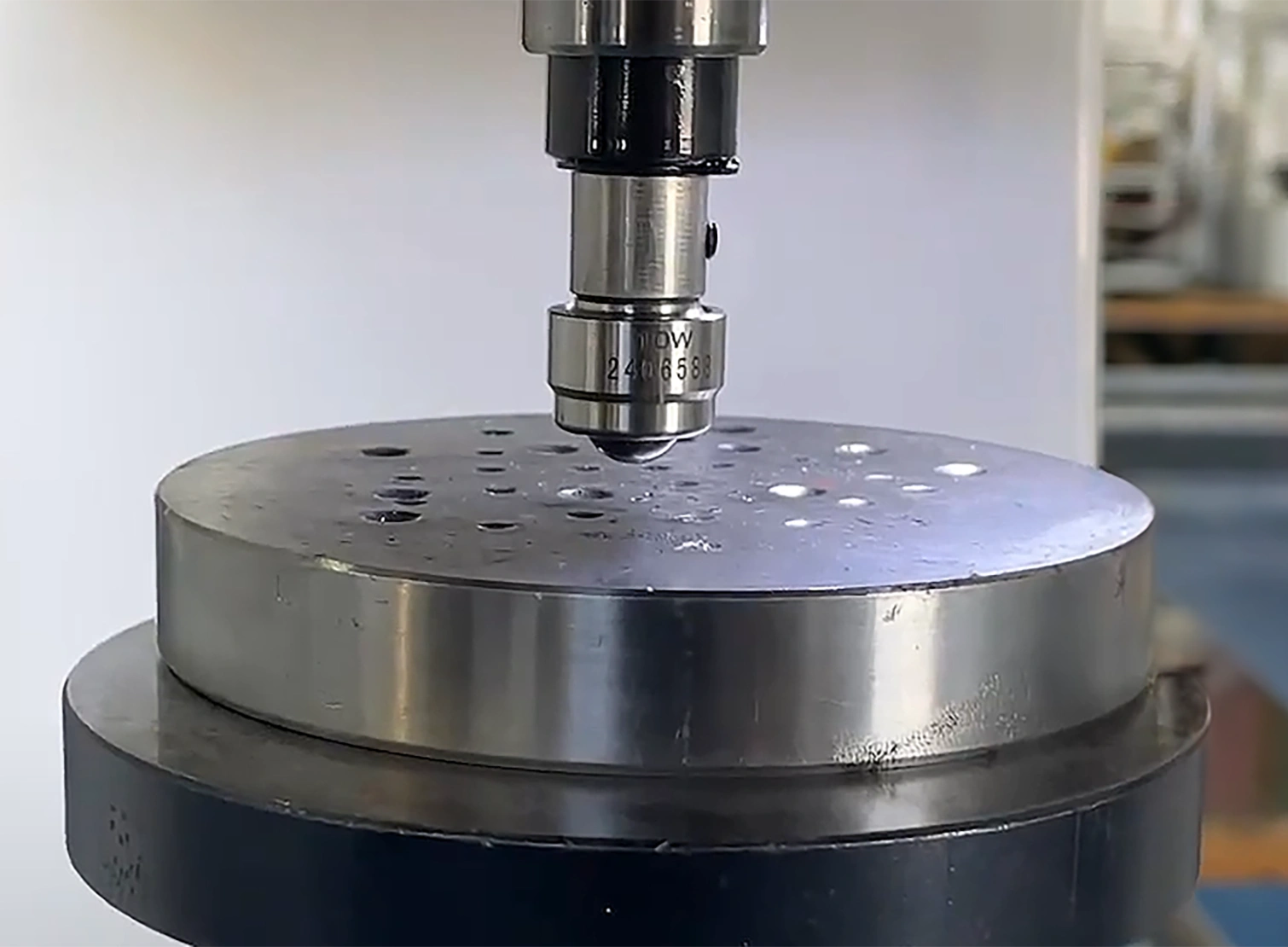
Application-Based Selection Guide
The fastest way to choose a hardness test is to start from the application. In most cases, the part type, the required result, and the size of the test area quickly narrow the method down to one or two realistic options.
If Your Application Looks Like This, Start Here
- Large castings, forgings, or heterogeneous structures: Start with Brinell.
It is well suited to thicker sections and coarse or non-uniform microstructures because the larger indentation gives a more representative bulk reading. Confirm that thickness, spacing, and edge distance are physically feasible before using it. - Routine QC on steels and common alloys: Start with Rockwell.
It is usually the most efficient choice for repeated production checks, incoming inspection, and pass/fail workflows because it is depth-based and does not require optical measurement of the indentation. Scale selection still has to match hardness range and section thickness. - Mixed materials in one lab: Start with Vickers.
It is often the most practical optical method when one lab needs a consistent approach across different alloys and heat-treated materials, especially when the test area is smaller than Brinell allows. The selected force should still produce a measurable diagonal within the intended method range. - Case depth on carburized or nitrided parts: Use Micro Vickers or Knoop.
This is the standard direction when hardness has to be measured as a function of depth rather than reported as a single surface or bulk value. In ISO 2639 case depth work, case hardness depth is commonly referenced at the point where hardness falls to 550 HV. - Weld HAZ mapping: Use Micro Vickers.
Hardness traverses across base metal, HAZ, and fusion zone are usually done on polished metallographic cross-sections with controlled spacing between indents. Bulk methods are generally not suitable for this kind of localized profile. - Thin coatings or thin layers: Use Knoop or very low-force Vickers.
Knoop is often preferred when shallow penetration matters because it gives a longer measurable impression with less penetration depth than a comparable Vickers indent. That helps reduce substrate influence in thin-layer work.
Common Mistakes
Most bad hardness data comes from a mismatch between the method and the application, not from the tester alone. The problems below are the ones that most often lead to retesting, inconsistent readings, or weak audit support.
Mistakes That Cause Problems
- Choosing by habit instead of by application
A method that works well on one product line can become the wrong choice after a change in thickness, geometry, heat treatment, or inspection objective. The method should follow the part and the test requirement, not the lab routine. - Ignoring thickness limits
If the section is too thin for the chosen load and indenter, the reading can be influenced by support conditions or backside deformation. This is one of the most common reasons a test looks acceptable while the result is still unreliable. - Ignoring spacing and edge distance
Indents placed too close to each other or too close to an edge can interfere with one another because the surrounding material has already been plastically deformed. Spacing rules are basic validity rules, not optional refinements. - Using microindentation without proper preparation
Low-force Vickers and Knoop work require high-quality polish, good perpendicularity, and clean edge definition. Even slight roughness can distort the measurement enough to change the conclusion in case depth, coating, or weld work. - Treating hardness conversions as exact values
Conversion tables such as ASTM E140 are useful reference tools, but they are approximate and material-dependent. They should not be treated as perfect substitutes for a direct test when the specification calls for a specific method. - Underestimating operator influence in optical methods
Brinell, Vickers, and Knoop all depend on reading an impression correctly. Lighting, focus, and edge interpretation can shift the result, which is why automated optical systems are often used to improve consistency.
Industry Use Cases
Different industries tend to return to the same method families because the parts, materials, and reporting requirements repeat. These examples are not rigid rules, but they reflect common and defensible starting points.
Common Method Fit By Industry
- Foundry and cast components — Brinell
Commonly used for bulk hardness acceptance on cast iron and cast steel sections, especially where the structure is not perfectly uniform and the part can accommodate a larger indentation. - Heat treatment shops — Rockwell plus microhardness
Rockwell is commonly used for routine verification, while microindentation is used for case depth, decarburization work, and hardness gradients below the surface. - Weld QA — Micro Vickers
Traverses across weld regions are commonly run on polished cross-sections to compare hardness across base metal, HAZ, and fusion zone. - Coatings and surface treatments — Knoop
Frequently preferred when shallow penetration and a longer measurable impression are needed in thin-layer work.
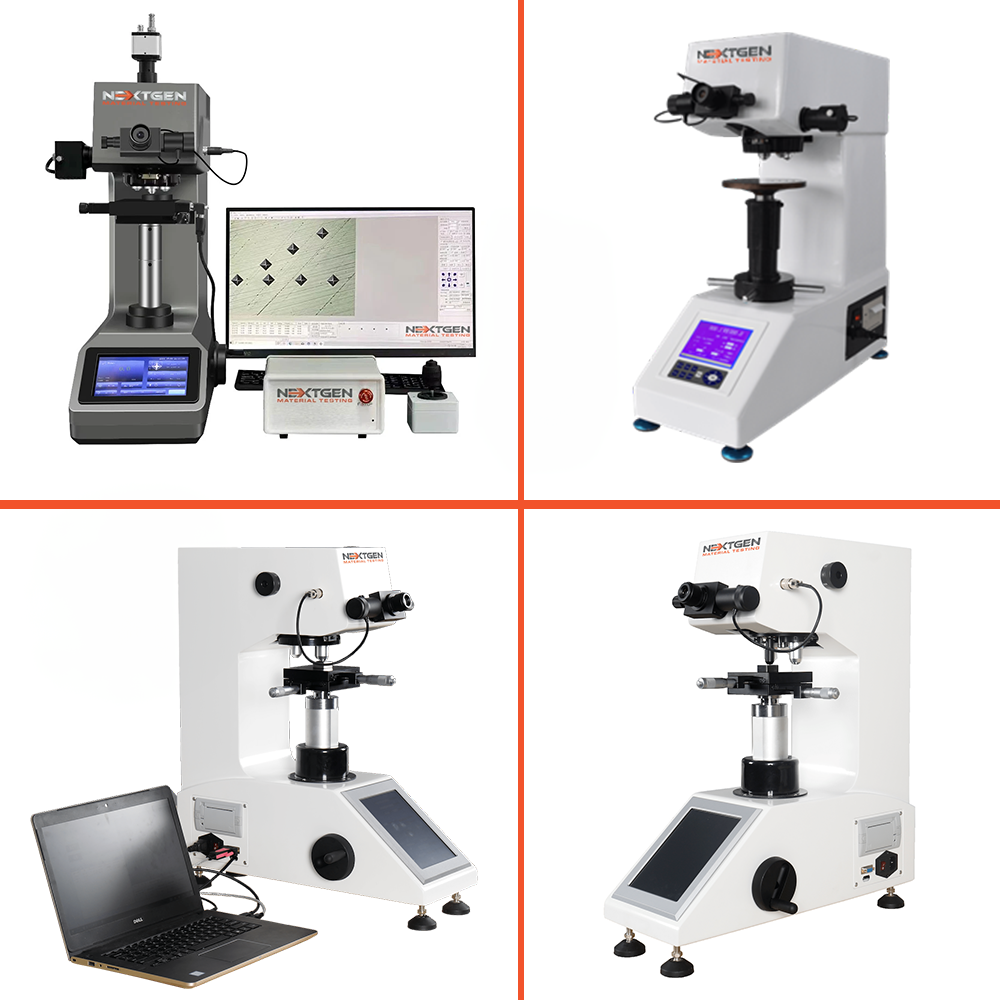
How To Choose The Right Hardness Tester
Selecting the test method is only part of the decision. The next step is choosing a machine setup that fits the way the work is actually done. Some labs need a dedicated bench unit for one routine method. Others need a broader platform because the workload changes from part to part, material to material, or from production checks to metallographic work. Portability also matters when the part cannot be brought to the tester. On top of that, software, imaging, and automation can have a direct effect on repeatability, reporting, and operator consistency.
What To Match Before Choosing A Tester
Before choosing a machine, it helps to define a few practical points:
- Workload Type: one method used every day, or multiple methods across different materials and parts;
- Part Size And Access: small samples at the bench, or large components that require a portable setup;
- Level Of Control Needed: simple pass/fail checks, or detailed optical measurement and reporting;
- Throughput Expectations: occasional lab work, routine QC, or high-volume testing;
- Reporting Requirements: basic readings, stored data, image capture, export, or traceable documentation.
When A Dedicated Benchtop Tester Makes Sense
A dedicated benchtop system is usually the better fit when the workflow is stable and the same method is used repeatedly. That is common in production QC, incoming inspection, and routine verification work where speed and consistency matter more than broad method flexibility. A dedicated Brinell or Rockwell setup can be simpler to run, easier to standardize across operators, and more efficient when the workload is stable.
When A Universal System Makes More Sense
A universal hardness system makes more sense when one lab handles mixed materials, different part sizes, and more than one hardness method. That is often the case in central labs, R&D groups, failure analysis work, or facilities that support both production and development. In that environment, switching between Brinell, Rockwell, and Vickers or Knoop on one platform can be more practical than maintaining separate machines for every task.
When Portability Matters
Portable testing matters when the part is too large, too heavy, or too fixed in place to bring back to a standard bench machine. That comes up in field inspection, structural work, weld crews, larger fabrications, and certain maintenance environments. In those cases, portability is not a convenience feature. In those situations, portable testing is often the only practical option.
Why Automation Can Matter More Than It First Appears
Optical methods add another layer to machine selection because the quality of the reading depends not only on the indentation, but also on how that indentation is captured and measured. CCD imaging, software-assisted reading, autofocus, and automated reporting can reduce operator subjectivity and improve consistency from one test to the next. This matters most in optical methods, where manual indent reading can introduce variation.
Matching The Tester To The Job
The right equipment depends on the same factors that drive method selection: the part, the section thickness, the size of the test area, the number of parts being checked, and the level of reporting the job requires. We cover those needs with dedicated Brinell, Rockwell, Vickers, and microhardness systems, as well as universal platforms for labs that need broader capability.
Brinell Systems For Larger Sections And Cast Parts
For larger parts, thicker sections, castings, and forgings, a dedicated Brinell machine is often the most practical choice. Our BrinGen 3000M covers 62.5 to 3000 kgf and a stated range of 8 to 650 HBW, which fits a wide span of standard Brinell applications. When optical consistency and reporting are important, BrinGen Scope adds CCD-based Brinell measurement and reporting support. For field use, structural work, or welding crews, the Telebrineller gives a portable Brinell option when the part cannot come to the bench.
Rockwell Testers For Routine QC
For routine QC and repeated production checks, a dedicated Rockwell tester is often the better fit because it keeps the workflow fast and straightforward. Our RockGen analogue series covers common regular-force testing at 60, 100, and 150 kgf. For labs that want more flexibility, the RockGen DGEN series includes regular, superficial, and twin digital options. Where automated loading and timing are important, the GenRock NG-150 covers 15 to 150 kgf with automatic load, dwell, and unload functions.
Vickers Systems For Smaller Test Areas
When the application calls for a smaller optical indentation, broader material coverage, or a lab-oriented method that can span different hardness levels, a Vickers platform is usually the better direction. Our NG-5/10/30/50 series covers macro Vickers testing with different force capacities and automation levels, which allows the setup to be matched more closely to the workload rather than forcing every lab into the same configuration.
Microhardness Systems For Profiles And Traverses
When the work involves case depth, coatings, weld traverses, metallographic sections, or localized hardness gradients, the machine needs more than just a low-force indenter. It also needs controlled optics, stable positioning, and a workflow that supports repeatable measurement. Our NG-1000 series covers Micro Vickers and Knoop from 10 to 1000 g and includes automation options for stage movement and focus, which is especially useful in traverse work and repeated laboratory measurement.
Universal Systems For Mixed Workloads
Some labs do not benefit from buying a separate machine for every method. If the workload regularly moves between Brinell, Rockwell, and Vickers or Knoop, a universal system can be the better long-term fit. Our UniGen category is built around that kind of mixed-method environment, where one platform is expected to support broader hardness testing capability across multiple applications.
A Practical Way To Narrow The Equipment Choice
If the workload is mostly one method, one part family, and one reporting style, a dedicated tester is usually the cleaner choice.
If the lab supports multiple materials, different part types, and both routine and detailed measurement, a universal system is often more practical.
If the work depends on optical readings, traverses, or traceable image-based reporting, automation and software support become much more important.
Talk To NextGen About Your Application
The right choice depends on what you are testing and what the result needs to support. Material, section thickness, part geometry, surface condition, workflow, reporting requirements, and the level of detail needed all affect whether Brinell, Rockwell, Vickers, or microhardness is the better fit. Bulk acceptance testing and localized hardness evaluation are different jobs, and they usually call for different methods and different machine setups.
If you are selecting new equipment, the most useful starting point is a clear definition of the application: the material, the test area, the section thickness, the volume of testing, and the type of result or report you need to produce. That usually makes the right test method and tester configuration much easier to narrow down.
Talk to NextGen about your application. We can help match the right hardness test and the right tester to your workflow. Share your material, part geometry, section thickness, and testing requirements, and we can recommend a practical configuration for the work you need to do.