DIN 53529 is a German standard series used in rubber and elastomer labs to characterize vulcanization (curing) behavior using a vulcameter/rheometer. It is commonly referenced for comparing compound cure response, setting process windows, and supporting QC decisions based on a standardized cure curve.
If you need help mapping your compound type and test objective to the right DIN 53529 part and instrument mode, you can talk with our team about a practical test setup.
DIN 53529 — full standard title
DIN 53529 is published as multiple parts covering vulcametry (measurement of vulcanization characteristics, sometimes referred to as curometry) for rubber and elastomers. The scope is centered on generating and interpreting cure curves under controlled thermal and mechanical conditions.
This standard is most often used when a lab needs comparable cure-characteristic data across batches, formulations, or sites, rather than purely “pass/fail” product compliance.
Quick definition
In one line: DIN 53529 defines standardized vulcametry approaches for rubber/elastomers to measure cure behavior as a curve over time (and, depending on the part, to evaluate cure progression and kinetics).
Common outputs: A cure curve (torque- or stiffness-related response vs. time) and derived cure descriptors that depend on the selected DIN 53529 part and instrument method.
What this standard covers
DIN 53529 covers vulcanization-characteristic measurement for rubber and elastomer compounds using vulcametry instruments operated at controlled temperature and defined oscillatory/mechanical conditions (as specified by the cited part).
The series includes general working principles and, in specific parts, more detailed evaluation approaches (for example, evaluation of cross-linking isotherms in terms of reaction kinetics).
Why this standard matters in testing
Vulcametry is widely used to compare how a compound cures, which helps teams control production variability, optimize cure cycles, and screen formulation changes. Using a standardized approach supports consistent curve shape comparisons across batches and between labs.
For equipment selection, DIN 53529 is important because the instrument type (and its die system, temperature control, and software analysis capability) directly affects whether the intended DIN 53529 part can be executed as written.
Common materials, product types, or applications covered
DIN 53529 is commonly applied to rubber and elastomer compounds during formulation development and production quality control.
Typical use cases: Incoming material/compound checks, batch-to-batch comparison, formulation changes, and process troubleshooting where cure behavior must be quantified and trended.
Common test or verification workflow
A typical DIN 53529 workflow is to run a controlled, heated vulcametry test and capture the compound response over time as it cures. The resulting curve is then used to compare batches or to extract defined cure descriptors required by internal specifications.
Practical caution: Results and reportable values are highly sensitive to the exact DIN 53529 part and instrument configuration, including temperature control, oscillation/strain settings, and the analysis definitions used in the software.
Equipment commonly used for this standard
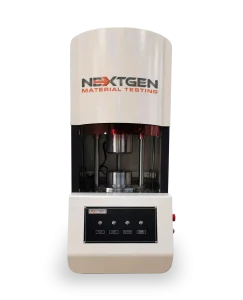
DIN 53529 testing is typically performed on a rubber vulcameter/rheometer designed for cure-characteristic measurement with heated dies and a torque- or stiffness-related measurement system.
Common equipment families: Moving-die rheometers (MDR) or other vulcametry-capable rubber rheometers (including rotorless systems), temperature-controlled die sets, and instrument software for curve display and parameter calculation.
If you are selecting a rheometer configuration (capacity, die system, temperature range, automation, and analysis package) for DIN 53529 reporting, you can request a detailed quote matched to your compound workflow.
How to read this designation or revision
DIN 53529 is typically cited by part number and edition date (for example, “DIN 53529-1:1983-03”). Because different parts cover different procedures and analysis approaches, the part number matters for both test setup and reporting.
Revision sensitivity: Even when the instrument type is similar, setup details and calculations can vary by the exact cited DIN 53529 part and edition.
Related standards, methods, or frameworks
DIN 53529 is often used alongside other rubber rheometry/vulcanization-characteristic methods used internationally. When a customer specification references multiple methods, the lab should confirm the required standard family and instrument mode before testing.
Talk with us about DIN 53529 testing capability
If you need to match a customer requirement to the correct DIN 53529 part, instrument mode, and reporting outputs, contact our team with the designation shown on your drawing, PO, or internal test plan.