Preparing round tensile specimens is one of the most demanding steps in mechanical testing. It requires precise geometry, consistent machining, and often depends on skilled operators or external machine shops. When preparation is delayed or inconsistent, it directly affects testing schedules and data reliability.
For many laboratories, this creates a bottleneck. Samples wait in queue, outsourcing adds lead time, and even small variations in specimen geometry can impact results. As testing volumes grow, these challenges become harder to manage with general-purpose machining solutions.
The TensileTurn CNC Industrial Upgrade addresses this problem by bringing round tensile specimen preparation in-house. Designed as a compact, automated CNC solution, it allows laboratories and production teams to prepare standardized specimens quickly, consistently, and without relying on external machining resources.
Why Round Tensile Specimen Preparation Slows Testing Down
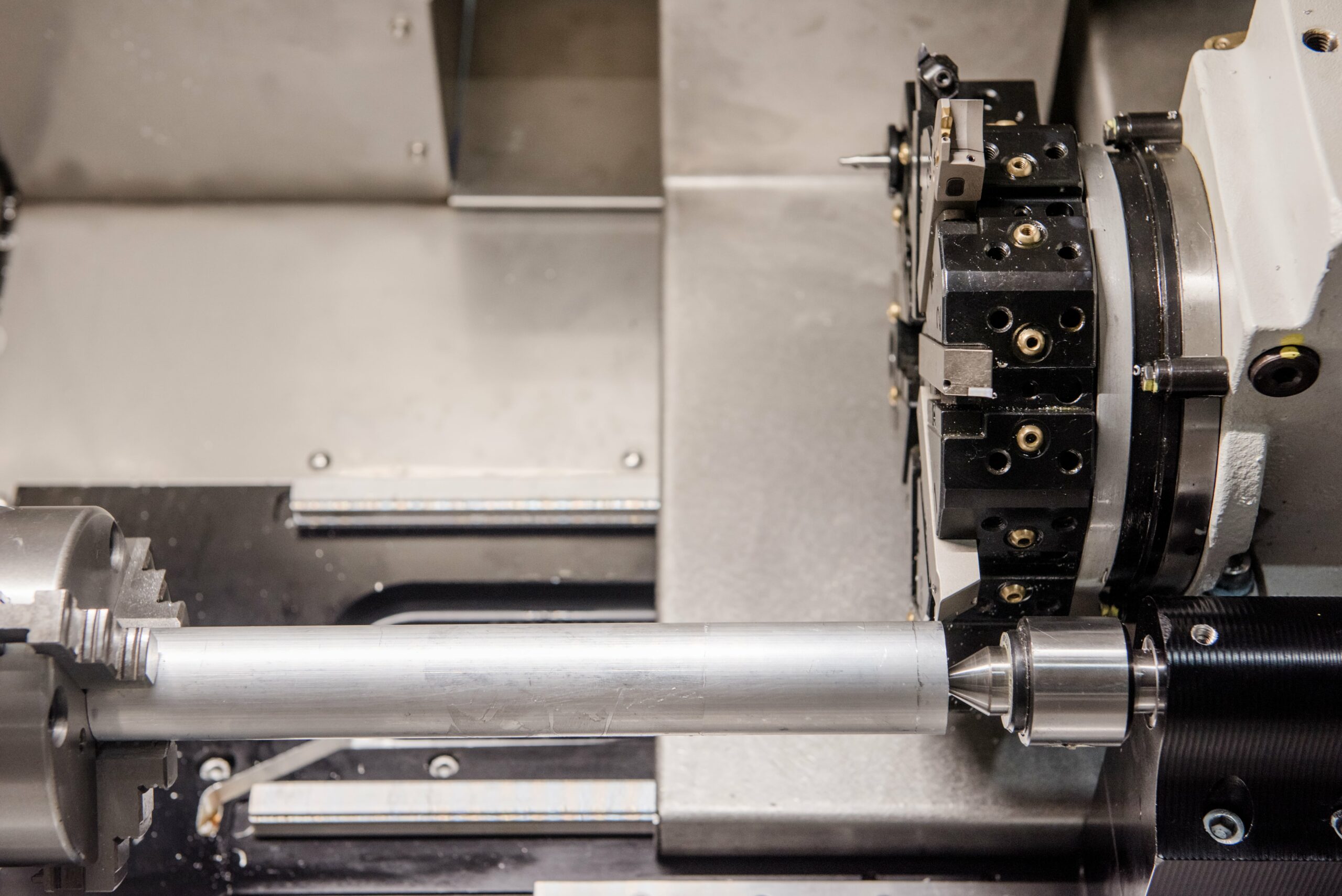 Round tensile specimen preparation is not just another machining step—it’s a critical part of the testing process that directly impacts accuracy and repeatability. Every specimen must meet strict dimensional requirements, including gauge diameter, gauge length, and transition geometry. Even small deviations can lead to inconsistent or invalid test results.
In many labs, preparation is still handled using general-purpose CNC equipment or outsourced to external machine shops. Both approaches introduce challenges. General-purpose machines require experienced operators, manual programming, and setup time for each specimen type. Outsourcing, on the other hand, adds delays, reduces flexibility, and makes it harder to maintain control over consistency across batches.
As a result, specimen preparation often becomes a hidden bottleneck. Testing timelines depend on machining availability, urgent jobs are harder to prioritize, and scaling up testing volume becomes inefficient. For labs working with standardized methods such as ASTM or ISO, this lack of control can be especially limiting.
What the TensileTurn CNC Industrial Upgrade Is Built to Do
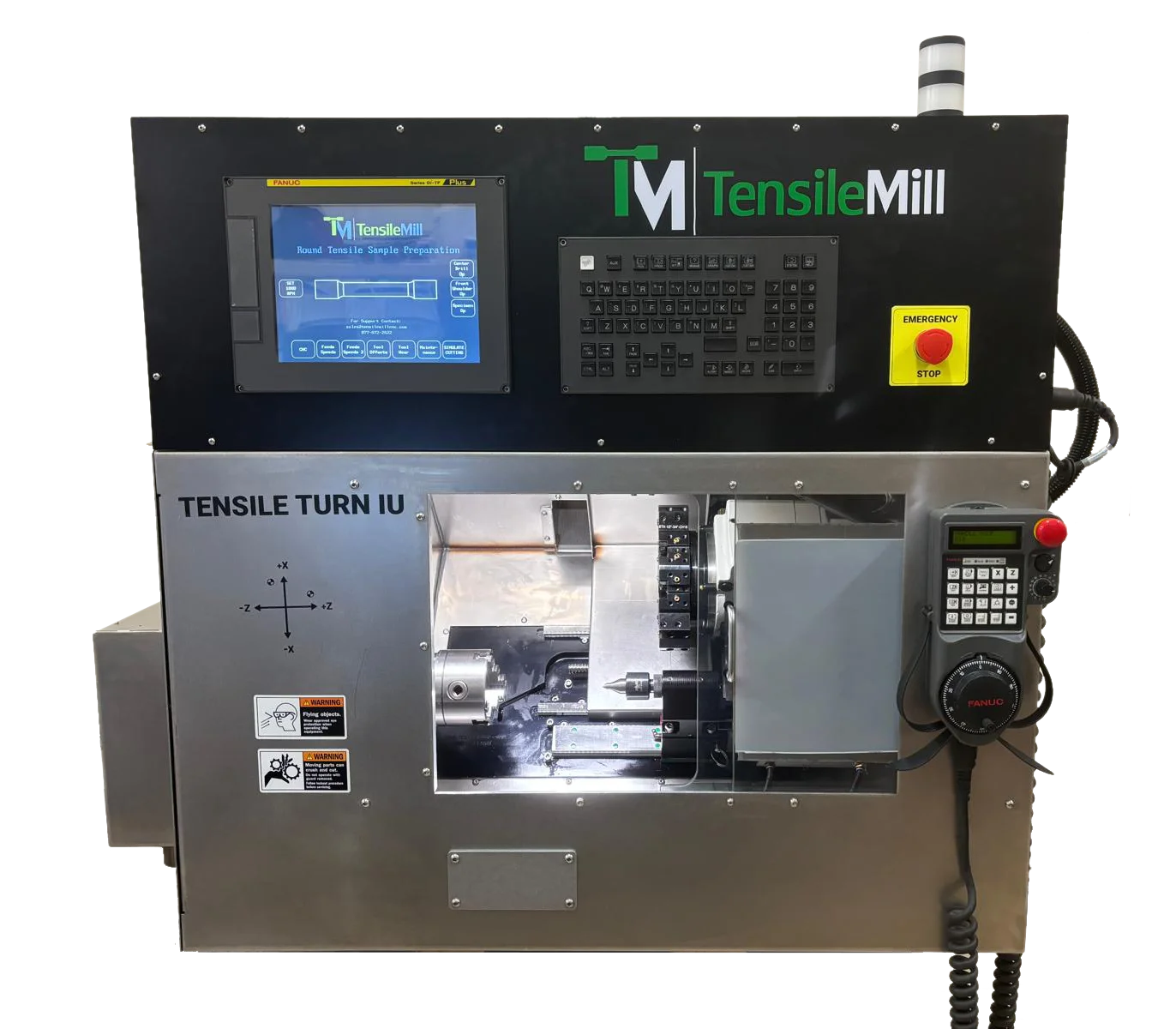 The TensileTurn CNC Industrial Upgrade is a compact automatic CNC lathe for preparing standardized round tensile specimens in lab and production settings. It is designed for labs that need repeatable specimen geometry without turning every job into a manual CNC setup.
The system runs on TensileSoft™ v2.0. Operators can select dimensions from a preloaded standards library covering ASTM E8, ASTM B557, ISO, and DIN specimen profiles, or enter custom parameters through the touchscreen interface.
The machine can process round, square, and irregular starting stock. Automated center drilling helps keep the preparation sequence consistent before turning begins, which is especially useful when preparing multiple specimens from the same material batch.
Because the workflow is guided, operators do not need deep CNC programming experience for standard specimen preparation. Experienced machinists can still access CNC control functions when the job requires more adjustment.
From Raw Stock to Finished Round Specimens
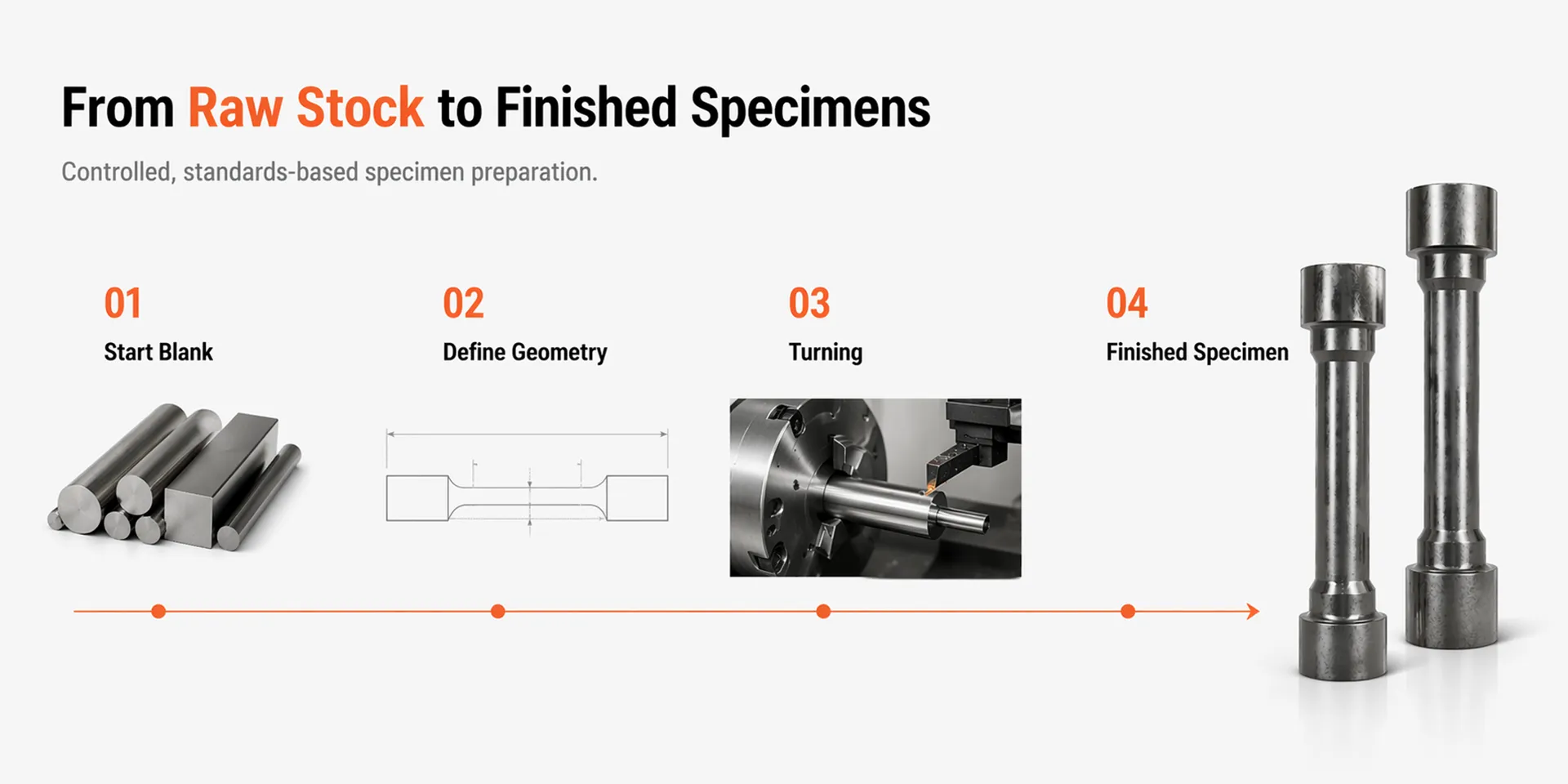
Before a round tensile specimen is ready for testing, the material has to move through several controlled machining steps. Each step affects the final geometry: how the blank is held, how the centerline is established, how the reduced section is turned, and how smoothly the shoulders transition into the grip area.
The TensileTurn CNC Industrial Upgrade is designed around this sequence, so the workflow is not treated as separate manual operations. The process can be broken down into a few practical stages.
Start with the Right Blank
Round tensile preparation begins before the first cutting pass. The starting material must be held securely, aligned properly, and prepared with enough stock for turning the gauge section, shoulders, and grip areas. Depending on the test method and material form, the blank may start as round bar, square stock, or an irregular pre-cut sample.
This is where a dedicated specimen preparation machine becomes useful. Instead of adapting every blank to a general-purpose lathe setup, the TensileTurn CNC Industrial Upgrade is built to handle different starting stock formats within a controlled preparation workflow.
Define the Specimen Geometry
The operator selects the required specimen profile through the TensileSoft™ interface or enters custom dimensions through the touchscreen. Key dimensions include gauge diameter, gauge length, reduced section length, shoulder transitions, and grip style.
These details matter because tensile test results depend on the specimen breaking in the intended gauge section, not at a poorly blended shoulder or an inconsistent transition. ASTM E8 and ISO 6892 workflows both place strong emphasis on controlled specimen geometry, gauge dimensions, and proper preparation before testing.
Center, Support, and Turn the Sample
For round tensile specimens, alignment is one of the most important setup steps. Center drilling helps establish a consistent reference point before turning begins, especially when the sample needs support between the chuck and tailstock.
The Industrial Upgrade includes automated center drilling, which helps standardize this part of the process. From there, the system can move through roughing and finishing operations to form the reduced section, shoulders, and required end geometry.
Control the Final Gauge Section
The final gauge section is the most sensitive part of the specimen. Diameter consistency, surface finish, concentricity, and smooth shoulder transitions all affect how the sample behaves during the tensile test.
The Industrial Upgrade is designed for this type of repeated dimensional control, with servo motion, a granite base, and positioning accuracy of ±0.0002 in / ±0.005 mm. For labs preparing multiple samples from the same batch, this helps keep the preparation process consistent from one specimen to the next.
Prepare for Testing, Not Rework
A finished specimen should be ready for measurement, documentation, and testing without unnecessary rework. For recurring tensile programs, the goal is not only to machine one acceptable sample, but to repeat the same geometry across batches with minimal variation.
That is the main value of bringing this workflow into the lab: raw stock can move from cutting and setup into finished round tensile specimens without waiting on external machining availability or rebuilding the process for every job.
Standards-Based Prep Without Reprogramming Every Job
 Preparing round tensile specimens often means repeating the same geometries across different batches. On a general-purpose CNC, this usually requires reloading programs, adjusting parameters, or relying on a machinist to set up each job.
With the TensileTurn CNC Industrial Upgrade, this step is simplified. The TensileSoft™ interface includes a built-in library of common specimen geometries based on ASTM E8, ASTM B557, as well as ISO and DIN standards. Operators can select the required profile directly from the touchscreen instead of programming it from scratch.
For non-standard applications, custom dimensions can be entered manually, without rewriting full CNC programs. This makes it easier to switch between specimen types and reduces setup time for repeat jobs.
Where the Industrial Upgrade Makes the Difference
The Industrial Upgrade is the right fit when round tensile specimen preparation is not occasional work, but part of a regular testing schedule. Its configuration is built for faster changeovers, stable machining, and repeatable output across multiple samples.
| Industrial Upgrade feature | Why it matters in specimen preparation |
|---|---|
| 8-position electric tool turret | Reduces manual tool changes and helps move through repeated machining steps more efficiently. |
| Automated center drilling | Standardizes the starting point of the preparation process and supports better alignment before turning. |
| Servo motion control | Helps maintain controlled, repeatable movement during gauge section and shoulder machining. |
| Granite base | Adds stability during cutting, especially when consistency across batches matters. |
| 3500 rpm spindle | Supports efficient machining across a range of metallic materials and specimen geometries. |
| ±0.0002 in / ±0.005 mm positioning accuracy | Helps maintain tight dimensional control for standardized tensile specimens. |
Together, these features make the Industrial Upgrade better suited for labs preparing production batches, recurring test series, or multiple specimen types on a regular basis. It gives the operator a dedicated workflow for tensile sample preparation instead of depending on a general-purpose CNC setup for every job.
Specimen Types and Materials It Supports
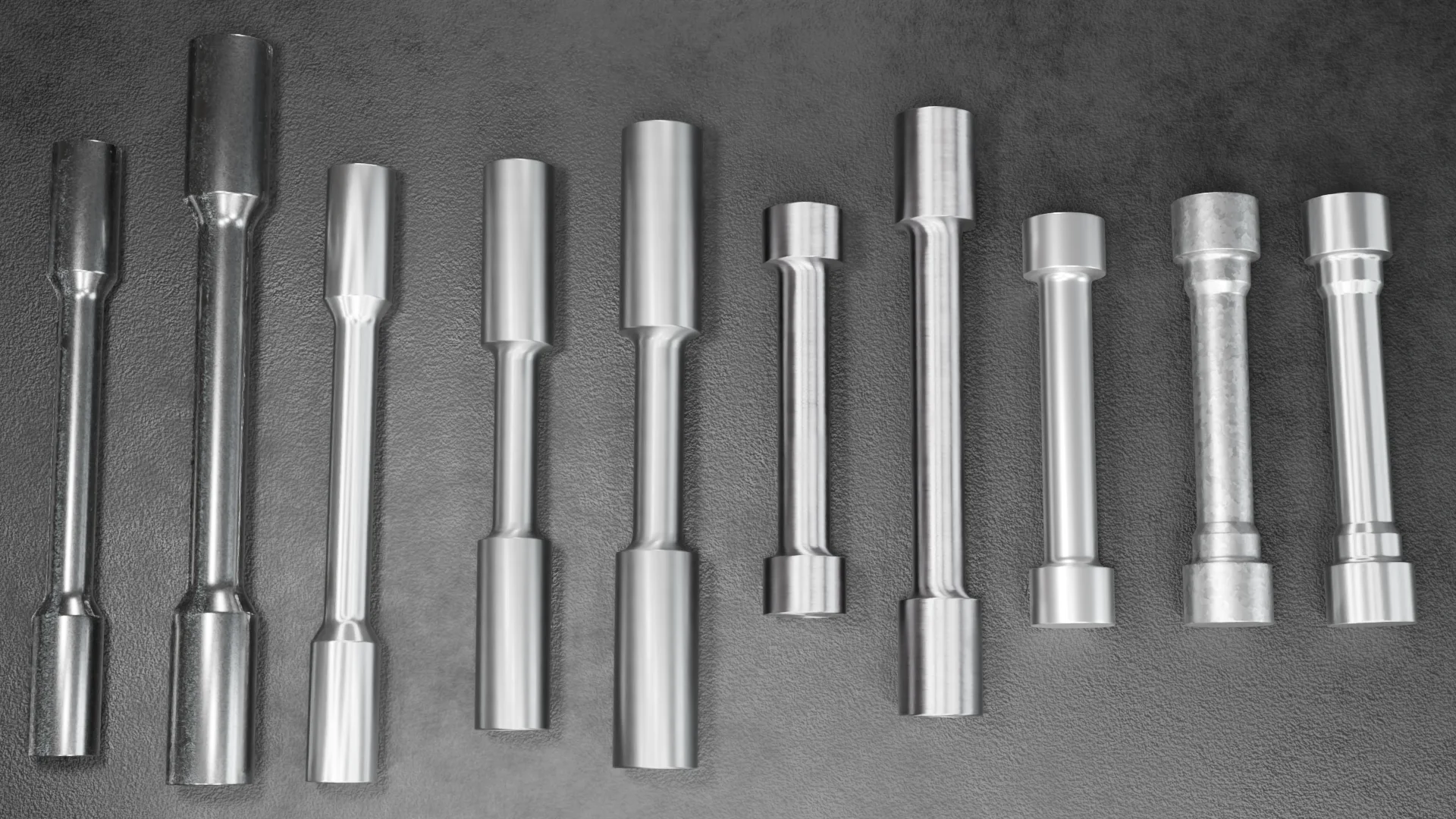
The TensileTurn CNC Industrial Upgrade supports the main round specimen formats used in tensile and fatigue testing, including:
- standard round tensile bars;
- sub-size specimens;
- threaded tensile samples;
- fatigue specimens;
- button-head tensile bars.
This makes it suitable for labs that prepare different specimen styles for ASTM, ISO, DIN, or internal testing procedures.
The machine is designed for a wide range of metallic materials, including heat-treated steels, aluminum, copper alloys, nickel alloys, magnesium, and specialty grades such as Inconel. This is especially useful for labs working with mixed material programs, where specimen preparation requirements can change from one batch to the next.
In-House Preparation vs. Outsourced Machining
 Outsourced machining can work well for one-off jobs or low testing volume. The problem starts when round tensile specimens become a recurring part of the lab workflow.
Each outsourced batch adds extra steps: sending drawings, confirming dimensions, waiting for machine availability, checking finished specimens, and adjusting the testing schedule if anything is delayed. Even when the machining quality is good, the lab still depends on someone else’s queue.
Bringing preparation in-house gives the lab more control over timing and consistency. Operators can prepare specimens closer to the test date, repeat the same geometry across batches, and respond faster when a new material lot, retest, or urgent project comes in.
For labs running standardized tensile workflows regularly, a dedicated system like the TensileTurn CNC Industrial Upgrade helps reduce the gap between sample cutting, specimen preparation, and actual testing.
Is the Industrial Upgrade the Right Fit for Your Lab?
The TensileTurn CNC Industrial Upgrade is a strong fit for labs that prepare round tensile specimens on a regular schedule, especially when repeatability and turnaround time matter.
It is most relevant for teams that:
- prepare standard round, threaded, sub-size, fatigue, or button-head specimens;
- work with ASTM E8, ASTM B557, ISO, or DIN specimen geometries;
- want to reduce dependence on external machine shops;
- need repeatable preparation across material batches;
- want standard jobs to be handled without relying only on experienced CNC machinists.
For labs that need a different work envelope or specimen size range, NextGen can also help compare the Industrial Upgrade with other TensileTurn configurations.
Need Help Choosing the Right TensileTurn Configuration?
Need help matching your specimen geometry, standards, and material range to the right TensileTurn configuration? NextGen can help you review the Industrial Upgrade and confirm whether it fits your round tensile preparation workflow.
Keep Reading in Round Tensile Specimen Preparation Machines
See the Round Tensile Specimen Preparation Machines range Flexural (Bend) Testing Explained: 3-Point vs 4-Point, Standards, and SetupFlexural (bend) testing explained: what it measures, three-point vs four-point setups, the standards for plastics, metals, composites and concrete, and how to choose the right fixtures and...Read the articleGenTest Software Setup Guide for NextGen NG-EML Universal Testing MachinesGenTest setup affects the full UTM testing workflow: method storage, PC-to-controller communication, user permissions, simulation files, live data acquisition, and report output. This guide follows the GenTest setup video step by step for NextGen NG-EML electromechanical universal testing machines. It covers installation, license activation, workspace configuration, UTM controller connection, safety and peripheral setup, user management, DEMO Mode, simulation files, Control Panel setup, Quick Test, and test method creation. GenTest is the software layer where the test method, machine connection, operator input, live data, calculated results, and report output come together. For operators, service teams, QA/QC labs, and R&D users, the goal is to...Read the articleBrinell, Rockwell, Vickers, or Microhardness: Which Test Makes Sense for Your Application?Choosing a hardness test starts with the part itself. Material type, section thickness, geometry, surface condition, inspection purpose, and required testing speed all affect which method will produce a reliable result. Brinell, Rockwell, Vickers, and microhardness methods work differently, so they are not equally suitable for the same component or the same quality task. Brinell, Vickers, and Knoop are based on the size of an indentation, while Rockwell is based on indentation depth. That difference directly affects how the result is obtained and where the method fits best. In production and lab work, problems usually appear when the test method does not fit the application. A part may be too thin for the selected load, the surface may be too rough...Read the article
Machines Behind This Article
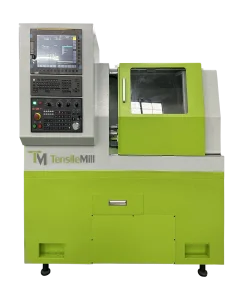 Round Tensile Specimen Preparation MachinesTensileTurn CNC Classic Upgrade – Round Tensile Specimen Preparation MachineTensileTurn CNC Classic Upgrade is a compact CNC lathe for accurate, repeatable preparation of round tensile specimens. It supports specimen diameters up to 1.5...View product
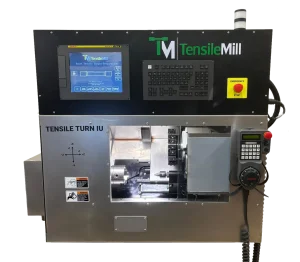 Round Tensile Specimen Preparation MachinesTensileTurn CNC Industrial Upgrade – Round Tensile Specimen Preparation MachineTensileTurn CNC Industrial Upgrade is a compact CNC lathe for preparing standardized round tensile specimens in laboratory and production environments. Guided...View product
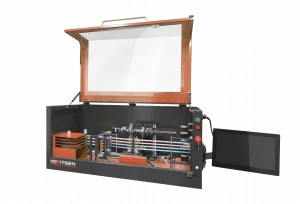 Tensile Sample PreparationNG-AutoPol – Automatic Longitudinal Polisher for Tensile SpecimensNG-AutoPol is an automatic longitudinal polishing system for metallic tensile and fatigue specimens. It removes machining marks, grinding stress, and residual...View product
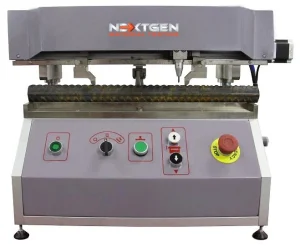 Tensile Sample PreparationGenMark 500 – Automatic Gauge Length Marking MachineThe GenMark 500 is a full-automatic gauge length marking machine for metal bar, rebar and wire rod, applying the reference marks used to determine elongation after...View product
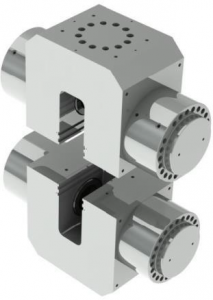 Grips and Fixtures for NextGen Universal Testing Machines (UTMs)Dual-Action Hydraulic Wedge Grips for High-Capacity TestingDual-Action Hydraulic Grips are high-capacity wedge-clamping fixtures for tensile testing on universal testing machines. Designed for metals, plastics, and...View product
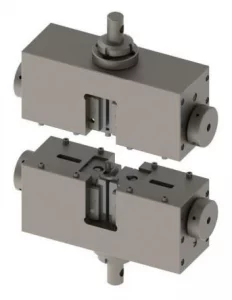 Grips and Fixtures for NextGen Universal Testing Machines (UTMs)Wedge Tensile Grips for Metals and CompositesWedge tensile grips are built for high-load tensile testing of flat and round specimens made from metals, composites, and plastics. Their wedge-action mechanism...View product
 Grips and Fixtures for NextGen Universal Testing Machines (UTMs)Grips and Fixtures for Hydraulic Universal Testing MachinesGrips and fixtures for hydraulic universal testing machines are built for high-force tensile, shear, proof load, flexural, splitting, and structural component...View product
 Grips and Fixtures for NextGen Universal Testing Machines (UTMs)TestStar Series Grips and Fixtures for Hydraulic UTMsTestStar® Series grips and fixtures are high-precision accessories for integrating tensile, snubbing, wedge-action, pneumatic, compression, and bending setups with...View product
 Grips and Fixtures for NextGen Universal Testing Machines (UTMs)Shoulder Fixtures for Pull-Off TestingShoulder fixtures are specialized tensile grips for specimens and components with shoulder geometries, where alignment and secure seating are essential for reliable...View product
 Grips and Fixtures for NextGen Universal Testing Machines (UTMs)Compression Fixtures for Rigid SamplesCompression fixtures provide aligned axial loading for rigid samples tested on NG-EML and SHM universal testing machines. They are suited for metals, polymers,...View product
 Universal Testing Machines for Metal TestingAlignment Device – NADCAP-Ready Precision FixtureThe Alignment Device is a NADCAP-ready precision fixture for verifying and correcting load-frame alignment on universal and fatigue testing machines. Designed to...View product
 Electromechanical Universal Testing Machines for Rubber TestingGenTest – Advanced UTM Testing SoftwareGenTest is NextGen’s advanced UTM testing software for electromechanical universal testing machines, managing test setup, live control, data acquisition,...View product