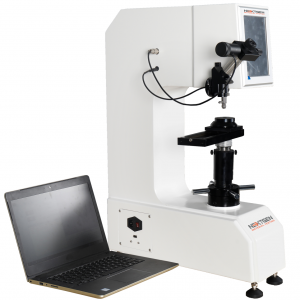
JIS Z 2244 is a Japanese Industrial Standard that specifies a Vickers hardness test method for primarily metallic materials. It is used when a Vickers “HV” hardness value is needed for material qualification, process control, weld and heat-treatment checks, and comparative hardness mapping.
This standard has been withdrawn and transitioned into a split set of newer documents (parts). If you need help matching an older JIS Z 2244 citation to today’s lab setup and reporting expectations, talk with our team.
JIS Z 2244: Vickers hardness test — Test method
JIS Z 2244 defines a Vickers hardness testing approach based on making a diamond-pyramid indentation and determining hardness from the applied test force and the measured indentation geometry. It is commonly referenced across metals manufacturing and fabrication when a standardized “HV” hardness result is required.
Document type: Test method (hardness testing).
Quick Definition
JIS Z 2244 is a Vickers hardness test method standard for primarily metallic materials, covering test conditions and measurement needed to produce a Vickers hardness value (HV) from an indentation.
What This Standard Covers
JIS Z 2244 focuses on how to perform a Vickers hardness test and determine the reported hardness number. At a practical level, it governs items that directly affect measurement quality and repeatability, such as selecting an appropriate test force range, producing an acceptable indentation, and measuring indentation features consistently.
What it does not do: It does not set pass/fail hardness limits by itself. Hardness requirements typically come from a product/material specification, drawing note, customer requirement, or a separate acceptance standard.
Why This Standard Matters in Testing
Vickers hardness is widely used because it supports a broad range of hardness levels and can be applied from relatively small features up through bulk material checks when the proper test force and optics are used. A standard method matters because small differences in surface preparation, indentation measurement, and instrument verification can shift the reported HV value enough to affect decisions on heat treatment, weld procedure qualification, or lot release.
Revision sensitivity: Hardness workflows are sensitive to the cited edition and any transition to newer replacement parts, especially where reporting format, verification expectations, and force ranges are concerned.
Common Materials, Product Types, or Applications Covered
JIS Z 2244 is typically used for metallic materials where Vickers hardness is a relevant property and where an indentation-based method is appropriate for the part geometry and surface condition.
Common applications: Incoming material checks, heat-treated component verification, weld cross-section hardness mapping, plated/coated parts where the base material hardness must be assessed (with appropriate test selection), and production QC where a quick hardness value is used to flag process drift.
Common Test or Verification Workflow
Most labs apply JIS Z 2244 within a straightforward indentation-hardness workflow.
Typical workflow: (1) define the test location(s) and acceptance criteria from the controlling spec/drawing, (2) prepare the surface so the indentation can be formed and measured cleanly, (3) select the test force appropriate to the material and feature size, (4) make one or more indentations, (5) measure the indentation consistently, (6) calculate and report the Vickers hardness value(s), and (7) confirm the tester condition using appropriate verification practices and reference blocks as required by the lab’s quality system.
Equipment Commonly Used for This Standard
Equipment selection for JIS Z 2244 centers on producing controlled Vickers indentations and measuring them reliably.
Common equipment: Vickers hardness tester (manual, semi-automatic, or automatic), Vickers diamond indenter, optical system or imaging/measurement software for indentation measurement, calibrated force application and timing controls as provided by the instrument, certified hardness reference blocks for ongoing checks, and specimen preparation tools (sectioning and polishing) when testing cross-sections or welds.
For quoting and configuration, the key decision points are typically the required test force range, automation level (manual vs. automatic indentation and measurement), required field of view/optical resolution, sample size/fixturing needs, and whether your workflow includes hardness mapping across multiple points.
If you are comparing Vickers hardness tester configurations for your parts and throughput, you can request a detailed quote with the right force range, optics, and automation level for your lab.
How to Read This Designation or Revision
JIS citations commonly include a year after a colon (for example, “JIS Z 2244:2009”), which indicates the year of that edition. When purchase orders, drawings, or customer documents cite JIS Z 2244, it is good practice to capture the full designation (including the year) to avoid ambiguity.
Status note: JIS Z 2244 (as a single document) has been withdrawn and transitioned into newer split parts. When you see JIS Z 2244 on a drawing or legacy procedure, you may need to align the test plan and reporting to the applicable replacement document(s) and the customer’s intent.
Related Standards, Methods, or Frameworks when useful
Vickers hardness testing is also standardized internationally, and many organizations manage hardness test methods through closely related documents (often with separate parts for the method, verification, and hardness tables). When you need cross-standard alignment, focus on matching the test method conditions and reporting expectations rather than assuming results are interchangeable across different editions or systems.
Common cross-references in practice: Product/material specifications that define allowable hardness ranges; instrument verification and calibration practices required by your quality system; and hardness mapping requirements for weld procedures or heat-treatment validation.
Get help selecting a Vickers hardness testing setup
If you need a Vickers hardness tester and accessories aligned to a JIS Z 2244 citation (or its replacement parts), contact our team with your material, hardness range, sample geometry, and expected throughput.