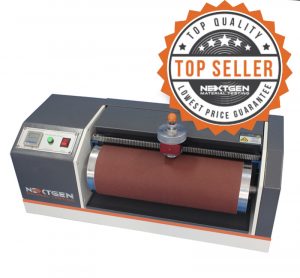
DIN 53516 is a legacy German standard for determining the abrasion resistance (wear) of rubber and elastomeric materials using a rotating cylindrical drum abrasion device (often called a “DIN abrasion” test).
Although widely referenced in specifications for rubber components and elastomer compounds, DIN 53516 (1987-06) is withdrawn and has been replaced by DIN ISO 4649. If you need help aligning your internal method, reporting format, or equipment setup to the exact edition cited in a customer document, talk with our team.
DIN 53516:1987-06 — Prüfung von Kautschuk und Elastomeren; Bestimmung des Abriebs (Testing of rubber and elastomers; determination of abrasion resistance)
DIN 53516 is used to compare how resistant a rubber or elastomer material is to abrasive wear under controlled laboratory conditions. Results are commonly used for compound selection, incoming material verification, and quality control trending.
This standard is most often encountered as a cited requirement in product specifications, supplier datasheets, and legacy qualification programs—especially where “DIN abrasion” is used as a procurement metric.
Quick Definition
What it is: A laboratory abrasion (wear) test method for rubber and elastomers using a rotating cylindrical drum abrasion device.
What it outputs: A wear/abrasion result based on material loss after abrasion under standardized conditions (often used for relative comparison between compounds).
Status note: DIN 53516:1987-06 is withdrawn and was replaced by DIN ISO 4649.
What This Standard Covers
DIN 53516 addresses abrasion resistance of rubber and elastomeric materials when a standardized abrasive surface is applied under controlled contact conditions using a rotating drum apparatus. It is intended to produce repeatable, comparative abrasion data for materials and compounds.
Because abrasion performance can be sensitive to sample preparation, conditioning, and the exact equipment configuration, labs typically treat the cited edition and any customer-specific callouts as essential to the test setup.
Why This Standard Matters in Testing
For many rubber products, abrasion resistance is tied directly to expected service life and durability. DIN 53516-style abrasion results are frequently used to screen formulations, compare suppliers, and set acceptance thresholds for wear-critical parts.
When the requirement is written as “DIN 53516 abrasion,” the practical need is usually consistent, comparable abrasion data—not a simulation of every real-world wear mechanism. The standard helps teams generate controlled results that can be tracked over time for QA/QC decisions.
Common Materials, Product Types, or Applications Covered
DIN 53516 is commonly associated with elastomer compounds and rubber-based products where wear is a key performance property.
- Rubber and elastomer compounds (including wear-resistant formulations)
- Industrial rubber parts such as seals, bumpers, and protective components
- Wear-prone rubber products such as belting and other abrasion-exposed components (when specified by a customer requirement)
Practical note: Always confirm whether the requirement is truly DIN 53516 (legacy) or whether the contract/specification expects testing to the replacement DIN ISO 4649 edition.
Common Test or Verification Workflow
Most labs use this type of abrasion requirement as a comparative material test within a broader qualification or QC program.
Common workflows: (1) prepare and condition specimens per the cited standard/customer spec, (2) run abrasion on a rotating drum abrasion tester with standardized abrasive media, (3) determine material loss and calculate the abrasion result, (4) report results with the exact test conditions and the referenced edition.
Revision sensitivity: Even small differences in how the cited edition defines equipment setup, abrasive media handling, conditioning, or reporting can affect comparability between suppliers and between historical datasets.
Equipment Commonly Used for This Standard
DIN 53516 points most directly to a rotating cylindrical drum abrasion tester (often referred to as a DIN abrasion tester) and supporting measurement tools needed to quantify material loss.
- Rotating drum abrasion tester: A controlled abrasion device using a rotating cylindrical drum with standardized abrasive sheet/media and a specimen holder
- Mass measurement: A suitable lab balance for determining mass change (where mass loss is part of the result calculation)
- Supporting tools: Specimen preparation and dimensional/density measurement tools as required by the cited procedure and reporting needs
If you are configuring a new abrasion station or matching a tester configuration to a procurement requirement, you can request a detailed quote based on your sample type, throughput needs, and the edition your customers cite.
How to Read This Designation or Revision
The designation is commonly written with a date suffix that identifies the edition. For example, DIN 53516:1987-06 refers to the June 1987 edition.
DIN 53516:1987-06 is listed as withdrawn and replaced by DIN ISO 4649:2006-11. When a customer specification still cites DIN 53516, it is important to confirm whether they require strict testing to the legacy DIN document or will accept testing to the DIN ISO 4649 replacement with equivalent reporting.
Related Standards, Methods, or Frameworks
DIN 53516 is commonly discussed alongside international rotating-drum abrasion methods for rubber.
- DIN ISO 4649 (replacement of DIN 53516 in DIN’s catalog)
- ISO 4649 (international rotating cylindrical drum abrasion method for vulcanized or thermoplastic rubber)
- ASTM D5963 (a widely used rubber abrasion resistance test method that is often cross-referenced during supplier alignment)
Good practice: When comparing results across methods, avoid assuming equivalency. Keep comparisons within the same standard and edition unless the customer specification explicitly permits otherwise.
Get help selecting a DIN abrasion testing setup
If you need an abrasion tester configuration that matches a DIN 53516 citation (or its DIN ISO 4649 replacement), contact our team to discuss specimen type, abrasive media handling, reporting expectations, and the documentation your customers require.