How do you confirm that a fabric, leather surface, coated material, or finished shoe can pass controlled lab testing before it reaches production or customer use?
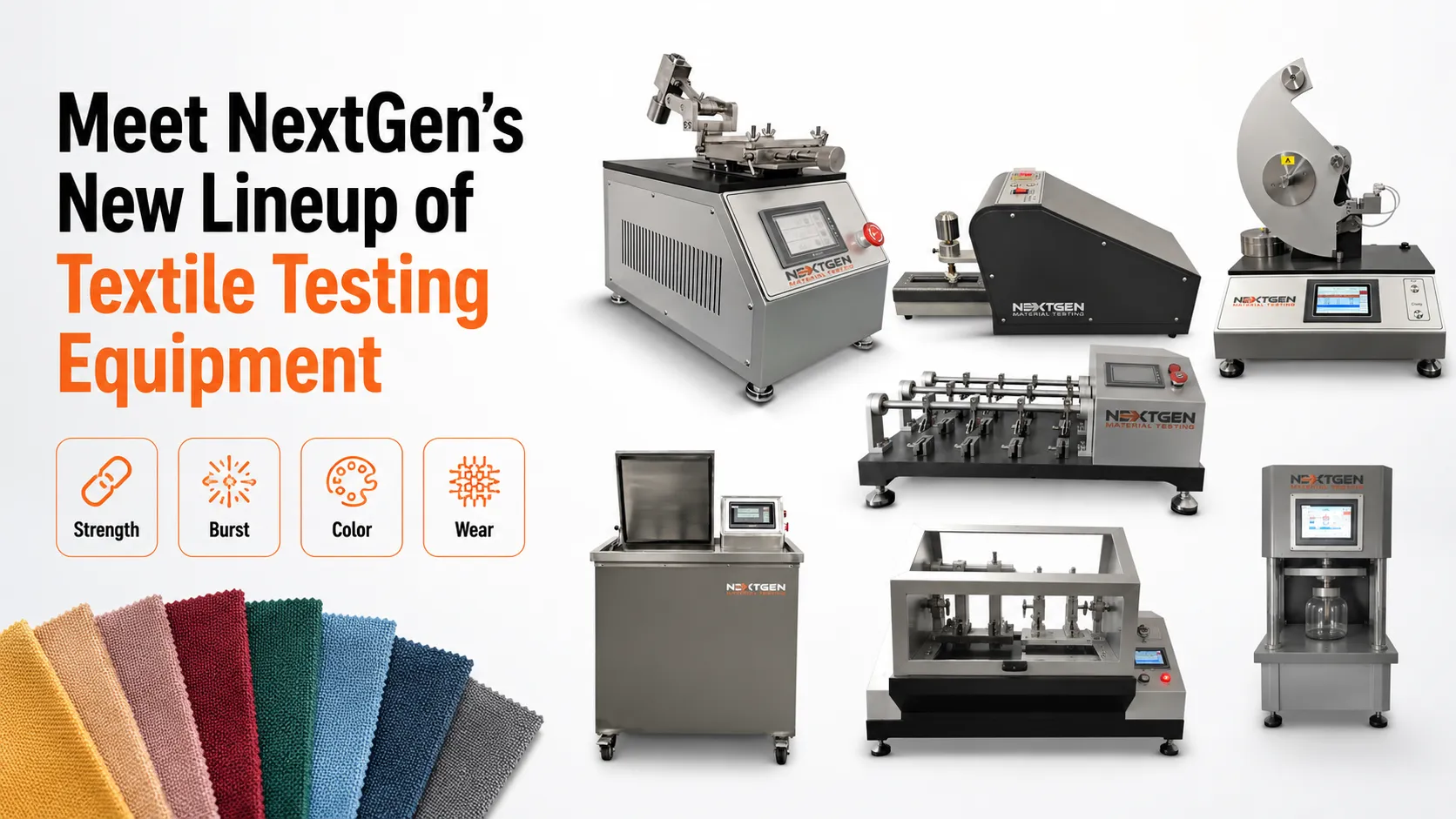
NextGen’s new textile testing equipment lineup brings together seven systems for three lab areas: fabric strength, color fastness, and footwear and leather durability. The systems are organized by failure mode, including tear propagation, bursting under pressure, dry and wet color transfer, washing fastness, surface abrasion, flex cracking, and whole-footwear flex performance.
Textile testing is rarely handled with one universal machine. A dyed fabric may need both rubbing and washing data. A nonwoven may require tear and burst results. A footwear program may need to check the material surface, the upper’s flex resistance, and the finished shoe after assembly.
The sections below explain where each system fits, which material risks it addresses, and how the seven products can be combined into QC, R&D, sourcing, and supplier approval workflows.
Why NextGen Built a Textile Testing Equipment Lineup
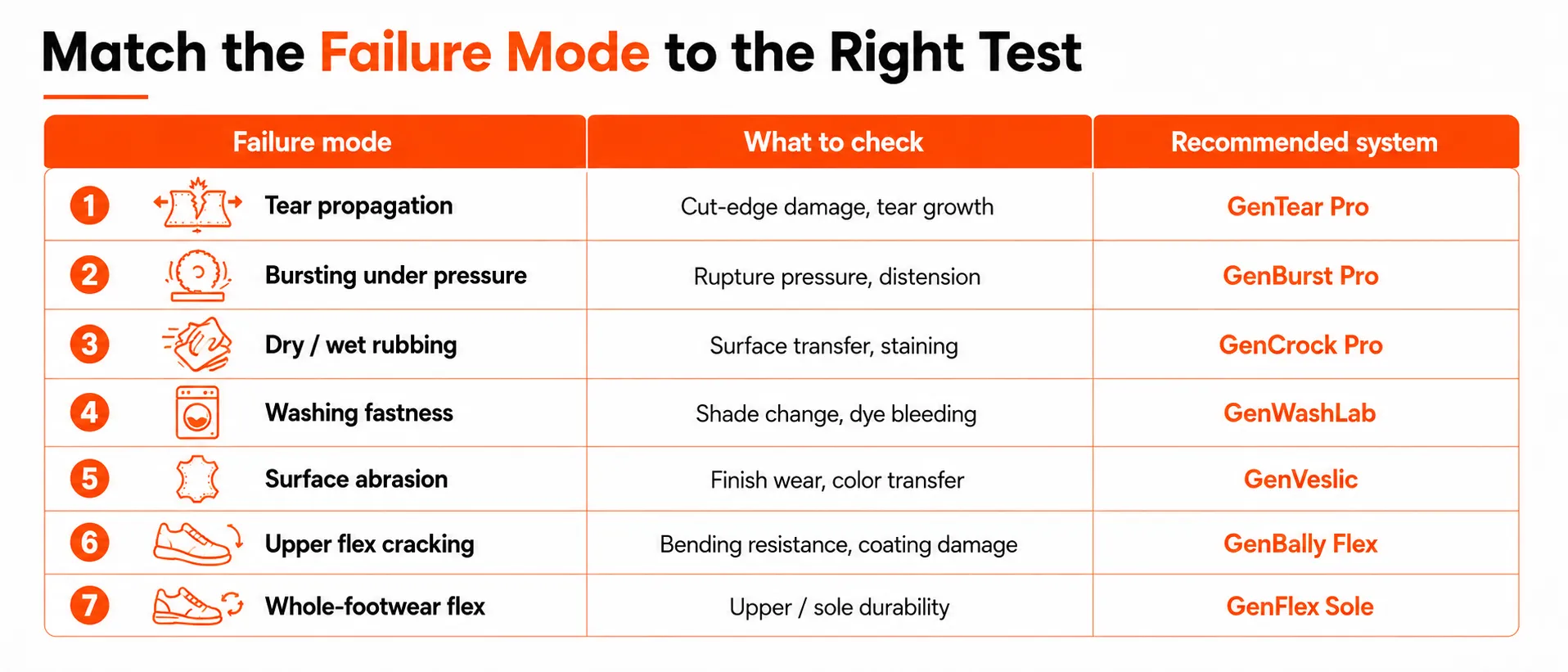
Textile, leather, coated materials, and finished footwear fail under different types of stress. A fabric may tear from a cut edge, rupture under pressure, lose color during washing, or transfer dye during rubbing. Leather and coated uppers may show surface wear or cracking only after repeated abrasion or flexing. If a lab checks only one property, the missed failure mode may appear later during production, shipment, retail handling, or customer wear.
NextGen grouped the new lineup by test function because each failure mode needs a different test setup. Tear testing measures how a cut continues through a specimen. Burst testing applies pressure through a diaphragm until the material ruptures. Crocking tests show whether color transfers during dry or wet rubbing. Wash fastness testing checks color change and staining after controlled washing exposure. Abrasion and flexing tests show how leather, coated materials, uppers, soles, and finished footwear respond to repeated surface contact or bending cycles.
The lineup is organized into three testing areas: Fabric Strength Testing Equipment, Color Fastness Testing Equipment, and Footwear and Leather Testing Equipment. This structure makes it easier for a lab to start from the actual testing question:
- Will the fabric continue tearing after damage starts?
- Will the material burst under pressure?
- Will the color transfer during rubbing?
- Will washing change the shade or stain adjacent material?
- Will leather or coated surfaces abrade?
- Will an upper crack after repeated flexing?
- Will the finished shoe hold up under flex cycles?
For QC, R&D, sourcing, and supplier approval teams, the category structure reduces guesswork: select the material, define the failure mode, then match it to the correct test method and equipment.
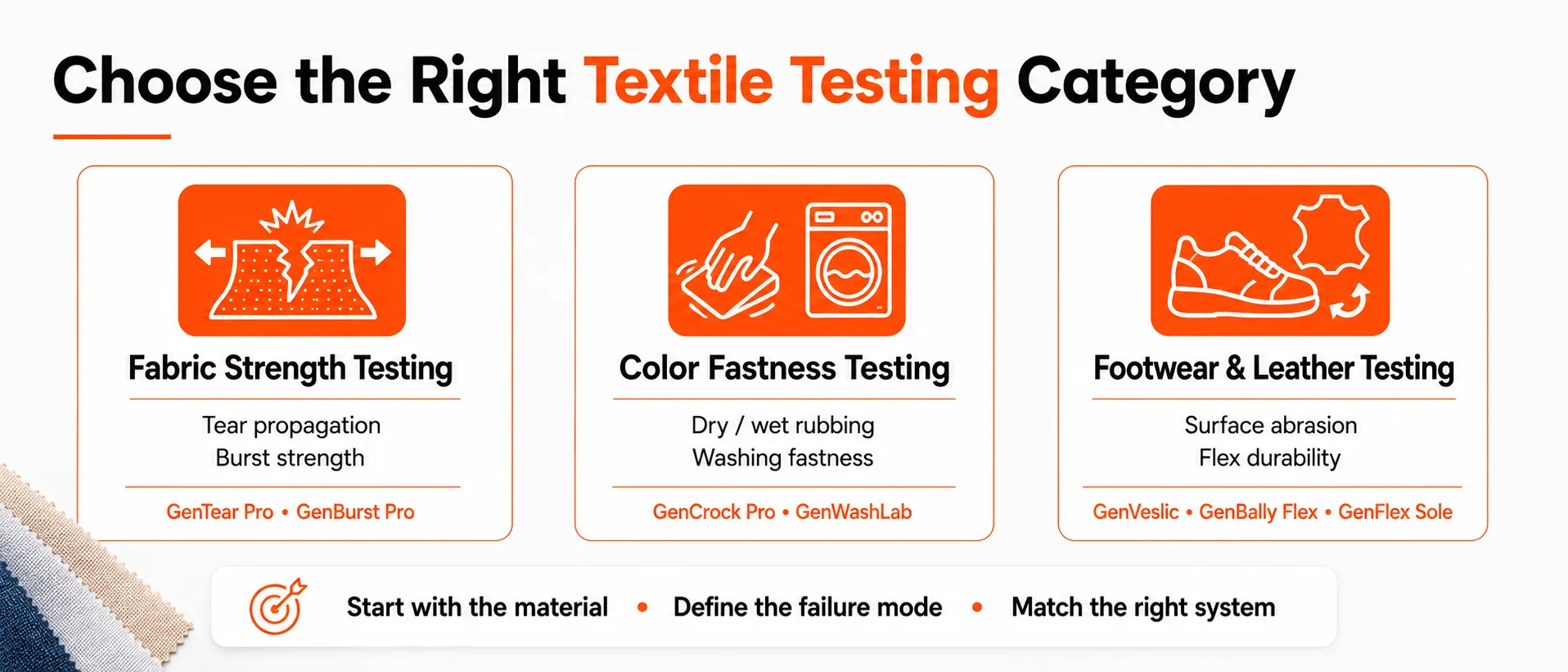
The Lineup at a Glance: 3 Categories, 7 Testing Systems
NextGen’s new Textile Testing Equipment lineup is organized by test function. Each category covers a different type of material behavior: mechanical strength, color stability, or durability under abrasion and flexing.
| Category | Equipment | Primary Test Focus |
| Fabric Strength Testing Equipment | GenTear Pro, GenBurst Pro | Tear propagation, bursting strength, material rupture under force or pressure |
| Color Fastness Testing Equipment | GenCrock Pro, GenWashLab | Dry/wet rubbing transfer, washing fastness, color change, staining |
| Footwear and Leather Testing Equipment | GenVeslic, GenBally Flex, GenFlex Sole | Surface abrasion, flex cracking, upper durability, whole-footwear flex performance |
The table is also a selection map. Strength testing starts with tear or burst behavior. Color fastness testing starts with rubbing transfer or washing exposure. Footwear and leather testing starts with the test level: surface material, flexible upper, or finished shoe.
A color fastness lab will usually start with rubbing and washing tests. A technical textile or nonwoven lab may prioritize tear and burst data. A footwear lab may need a staged setup: surface abrasion, upper flexing, then finished footwear flexing before approval.
Fabric Strength Testing Equipment: Understanding How Materials Fail Under Force
Fabric strength is measured through different failure modes: tearing, bursting, stretching, puncturing, seam opening, and rupture under pressure. For the new NextGen lineup, the fabric strength category focuses on two common failure modes: tear propagation and bursting strength.
Tear testing measures propagation after initial damage. Burst testing measures resistance to pressure until rupture. The results are not interchangeable. For QC and R&D teams, both results can be useful because they describe different types of mechanical failure.
GenTear Pro – Elmendorf Tearing Tester
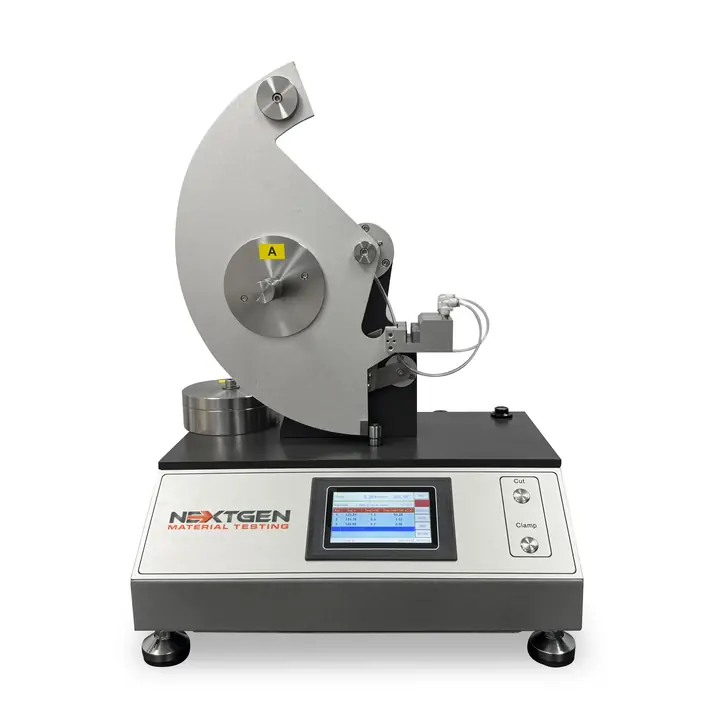
GenTear Pro is used to measure tear propagation resistance. The test starts after an initial slit or cut has been made, then measures the force required for the tear to continue.
This is relevant for materials exposed to cutting, edge damage, converting, packaging stress, repeated handling, or field use where a small tear can spread. A small tear in a weak material can continue quickly. In a stronger or better-constructed material, the tear may require more force to propagate.
Typical materials for Elmendorf tear testing include:
- woven fabrics;
- nonwovens;
- paper and paperboard;
- thin films;
- coated or flexible sheet materials.
For textile labs, tear data is useful when comparing fabric constructions, fiber blends, coating changes, finishing treatments, or supplier batches. For example, two nonwoven samples may look similar in thickness and weight, but show different tear propagation behavior after the initial cut is made.
GenTear Pro is relevant when tear force must be recorded consistently for product acceptance, durability comparison, converting performance, or supplier approval.
GenBurst Pro – Hydraulic Bursting Strength Tester
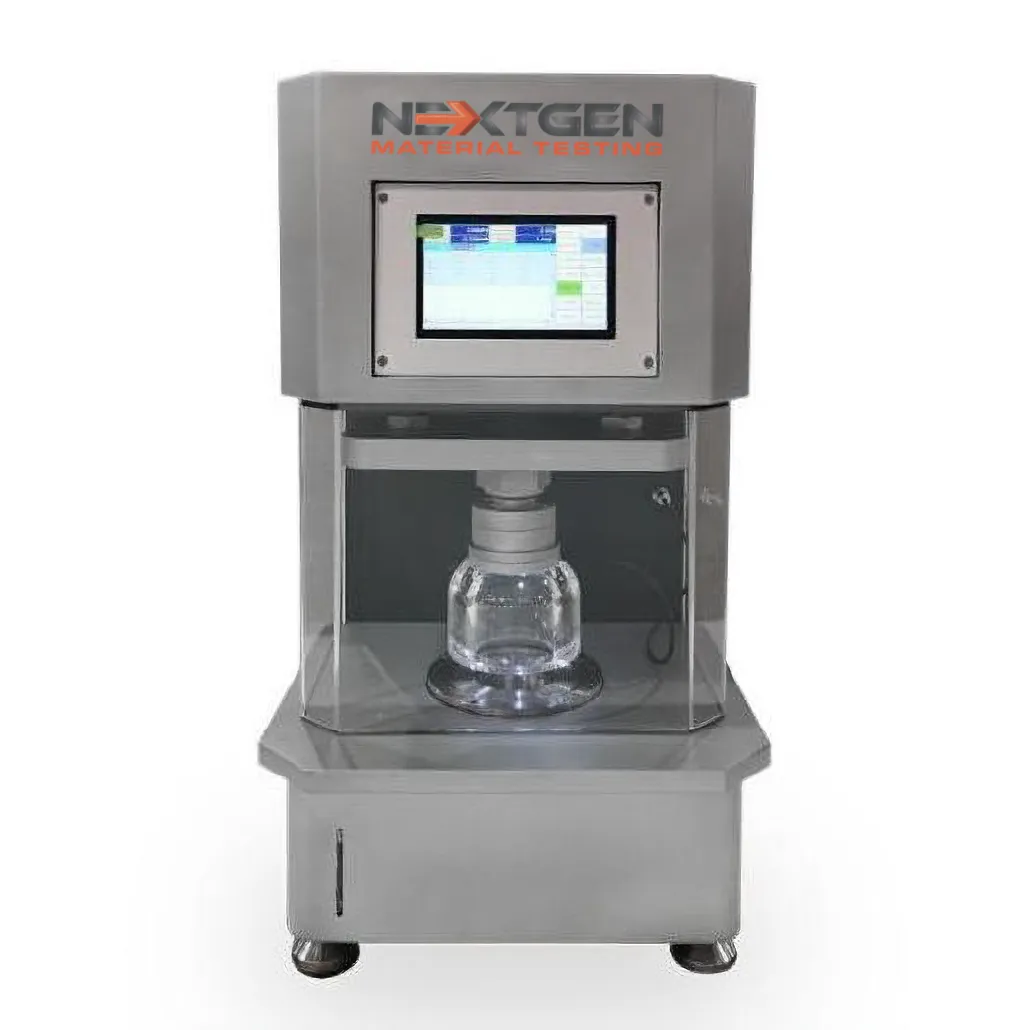 GenBurst Pro is used for bursting strength testing. This test applies pressure to the specimen through a diaphragm until the material ruptures. Instead of pulling the material in one direction, the test loads the specimen over an area.
Many materials do not fail from a straight-line pull in service. Knitted fabrics, nonwovens, technical textiles, filtration media, medical textiles, flexible packaging materials, and coated sheets can fail under pressure, expansion, or multidirectional stress.
Burst testing helps measure:
- maximum pressure before rupture;
- material distension at burst;
- resistance to multidirectional loading;
- consistency between production lots;
- effects of coating, lamination, finishing, or material weight changes.
This is different from tear testing. A material can show acceptable tear resistance but still burst at a lower pressure than expected. Another material can resist bursting well but tear easily once damage begins. The two results are not interchangeable.
GenBurst Pro fits labs that need to evaluate rupture behavior under controlled hydraulic pressure, especially when the material is used in applications where pressure, expansion, or surface loading matters more than a single-direction tensile result.
How GenTear Pro and GenBurst Pro Work Together
GenTear Pro and GenBurst Pro cover two separate mechanical failure modes.
| Test | Main Question | Typical Result |
| Elmendorf tear testing | How easily does a tear continue after initial damage? | Tear force / tear resistance |
| Hydraulic burst testing | How much pressure can the material withstand before rupture? | Burst strength and distension |
For a woven fabric, tear resistance may be important because damage can spread from a cut edge or puncture. For a knitted or nonwoven material, bursting strength may be more relevant because the material may deform and rupture under pressure. For coated or laminated materials, both tests can show how changes in construction affect mechanical durability.
Running both tests separates two mechanical properties: resistance to tear growth and resistance to pressure-driven rupture. That is useful for material development, supplier comparison, production QC, and failure analysis.
For labs testing woven, knitted, nonwoven, paper, film, or flexible sheet materials, NextGen can help review whether GenTear Pro, GenBurst Pro, or both systems are the right fit for the strength testing workflow.
Color Fastness Testing Equipment: Measuring Color Transfer, Staining, and Washing Performance
Color fastness testing checks whether a dye, print, finish, or coating remains stable under controlled exposure. In this lineup, the key exposures are dry/wet rubbing and washing. The lab needs to know whether the material will stain another fabric, lose shade, bleed during washing, or transfer color during use.
NextGen’s color fastness category covers two common test areas: rubbing fastness and washing fastness. These are related, but they measure different risks. Rubbing tests focus on color transfer caused by surface friction. Washing tests focus on color change, dye bleeding, and staining after controlled laundering exposure.
GenCrock Pro – Electronic Crockmeter
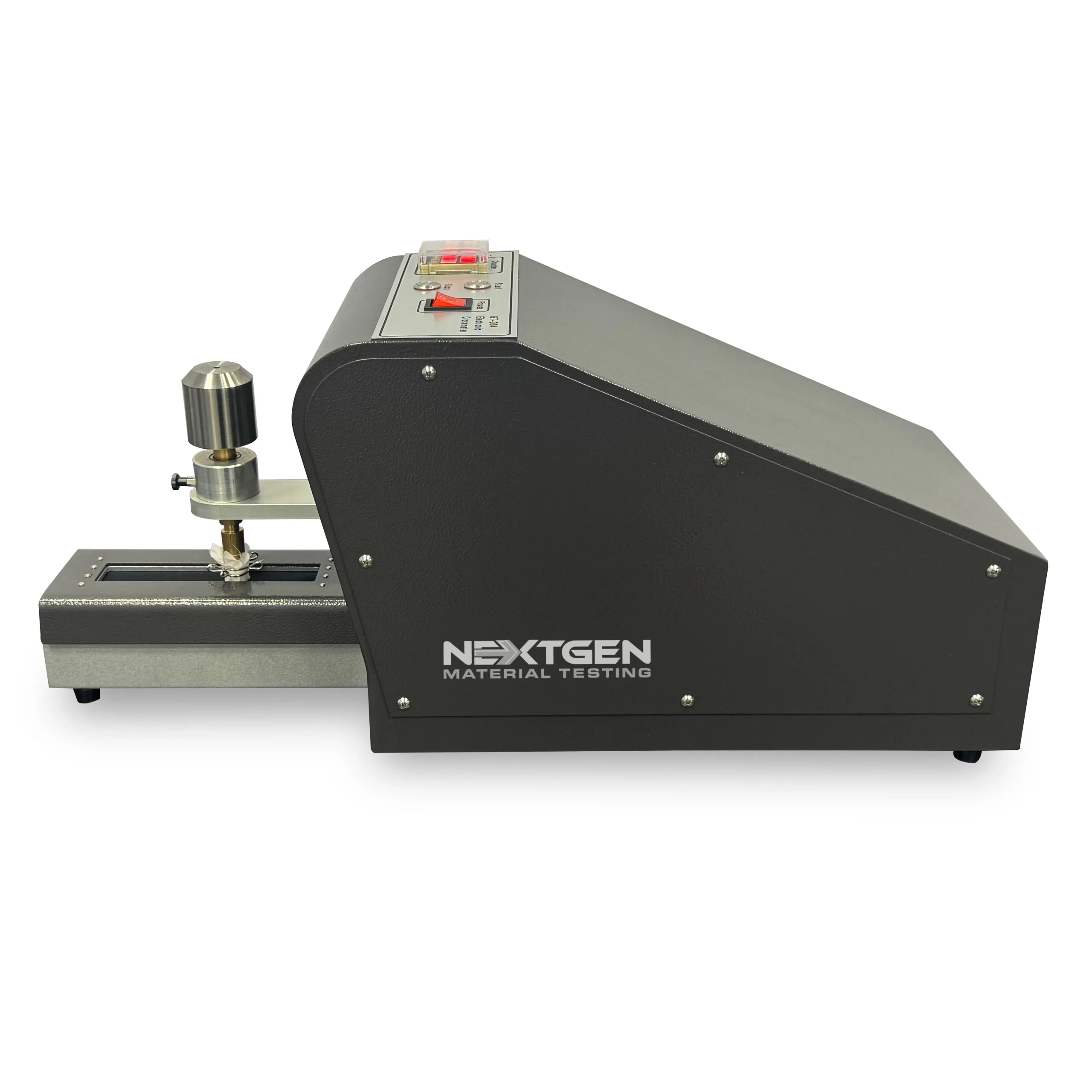 GenCrock Pro is used for dry and wet rubbing fastness testing. The test checks whether color transfers from the specimen surface to a standard rubbing cloth under controlled contact, pressure, and motion.
Typical samples include dark dyed fabrics, printed textiles, denim-like materials, coated fabrics, leather panels, footwear linings, upholstery materials, and apparel components that rub against skin, socks, bags, seating, or other garments.
A dry rubbing test shows how the surface behaves under friction without added moisture. A wet rubbing test adds another variable: water can loosen unfixed dye, affect coatings, or increase color transfer. For some materials, the wet result is more critical than the dry result.
GenCrock Pro fits QC and development workflows where the lab needs to check:
- color transfer from dyed or printed textiles;
- rubbing performance of coated materials;
- staining risk from leather or footwear linings;
- consistency between production lots;
- changes caused by dyeing, printing, coating, or finishing adjustments.
For apparel QC, this test is useful when a material may contact lighter garments or skin. For footwear labs, it is especially relevant for linings, uppers, leather panels, and coated surfaces where rubbing and moisture can happen during wear.
GenWashLab – Color Fastness to Washing Tester
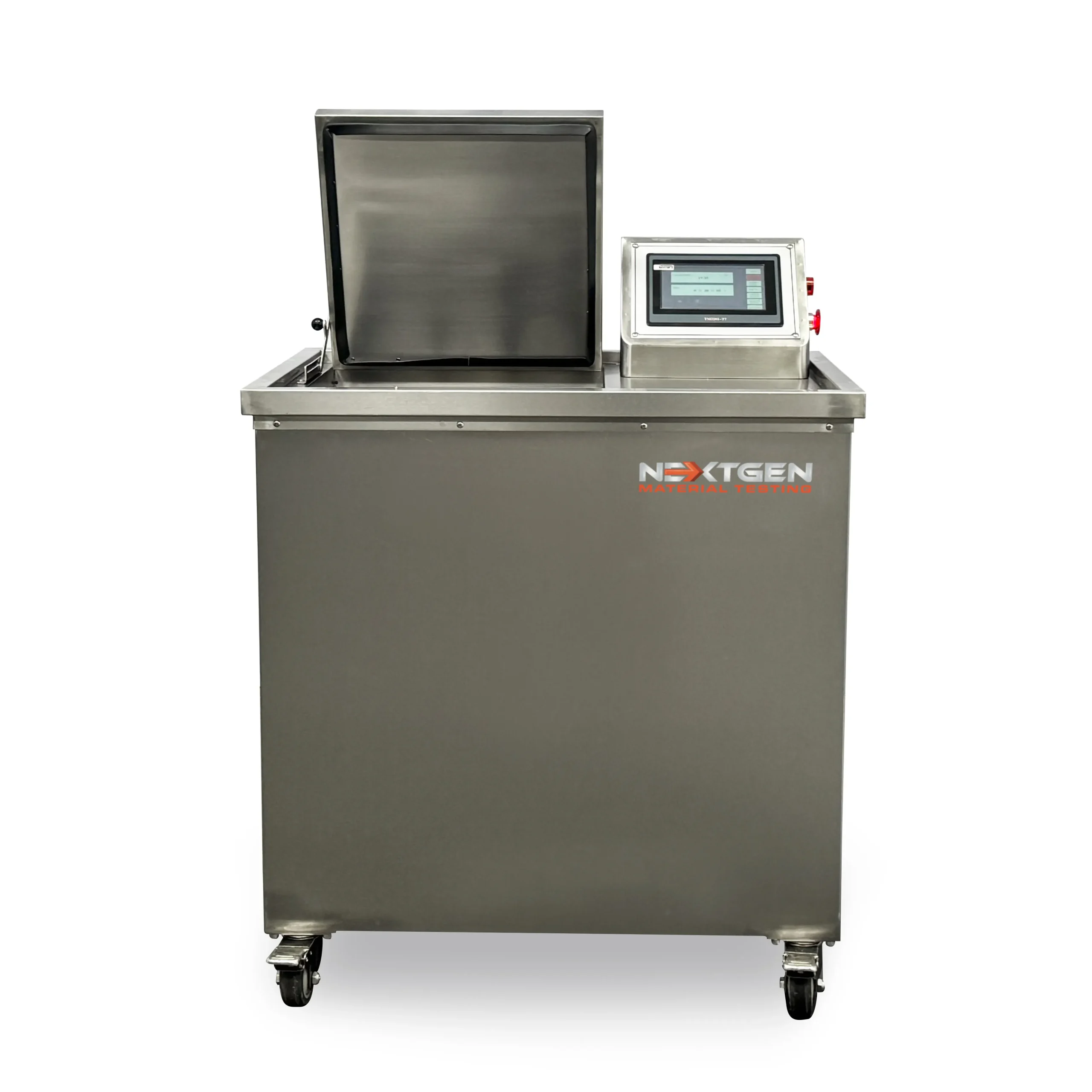 GenWashLab is used for color fastness to washing testing. Instead of measuring surface transfer from rubbing, this test evaluates how color behaves during controlled laundering or dry-cleaning exposure.
The main results are usually:
- color change in the tested specimen;
- staining of adjacent fabrics;
- dye bleeding into the wash bath;
- shade stability after heat, detergent, time, and mechanical agitation;
- consistency between dye lots or finishing processes.
This type of testing is important for apparel fabrics, home textiles, dyed yarns, printed materials, textile trims, and other textile components that require repeatable laundering or dry-cleaning evaluation. It also helps dye houses and textile manufacturers check whether a dyeing or finishing process is stable before the material moves into production.
GenWashLab fits workflows where the lab needs repeatable wash conditions instead of informal wash checks. Controlled temperature, timing, bath conditions, vessel setup, and agitation make it possible to compare samples more consistently across batches, suppliers, or development trials.
Why Rubbing and Washing Fastness Belong in the Same Workflow
Rubbing fastness and washing fastness should not be treated as duplicate tests. They answer different QC questions.
| Test Type | What It Checks | Typical Risk |
| Dry rubbing fastness | Color transfer under dry friction | Surface dye or finish stains another material |
| Wet rubbing fastness | Color transfer under friction with moisture | Dye transfer increases with water, sweat, or humidity |
| Washing fastness | Color behavior after controlled laundering | Shade change, bleeding, or staining of adjacent fabric |
Passing one color fastness test does not confirm the other. Dark shades, pigment prints, denim-like finishes, coated surfaces, and leather can show acceptable washing results but still transfer color during rubbing. Some materials show the opposite pattern: acceptable rubbing results but shade change or staining after laundering.
For dye houses, apparel brands, textile manufacturers, and third-party labs, the practical workflow is usually to test both surface transfer and laundering behavior. GenCrock Pro covers the rubbing side of the workflow. GenWashLab covers the washing side.
For labs working with dyed, printed, coated, or leather materials, NextGen can help review whether GenCrock Pro, GenWashLab, or both systems fit the color fastness testing setup.
Footwear and Leather Testing Equipment: From Surface Wear to Finished Shoe Flexing
Footwear and leather testing usually requires several test levels. A lab may need three separate checks: surface finish behavior, upper material flex resistance, and complete shoe performance under flex cycles.
Surface abrasion testing looks at rubbing, finish wear, fading, and staining transfer. Flex testing on material samples looks at cracking and crease failure. Whole-footwear flex testing checks how the complete shoe construction behaves when the upper, sole, adhesive, stitching, and shape are tested together.
GenVeslic – Leather and Surface Abrasion Tester
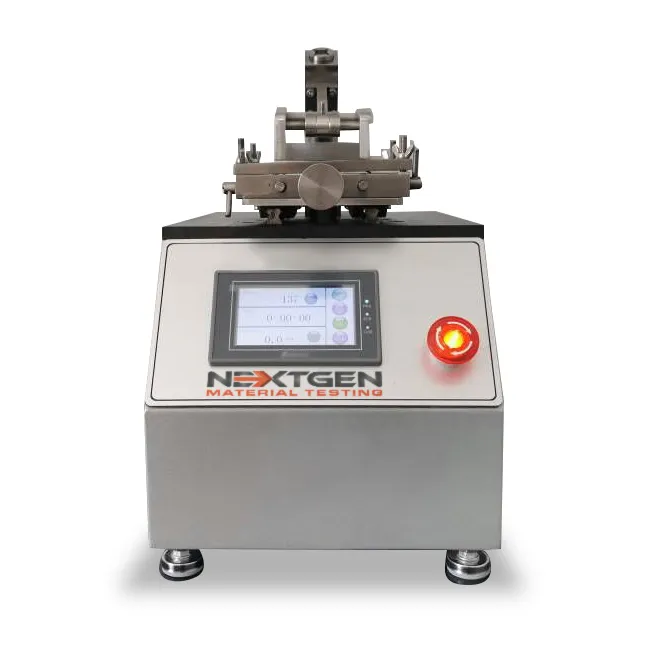 GenVeslic is used to evaluate surface behavior under controlled rubbing or abrasion. The test is relevant when the lab needs to check whether a leather finish, coating, dye, or treated surface wears down, changes shade, or transfers color to another material.
This applies to:
- footwear uppers;
- leather goods;
- coated textiles;
- synthetic leather;
- plastic-coated materials;
- dyed or finished textile surfaces;
- accessories and trim materials.
For footwear and leather QC, the key issue is how the surface changes after repeated contact. A material can look acceptable before testing but show finish loss, color transfer, staining, or visible abrasion marks after repeated contact. This is especially important for dark leather, coated uppers, linings, bags, belts, upholstery materials, and surfaces that rub against clothing or skin.
GenVeslic is relevant when surface durability must be compared across material lots, finish recipes, coating changes, dye systems, or supplier samples under repeatable rubbing conditions.
GenBally Flex – Resistance Flexing Tester
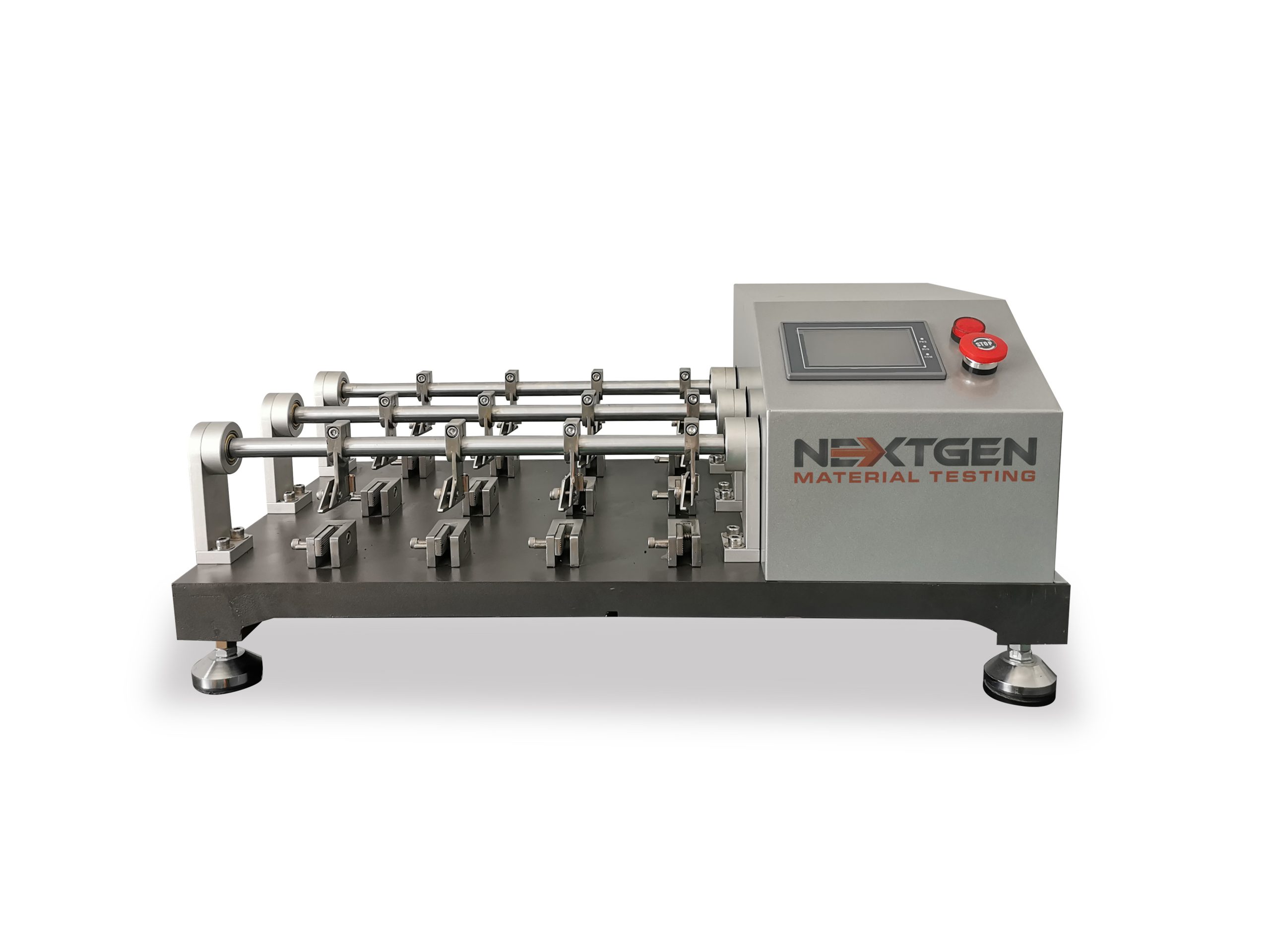 GenBally Flex is used to test resistance to repeated bending in flexible materials. In footwear, this is especially relevant for upper materials because the vamp and forepart area flex with every step.
The test is used to observe issues such as:
- cracking in leather or coated surfaces;
- crease failure;
- finish separation;
- coating damage;
- weakening around flex zones;
- differences between supplier lots or material constructions.
This test belongs before production approval, especially when the material will be used in flex zones such as the vamp or forepart. A leather or coated fabric may pass surface checks but still crack when flexed repeatedly. For footwear manufacturers, that failure can appear later as visible creasing, cracking, or finish breakdown in the finished shoe.
GenBally Flex fits the material-level stage of the footwear workflow. It helps labs evaluate whether upper materials can tolerate repeated flexing before they are cut, stitched, assembled, and approved for larger production runs.
GenFlex Sole – Whole Footwear Flexing Tester
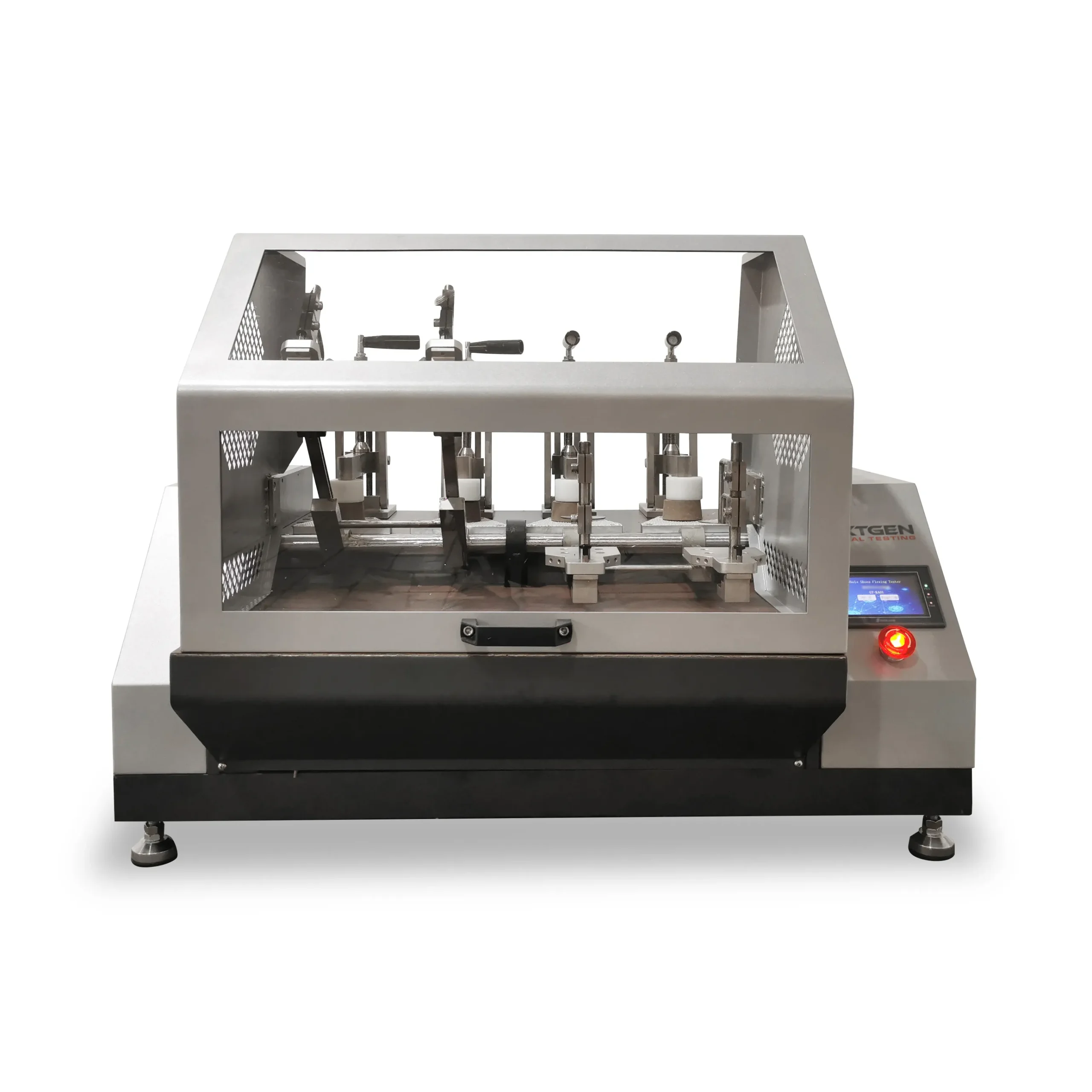 GenFlex Sole is used to test finished footwear under repeated flexing. This is a different test level from material sample testing because the complete shoe construction is involved.
Whole-footwear flexing can reveal problems that may not appear in flat material tests, including:
- sole cracking;
- upper cracking in assembled form;
- adhesive failure;
- separation between upper and sole;
- damage around stitched or bonded areas;
- construction weakness during repeated bending.
Finished footwear performance depends on the assembled system: upper, outsole, midsole, adhesive, stitching, last shape, and construction method. A material may perform acceptably as a sample but behave differently once it is part of a finished shoe.
GenFlex Sole fits the final validation stage. It helps QC, R&D, and product development teams check finished footwear before release, supplier approval, or production sign-off.
A Complete Footwear Testing Workflow
For footwear development, these three systems cover different stages of evaluation:
| Stage | Main Question | Equipment |
| Surface material check | Will the finish wear, fade, or transfer color? | GenVeslic |
| Upper material flex check | Will the leather or coated upper crack under repeated bending? | GenBally Flex |
| Finished footwear check | Will the assembled shoe hold up under flex cycles? | GenFlex Sole |
A practical footwear testing workflow may start with GenVeslic to check surface abrasion and color transfer. GenBally Flex can then be used to evaluate upper material flex resistance before production. GenFlex Sole can be used later to test the completed shoe under repeated bending.
For teams testing footwear from material selection through finished product approval, NextGen can help configure a workflow across surface abrasion, upper flexing, and whole-shoe flex testing.
Example Workflows Using the New NextGen Lineup
The examples below show common ways to group the seven systems by lab application. The combinations are not fixed; they depend on sample type, required standards, and the failure modes the lab needs to document.
Apparel and Dyed Fabric QC Workflow
For apparel fabrics, dyed textiles, printed materials, linings, and trims, the first checks are usually rubbing transfer and washing fastness. The material may need to keep its shade after washing, avoid staining adjacent fabrics, and resist color transfer during rubbing.
A practical setup may include:
| Testing Need | Equipment | What the Lab Checks |
| Dry and wet rubbing fastness | GenCrock Pro | Color transfer from the fabric surface under rubbing |
| Washing fastness | GenWashLab | Color change, dye bleeding, and staining after controlled washing |
| Tear resistance, if needed | GenTear Pro | Whether a tear continues easily after initial damage |
| Burst strength, if needed | GenBurst Pro | How the material behaves under pressure or multidirectional stress |
This workflow is useful for dye houses, apparel manufacturers, brand QC teams, and sourcing teams reviewing production lots or supplier submissions.
For example, a dark dyed fabric may show acceptable washing results but still transfer color during wet rubbing. In that case, GenWashLab and GenCrock Pro provide different data points. GenWashLab documents laundering behavior; GenCrock Pro documents surface transfer under friction.
If the same fabric also needs basic durability screening, GenTear Pro or GenBurst Pro can be added depending on the construction. A woven fabric may need tear testing. A knitted or nonwoven material may need burst testing.
Technical Textile or Nonwoven Workflow
Technical textiles and nonwovens are usually evaluated by tear propagation, rupture under pressure, and lot-to-lot consistency. The lab may also need to compare the effect of coating, lamination, fiber blend, or basis weight changes.
A focused workflow may include:
| Testing Need | Equipment | What the Lab Checks |
| Tear propagation | GenTear Pro | Force required for a tear to continue after an initial cut |
| Bursting strength | GenBurst Pro | Pressure required to rupture the specimen |
| Distension at burst | GenBurst Pro | How much the material expands before failure |
This setup is useful for nonwoven manufacturers, technical textile producers, filtration media labs, coated material suppliers, packaging labs, and R&D teams comparing material constructions.
For example, two nonwoven samples can have similar weight and thickness but different tear behavior. One may resist tear propagation better, while the other may perform better under burst pressure. Testing both properties gives the lab a clearer comparison than relying on one strength value.
This workflow is also useful when a material is changed during development. A coating may improve burst strength but reduce tear resistance. A fiber blend change may improve tear behavior but affect rupture under pressure. GenTear Pro and GenBurst Pro help separate those effects.
Footwear Development Workflow
Footwear testing should separate material-level failures from construction-level failures. A lab may approve a leather or coated upper material at the sample stage, then find cracking, abrasion, color transfer, or sole separation after the shoe is assembled.
A practical footwear workflow may include:
| Stage | Equipment | What the Lab Checks |
| Surface material testing | GenVeslic | Abrasion, finish wear, fading, staining, or color transfer |
| Upper material flex testing | GenBally Flex | Cracking, crease failure, coating damage, or flex fatigue |
| Finished footwear testing | GenFlex Sole | Whole-shoe flex durability, sole failure, adhesive failure, construction weakness |
| Optional lining or surface color transfer test | GenCrock Pro | Dry/wet rubbing transfer from linings, uppers, or dyed components |
This workflow is useful for footwear manufacturers, leather goods brands, product development teams, supplier approval teams, and third-party labs testing finished shoes or footwear components.
A typical sequence can look like this:
- Test leather, coated material, or upper surface with GenVeslic.
- Test the upper material under repeated bending with GenBally Flex.
- Test the finished shoe under flex cycles with GenFlex Sole.
- Add GenCrock Pro if linings, dark uppers, or dyed components may transfer color during wear.
This staged approach helps separate material problems from construction problems. If a material cracks during GenBally Flex testing, the issue may be with the upper material, coating, finish, or supplier batch. If the material performs well but the finished shoe fails during GenFlex Sole testing, the issue may be related to sole design, adhesive, stitching, assembly, or the interaction between components.
Third-Party Testing Lab Workflow
Third-party laboratories often handle mixed sample types within one service portfolio: dyed apparel fabrics, leather panels, nonwovens, footwear components, paper, films, and finished shoes.
For this type of lab, the lineup can be grouped by service area:
| Testing Area | Equipment |
| Fabric strength | GenTear Pro, GenBurst Pro |
| Color fastness | GenCrock Pro, GenWashLab |
| Leather and surface abrasion | GenVeslic |
| Upper flex resistance | GenBally Flex |
| Whole-footwear flex testing | GenFlex Sole |
This workflow is relevant for labs that need flexibility across client sample types, standards, and reporting requirements.
For example, a client may send a coated textile for rubbing fastness, abrasion behavior, and tear resistance. Another client may send finished footwear for flex testing and lining color transfer. Grouping the equipment by service area helps the lab quote, schedule, test, and report mixed sample requests more consistently.
For laboratories planning new services, the lineup can also be built in stages. A lab may start with color fastness equipment, then add fabric strength testing, then expand into footwear and leather durability testing as client demand grows.
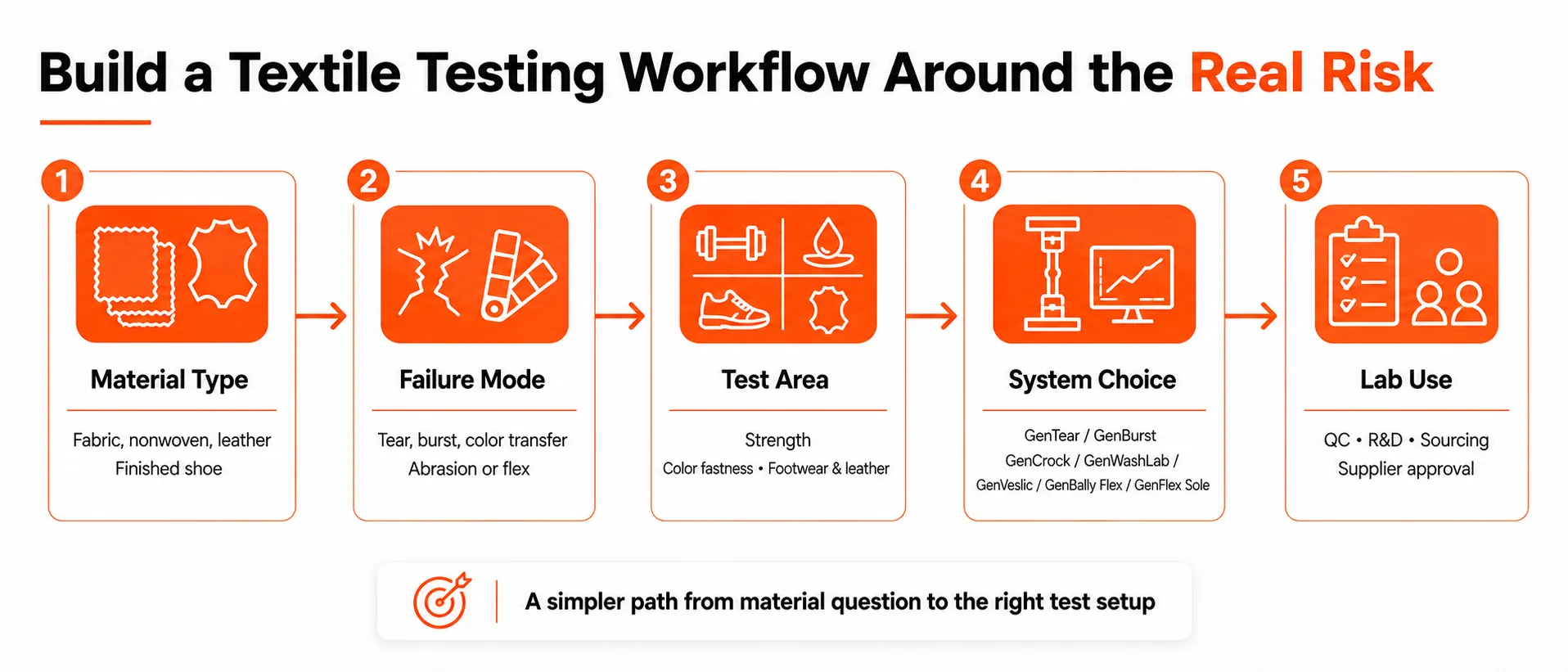
How to Choose the Right Equipment from the Lineup
Selecting textile testing equipment should start with the sample and the failure mode, not with the machine name. A dyed apparel fabric, nonwoven sheet, coated leather panel, and finished shoe require different fixtures, sample preparation steps, loading methods, and result types. Reporting requirements also matter: production QC, R&D comparison, supplier approval, and third-party reports do not always need the same level of documentation.
-
Start With the Material
Material type defines the first selection filter. Fabric, leather, coated materials, nonwovens, films, paper, board, and finished footwear do not behave the same way under load, friction, washing, or flexing.
A woven fabric may need tear resistance data because damage can spread from a cut or edge. A knitted fabric or nonwoven may need burst testing because the material can deform and rupture under pressure. A dyed or printed textile may need color fastness testing because the main risk is staining, shade change, or color transfer. Leather and coated materials may need abrasion and flex testing because surface finish and cracking are common failure points. Finished footwear requires another level of testing because the upper, sole, adhesive, stitching, and construction all work together during flexing.
Once the material is defined, the equipment group usually becomes clear. For example, GenTear Pro and GenBurst Pro fit fabric strength testing. GenCrock Pro and GenWashLab fit color fastness testing. GenVeslic, GenBally Flex, and GenFlex Sole fit leather, footwear, and flex durability testing.
-
Define the Failure Mode
After the material is defined, select the failure mode to be measured.
If the concern is tear propagation, the lab needs Elmendorf tear testing with GenTear Pro. If the concern is rupture under pressure, GenBurst Pro is the better fit. If the concern is color transfer during dry or wet rubbing, GenCrock Pro is the relevant system. If the concern is shade change, dye bleeding, or staining after washing, GenWashLab fits that workflow.
For leather, coated materials, and footwear components, the failure mode may be surface abrasion, finish wear, staining transfer, or flex cracking. GenVeslic is used for surface abrasion and rubbing behavior. GenBally Flex is used for repeated bending of flexible materials such as leather and coated uppers. GenFlex Sole is used when the finished shoe must be tested under repeated flex cycles.
The term “textile testing equipment” is too broad for equipment selection unless the failure mode is defined first. Tear, burst, rubbing, washing, abrasion, flex cracking, and finished product failure are separate test questions.
-
Match the Test to the Workflow
Once the material and failure mode are defined, the lab can match the equipment to its workflow.
For a color issue, the starting point is usually GenCrock Pro, GenWashLab, or both. GenCrock Pro checks dry and wet rubbing transfer. GenWashLab checks washing fastness, shade change, dye bleeding, and staining of adjacent material. A dyed apparel fabric, printed textile, lining, or coated material may need both tests because friction and washing create different risks.
For a mechanical strength issue, the starting point is GenTear Pro or GenBurst Pro. GenTear Pro is used when the lab needs tear propagation data after an initial cut. GenBurst Pro is used when the material is loaded by pressure through a diaphragm until rupture. Woven fabrics, nonwovens, films, paper, board, and flexible sheet materials may require one or both depending on the application.
For a footwear durability issue, the workflow usually moves through several stages. GenVeslic can be used to check surface abrasion, finish wear, and color transfer. GenBally Flex can be used to check repeated bending behavior in upper materials. GenFlex Sole can be used to test the complete shoe after assembly. If the shoe includes dark linings, dyed uppers, or materials that may stain socks or skin, GenCrock Pro can also be added for rubbing fastness checks.
-
Think About Throughput and Reporting
Daily sample volume and reporting requirements can change the equipment configuration. A development lab testing a few prototypes may have different needs from a QC lab checking repeated production lots or a third-party lab handling varied client samples.
Before choosing a configuration, the lab should define expected sample volume, required standards, sample preparation steps, fixture needs, consumables, result format, and reporting requirements. Repeatability is also important. If results will be used for supplier approval, production release, or customer documentation, the test setup should support consistent specimen handling, controlled conditions, and clear result recording.
Accessories and configuration matter as well. A lab may need different clamps, test areas, rubbing materials, wash vessels, force ranges, or sample preparation tools depending on the test method. These details should be confirmed before the equipment is selected, especially when the lab must follow ASTM, ISO, AATCC, SATRA, EN, JIS, or customer-specific methods.
Building a More Complete Textile Testing Lab with NextGen
NextGen’s new Textile Testing Equipment lineup can be configured by testing area: color fastness, fabric strength, leather surface durability, upper flexing, and whole-footwear flex testing. A lab can start with one testing area, such as color fastness, then add strength testing or footwear-specific systems as the sample range expands.
For example, a textile QC lab may begin with GenCrock Pro and GenWashLab to check rubbing transfer and washing fastness. A nonwoven or technical textile lab may start with GenTear Pro and GenBurst Pro to measure tear propagation and bursting strength. A footwear development team may need GenVeslic, GenBally Flex, and GenFlex Sole to check surface wear, upper flexing, and finished shoe durability.
Equipment selection should start with material type, required method, sample format, expected throughput, and the result the lab needs to report. Product name comes after those inputs are defined. A useful setup should match the way samples move through the lab, from incoming inspection and development testing to supplier approval and production QC.
Planning a textile, leather, or footwear testing workflow? Send NextGen your material type, target standard, sample format, expected daily volume, and reporting requirements. Our team can recommend which systems from the new Textile Testing Equipment lineup match your QC, R&D, supplier approval, or third-party testing process.